Search
Invitrogen
Desmin Monoclonal Antibody (DE-U-10), Alexa Fluor™ Plus 750
{{$productOrderCtrl.translations['antibody.pdp.commerceCard.promotion.promotions']}}
{{$productOrderCtrl.translations['antibody.pdp.commerceCard.promotion.promocode']}}: {{promo.promoCode}} {{promo.promoTitle}} {{promo.promoDescription}}. {{$productOrderCtrl.translations['antibody.pdp.commerceCard.promotion.learnmore']}}
{{$ctrl.translations['antibody.pdp.skuNotes.additionalInformation']}}:
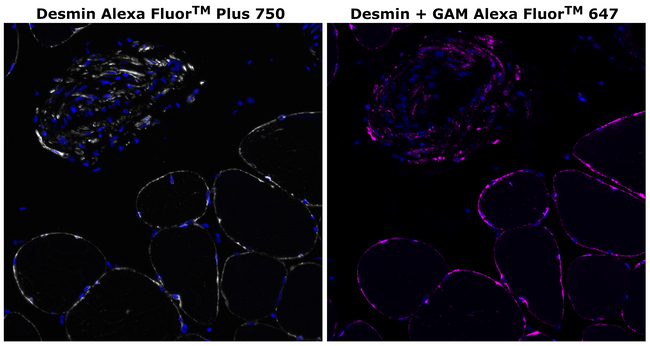
图: 1 / 5
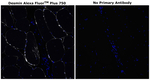
Desmin Antibody (757-9747-94) in IHC (P)
Immunohistochemical analysis of Desmin was performed on FFPE human skeletal muscle tissue. To expose the target protein, HIER was performed on de-paraffinized sections using BOND Epitope Retrieval Solution 2 (pH 9) for 20-mins, followed by a 5-min cool down, a 1-min wash with ddH2O, and then transferred to 1X PBS. Tissues were permeabilized with 0.1% Triton X-100 in 1X PBS for 30-mins, washed thrice with 1X... View More
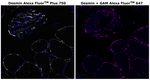
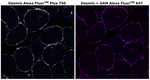
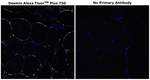
Please note: We are reviewing Western blot images included in the antibody testing data in our catalog, including those provided by third parties. Unless expressly labeled or annotated as “raw-unedited”, Western blot images included in the antibody testing data in our catalog may have been edited, optimized or otherwise adjusted for presentation.


产品信息
757-9747-94
产品规格
种属反应
Human
宿主/亚型
Mouse
/ IgG1, kappa
分类
Monoclonal
类型
Antibody
克隆号
DE-U-10
偶联物
Alexa Fluor™ Plus 750
Alexa Fluor™ Plus 750
Alexa Fluor™ Plus 750
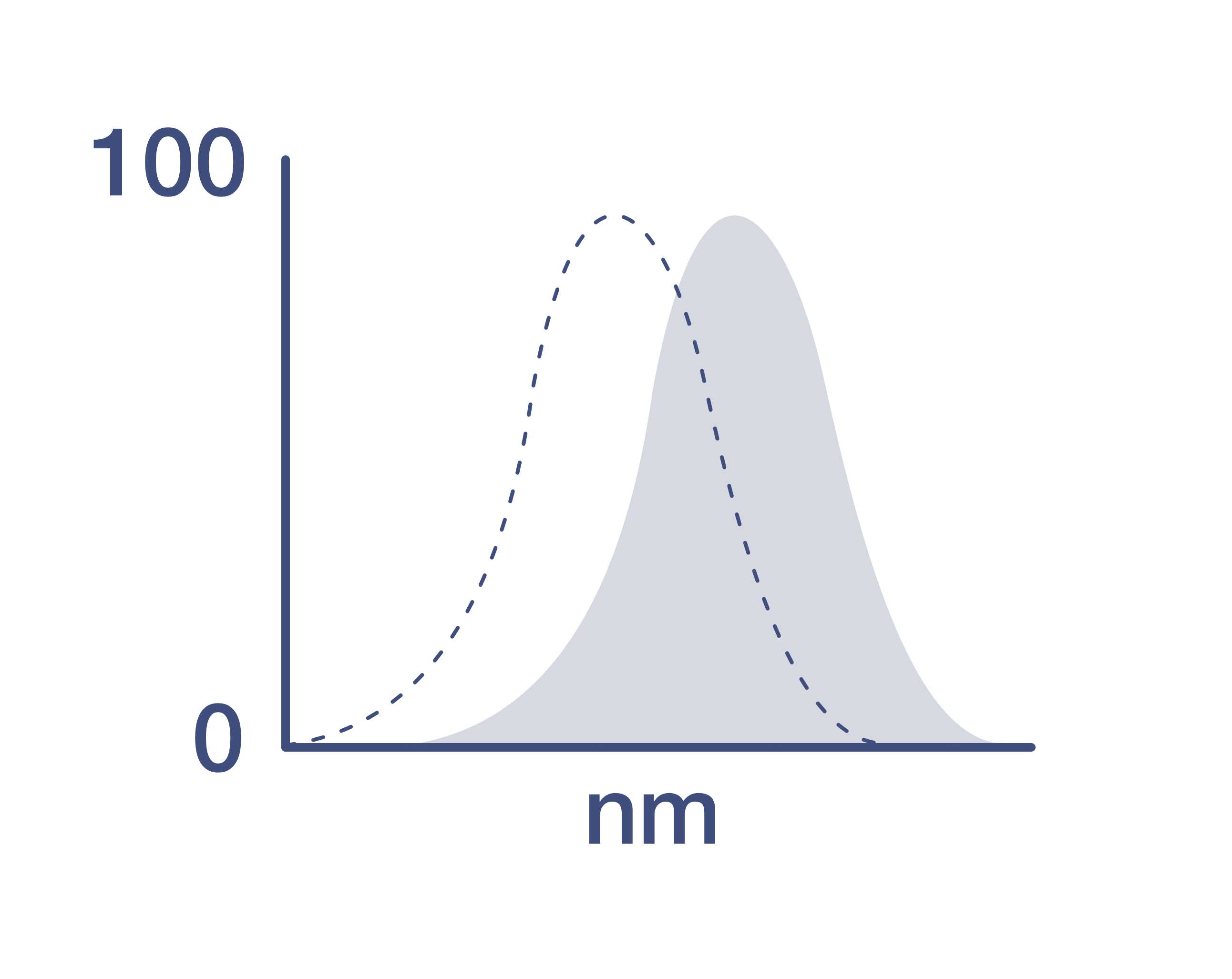
激发/发射光谱
760/788 nm
查看光谱
形式
Liquid
浓度
0.2 mg/mL
规格
100 µg
纯化类型
Affinity chromatography
保存液
PBS, pH 7.2, with 0.5% BSA, 10% proprietary stabilizer
内含物
0.05% sodium azide
保存条件
4°C, store in dark
运输条件
Wet ice
产品详细信息
Description: The monoclonal antibody DE-U-10 recognizes desmin. Desmin is the protein subunit of class-III intermediate filaments. Desmin is found predominantly in skeletal, cardiac, and smooth muscle. Desmin plays a role in muscle cell development and differentiation, muscle cell architecture and structure, and mitochondrial function. Desmin forms scaffolds around the Z-disk of sarcomeres in muscle cells. Desmin knockout mice exhibit defects in skeletal, smooth, and cardiac muscle and have impaired mitochondrial function. Mutations in Desmin result in conditions such as desmin-related myopathy (DRM), cardiomyopathy dilated type 1I (CMD1I), and neurogenic scapuloperoneal syndrome Kaeser type (Kaeser syndrome).
The DE-U-10 antibody recognizes human, mouse, rat, feline, bovine, goat, hamster, sheep, porcine, rabbit, and chicken desmin. The DE-U-10 antibody will also label tumors derived from muscle tissue, such as leiomyomas and rhabdomyosarcomas.
Applications Reported: This DE-U-10 antibody has been reported for use in western blotting, immunohistochemical staining of formalin-fixed paraffin embedded tissue sections, microscopy, and immunocytochemistry.
Applications Tested: This DE-U-10 antibody has been tested by immunohistochemical staining of formalin-fixed paraffin embedded human tissue using high pH antigen retrieval and can be used at 2 µg/mL. It is recommended that the antibody be carefully titrated for optimal performance in the assay of interest.
Using conjugate solutions: Centrifuge the protein conjugate solution briefly in a microcentrifuge before use; add only the supernatant to the experiment. This step will help eliminate any protein aggregates that may have formed during storage, thereby reducing nonspecific background staining.
靶标信息
Desmin (approximately 53 kDa) exhibits a high degree of tissue specificity, its expression being predominantly confined to all types of muscle cells (cardiac, skeletal and smooth muscle). Regulation of desmin expression is stage and tissue-specific, since it is induced during terminal development of, for example, skeletal muscle cell differentiation. In skeletal en cardiac muscle cells desmin is localized in the Z-disk region and at the intercalated disk. The expression pattern of desmin in smooth muscle is much more heterogenous. Coexpression of vimentin and desmin has been observed in tumors derived from muscle tissue, i.e. rhabdomyosarcomas and leiomyosarcomas. Furthermore, during myocard dysfunction dramatic changes in the distribution of desmin have been observed.
仅用于科研。不用于诊断过程。未经明确授权不得转售。
篇参考文献 (0)
您是否在文献中引用过该产品?请点击下方按钮邮件告知我们。
生物信息学
蛋白别名: cardiomyocyte intermediate filament protein; cardiomyopathy, dilated 1F (autosomal dominant); cardiomyopathy, dilated 1I; CMD1I; epididymis secretory sperm binding protein; FLJ12025; FLJ39719; FLJ41013; FLJ41793; intermediate filament; intermediate filament protein; MFM1; muscle specific intermediate filament; SCPNK; unnamed protein product
基因别名: CDCD3; CSM1; CSM2; LGMD1D; LGMD1E; LGMD2R
UniProt ID: (Human) P17661
Entrez Gene ID: (Human) 1674
Disclaimer

Clicking the images or links will redirect you to a website hosted by BenchSci that provides third-party scientific content. Neither the content nor the BenchSci technology and processes for selection have been evaluated by us; we are providing them as-is and without warranty of any kind, including for use or application of the Thermo Fisher Scientific products presented.

