Search
Rockland
8-Hydroxy Guanine Monoclonal Antibody (15A3)
{{$productOrderCtrl.translations['antibody.pdp.commerceCard.promotion.promotions']}}
{{$productOrderCtrl.translations['antibody.pdp.commerceCard.promotion.viewpromo']}}
{{$productOrderCtrl.translations['antibody.pdp.commerceCard.promotion.promocode']}}: {{promo.promoCode}} {{promo.promoTitle}} {{promo.promoDescription}}. {{$productOrderCtrl.translations['antibody.pdp.commerceCard.promotion.learnmore']}}
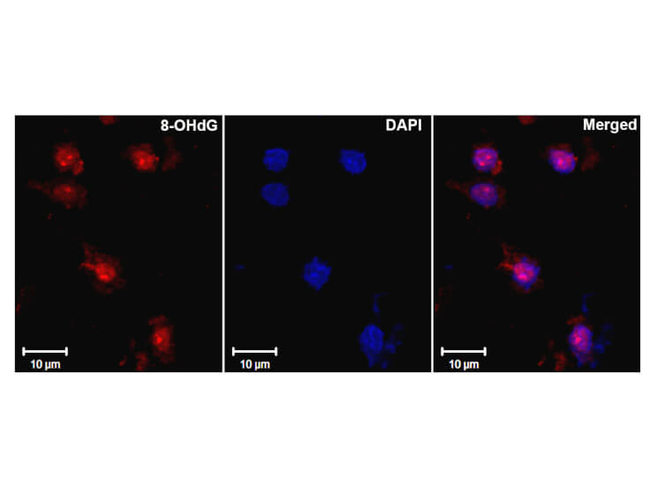
图: 1 / 1
8-Hydroxy Guanine Antibody (200-301-A99) in IHC (P)
Immunofluorescence of mouse monoclonal anti-8-hydroxy-guanine antibody. Tissue: Ischemic rat brain. Fixation: formalin fixed paraffin embedded. Antigen retrieval: not required. Primary antibody: 8 hydroxy guanine antibody. Localization: nuclear. Staining: antibody as red signal with a DAPI blue nuclear counterstain.
Please note: We are reviewing Western blot images included in the antibody testing data in our catalog, including those provided by third parties. Unless expressly labeled or annotated as “raw-unedited”, Western blot images included in the antibody testing data in our catalog may have been edited, optimized or otherwise adjusted for presentation.

产品信息
200-301-A99
应用
建议稀释比
已发表文章
产品规格
种属反应
Human,
Mouse,
Rat
宿主/亚型
Mouse
/ IgG2b
分类
Monoclonal
类型
Antibody
克隆号
15A3
抗原
This Protein G purified monoclonal antibody was prepared using conventional hybridoma technology after repeated immunizations with 8-hydroxy-guanosine-BSA and casein conjugates.
偶联物
Unconjugated
Unconjugated
Unconjugated
形式
Liquid
浓度
1 mg/mL
规格
100 µg
纯化类型
Protein G
保存液
PBS, pH 7.2, with 50% glycerol
内含物
0.1% sodium azide
保存条件
-20°C, Avoid Freeze/Thaw Cycles
运输条件
Ambient (domestic); Wet ice (international)
靶标信息
8-hydroxyguanosine (8-OHG) is a marker for measuring the rate of oxidative damage to nucleic acids and lipids. Production of reactive oxygen species (ROS) damage proteins, lipid membranes, and nucleic acids (DNA and RNA), all critical functional components of living cells. The progressive accumulation of unrepaired free radical damage over time is believed to be a major contributor to the aging process and to a variety of age-related chronic diseases. Generation of most free radicals is a 'side effect' of normal metabolic processes, especially mitochondrial production of ROS, including superoxide anion, hydrogen peroxide, and hydroxyl radical, coincident to oxidative metabolism. 8-OHG (marker of oxidative damage to RNA) was found in the cerebral cortex in three of six cases of neuropathologically examined autopsy of subacute sclerosing panencephalitis patients. Subacute sclerosing panencephalitis is caused by persistent brain infection of mutated measles virus, showing inflammation, neuronal loss, and demyelination. The concentration of 8-OHG in CSF in Parkinson's disease (PD) patients is approximately three-fold that in controls. The concentration of 8-OHG in CSF decreased significantly with the duration of disease. However, the concentration of 8-OHG in serum was not significantly altered in PD patients compared to that in controls. [National Center for Biotechnology Information. PubChem Compound Database; CID=65131].
仅用于科研。不用于诊断过程。未经明确授权不得转售。
篇参考文献 (0)
您是否在文献中引用过该产品?请点击下方按钮邮件告知我们。
生物信息学
蛋白别名: C10H13N5O6
Disclaimer

Clicking the images or links will redirect you to a website hosted by BenchSci that provides third-party scientific content. Neither the content nor the BenchSci technology and processes for selection have been evaluated by us; we are providing them as-is and without warranty of any kind, including for use or application of the Thermo Fisher Scientific products presented.

