Search
Disclaimer

Clicking the images or links will redirect you to a website hosted by BenchSci that provides third-party scientific content. Neither the content nor the BenchSci technology and processes for selection have been evaluated by us; we are providing them as-is and without warranty of any kind, including for use or application of the Thermo Fisher Scientific products presented.
Bioss
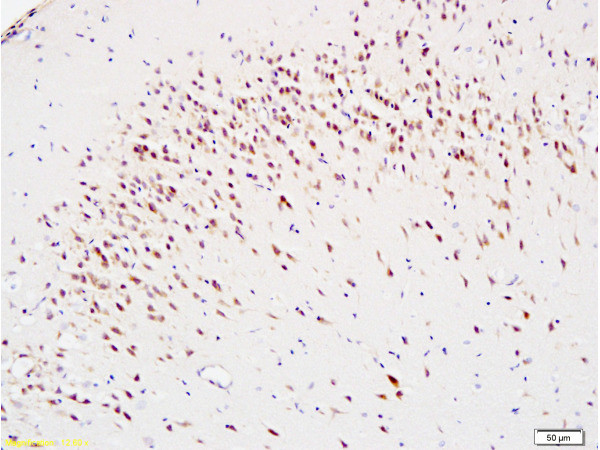
8-OHdG/8 Hydroxyguanosine Polyclonal Antibody
{{$productOrderCtrl.translations['antibody.pdp.commerceCard.promotion.promotions']}}
{{$productOrderCtrl.translations['antibody.pdp.commerceCard.promotion.viewpromo']}}
{{$productOrderCtrl.translations['antibody.pdp.commerceCard.promotion.promocode']}}: {{promo.promoCode}} {{promo.promoTitle}} {{promo.promoDescription}}. {{$productOrderCtrl.translations['antibody.pdp.commerceCard.promotion.learnmore']}}


产品信息
BS-1278R
应用
建议稀释比
已发表文章
产品规格
种属反应
Chemical
宿主/亚型
Rabbit
/ IgG
分类
Polyclonal
类型
Antibody
抗原
KLH conjugated 8-OhdG.
偶联物
形式
Liquid
浓度
1 mg/mL
纯化类型
Protein A
保存液
0.01M TBS, pH 7.4, with 1% BSA, 50% glycerol
内含物
0.02% ProClin 300
保存条件
-20°C
运输条件
Ambient (domestic); Wet ice (international)
靶标信息
Oxygen is necessary for aerobic life, it can also participate in potentially toxic reactions involving oxygen free radicals and transition metals such as iron that damage membranes, proteins, and nucleic acids. n a normal human cell, there is a steady accumulation of DNA lesions with time. Substantial parts of these lesions are due to endogenous factors that damage DNA. These include reactive oxygens pecies derived from oxidative respiration. Additionally, malignant cells can produce hydrogen peroxide at levels as high as those characteristics for stimulated polymorphonuclear leukocytes. Some tumors may stimulate the defense systems of the body so that they react against the tumor to produce cytokines. Some cytokines can produce large amounts of ROS. 8-OHdG is one of the most widely studied lesions of this type. The presenceof 8-OHdG residues in DNA leads to GC to TA transversion unless repairs are made before DNA replication. Therefore, the presence of 8-OHdG may lead to mutagenesis. Furthermore, many observations indicate a direct correlation between 8-OHdG formation and carcinogenesis in vivo. It is generally accepted that the repair products of cellular DNA, for example 8-OHdG, are excreted into the urine without further metabolism. Therefore, 8-OHdG has been proposed as a urinary biomarker for in vivo oxidative DNA lesions.
仅用于科研。不用于诊断过程。未经明确授权不得转售。
篇参考文献 (0)
您是否在文献中引用过该产品?请点击下方按钮邮件告知我们。

