Search
GenScript
PEG Monoclonal Antibody (5E10E9), Biotin, THE™
{{$productOrderCtrl.translations['antibody.pdp.commerceCard.promotion.promotions']}}
{{$productOrderCtrl.translations['antibody.pdp.commerceCard.promotion.viewpromo']}}
{{$productOrderCtrl.translations['antibody.pdp.commerceCard.promotion.promocode']}}: {{promo.promoCode}} {{promo.promoTitle}} {{promo.promoDescription}}. {{$productOrderCtrl.translations['antibody.pdp.commerceCard.promotion.learnmore']}}
Additional Information:
{{banner.description}}
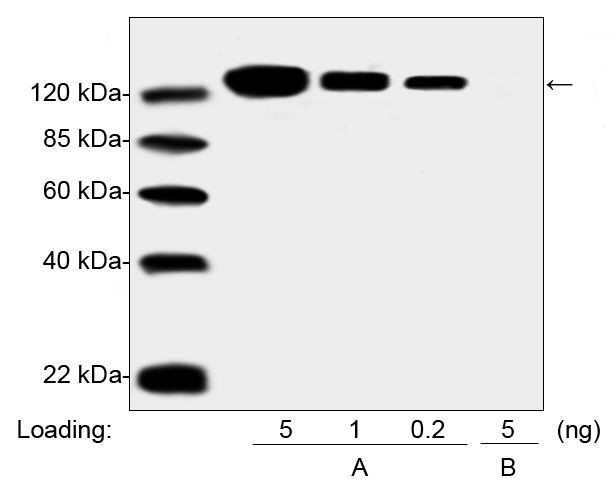
图: 1 / 3
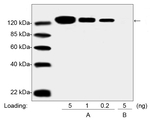
PEG Antibody (A01796-100) in WB
Western blot analysis of PEGylated drug (Pegasys, Peginterferon Alfa 2A) and Non-PEGylated Interferon Alfa 2A protein using THE™ PEG Antibody [Biotin], mAb, Mouse (Cat. No. A01796-100, 0.2 µg/mL). A PEGylated drug (Pegasys, Peginterferon Alfa 2A) B Interferon Alfa 2A protein.


产品信息
A01796-100
产品规格
种属反应
Chemical
宿主/亚型
Mouse
/ IgM
分类
Monoclonal
类型
Antibody
克隆号
5E10E9
抗原
PEG conjugated to KLH
偶联物
Biotin
Biotin
Biotin
形式
Lyophilized
规格
100 µg
纯化类型
Affinity chromatography
保存液
PBS, pH 7.4, with 10mg/mL BSA
内含物
0.02% sodium azide
保存条件
-20°C, Avoid Freeze/Thaw Cycles
运输条件
Ambient (domestic); Wet ice (international)
产品详细信息
Reconstitute the lyophilized product with deionized water (or equivalent) to make antibody concentration of 0.5 mg/mL. For long-term storage, we suggest adding glycerol to 50% to the reconstituted antibody.
PEG (Polyethylene glycol) is a polyether compound with many applications from industrial manufacturing to medicine. PEGylation is a technology that covalently couples non-toxic, hydrophilic polyethylene glycol (PEG) to the drug. It is an FDA-approved method for the delivery of protein drugs. PEG modification can reduce the drug immunogenicity and antigenicity. PEGylated drug decelerates renal excretion, improves stability towards proteolysis and increases its half life in blood. Accurate and sensitive quantification of PEG conjugates is important for PEG conjugated product development and pharmaceutical study. Biotin conjugated PEG Antibody is a useful tool for the detection of PEGylated molecules. GenScript THE™ PEG Antibody [Biotin], mAb, Mouse is PEG antibody conjugated with biotin.
Upon reconstitution, it can be stored for 2-3 weeks at 2-8 °C or for up to 12 months at -20 °C or below.
靶标信息
Polyethylene glycol (PEG) is a polyether compound with many applications from industrial manufacturing to medicine. PEG is also known as polyethylene oxide (PEO) or polyoxyethylene (POE) depending on its molecular weight.
仅用于科研。不用于诊断过程。未经明确授权不得转售。
篇参考文献 (0)
您是否在文献中引用过该产品?请点击下方按钮邮件告知我们。
生物信息学
蛋白别名: Poly Ethylene Glycol; Polyethylene Glycol
Disclaimer

Clicking the images or links will redirect you to a website hosted by BenchSci that provides third-party scientific content. Neither the content nor the BenchSci technology and processes for selection have been evaluated by us; we are providing them as-is and without warranty of any kind, including for use or application of the Thermo Fisher Scientific products presented.

