Search
Agrisera
ADH/ALDH/Alcohol/acetaldehyde dehydrogenase Polyclonal Antibody
{{$productOrderCtrl.translations['antibody.pdp.commerceCard.promotion.promotions']}}
{{$productOrderCtrl.translations['antibody.pdp.commerceCard.promotion.viewpromo']}}
{{$productOrderCtrl.translations['antibody.pdp.commerceCard.promotion.promocode']}}: {{promo.promoCode}} {{promo.promoTitle}} {{promo.promoDescription}}. {{$productOrderCtrl.translations['antibody.pdp.commerceCard.promotion.learnmore']}}
Additional Information:
{{banner.description}}
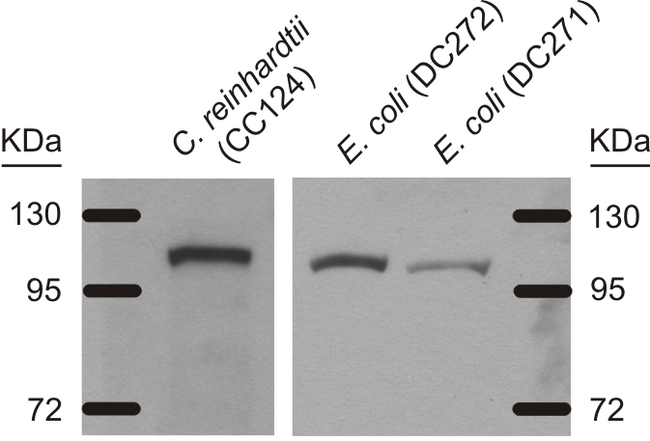
图: 1 / 2
ADH/ALDH/Alcohol/acetaldehyde dehydrogenase Antibody (AS10-748) in WB
30 µg of a total cell extract from Chlamydomonas reinhardtii and E. coli strains DC 272 and DC 271 were loaded on Criterion, Tris-HCl 10% polyacrylamide gels (Bio-Rad) and molecular weight compared to those of the Page Ruler™ Plus Prestained Protein Ladder (Fermentas). After SDS-PAGE, gels were transferred to PVDF membranes (Bio-Rad) by the Trans-Blot SD semidry Transfer Cell method (Bio-Rad) for 1 hour at ... View More


产品信息
AS10-748
产品规格
种属反应
Algae,
Bacteria
宿主/亚型
Rabbit
分类
Polyclonal
类型
Antibody
抗原
KLH-conjugated peptide derived from available algal and bacterial ADH sequences.
偶联物
形式
Lyophilized
保存液
whole serum
内含物
no preservative
保存条件
-20°C, Avoid Freeze/Thaw Cycles
运输条件
Ambient (domestic); Wet ice (international)
产品详细信息
Store lyophilized/reconstituted at -20°C; once reconstituted make aliquots to avoid repeated freeze-thaw cycles. Please remember to spin the tubes briefly prior to opening them to avoid any losses that might occur from material adhering to the cap or sides of the tube.
For reconstitution add 200 µL of sterile water.
Specific Species Reactivity: Chlamydomonas reinhardtii, E.coli, Streptococcus pmenumoniae
靶标信息
ALDH refers to aldehyde dehydrogenases, a broad family of enzymes in plants that oxidize reactive aldehydes to their corresponding acids using NAD or NADP as cofactors, thereby detoxifying harmful products of lipid peroxidation, photorespiration, and various metabolic pathways. Plant ALDHs are distributed across multiple organelles, including mitochondria, chloroplasts, peroxisomes, and the cytosol, and support redox balance, stress tolerance, and developmental processes. They contribute to drought and salinity resilience, detoxification during pathogen challenge, and maintenance of cellular homeostasis by limiting accumulation of toxic aldehydes such as malondialdehyde and formaldehyde derivatives. Specific ALDH isoforms also participate in biosynthesis of osmoprotectants and signaling molecules, and their expression is often induced by abiotic stress, hormone cues, or developmental transitions. Genetic and biochemical studies show that ALDH activity enhances stress tolerance and metabolic efficiency by protecting macromolecules and membranes from aldehyde driven damage.
仅用于科研。不用于诊断过程。未经明确授权不得转售。
篇参考文献 (0)
您是否在文献中引用过该产品?请点击下方按钮邮件告知我们。
生物信息学
蛋白别名: aldehyde dehydrogenase; ALDH6B2; AT2G14170; T22C12.10; T22C12_10
Disclaimer

Clicking the images or links will redirect you to a website hosted by BenchSci that provides third-party scientific content. Neither the content nor the BenchSci technology and processes for selection have been evaluated by us; we are providing them as-is and without warranty of any kind, including for use or application of the Thermo Fisher Scientific products presented.

