Search
Bethyl Laboratories
AF9 Polyclonal Antibody
{{$productOrderCtrl.translations['antibody.pdp.commerceCard.promotion.promotions']}}
{{$productOrderCtrl.translations['antibody.pdp.commerceCard.promotion.promocode']}}: {{promo.promoCode}} {{promo.promoTitle}} {{promo.promoDescription}}. {{$productOrderCtrl.translations['antibody.pdp.commerceCard.promotion.learnmore']}}
{{$ctrl.translations['antibody.pdp.skuNotes.additionalInformation']}}:
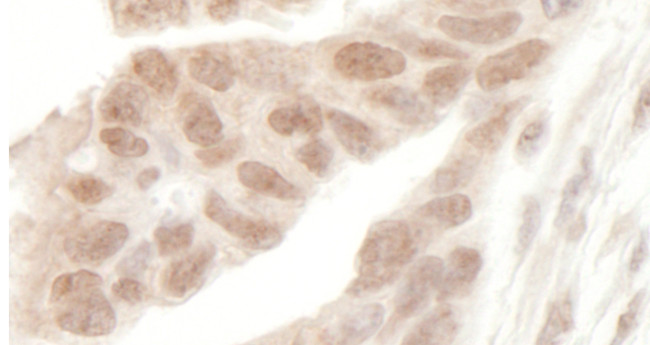
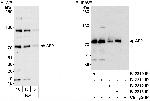
Please note: We are reviewing Western blot images included in the antibody testing data in our catalog, including those provided by third parties. Unless expressly labeled or annotated as “raw-unedited”, Western blot images included in the antibody testing data in our catalog may have been edited, optimized or otherwise adjusted for presentation.


产品信息
A300-596A
应用
建议稀释比
已发表文章
产品规格
种属反应
Human
宿主/亚型
Rabbit
/ IgG
分类
Polyclonal
类型
Antibody
抗原
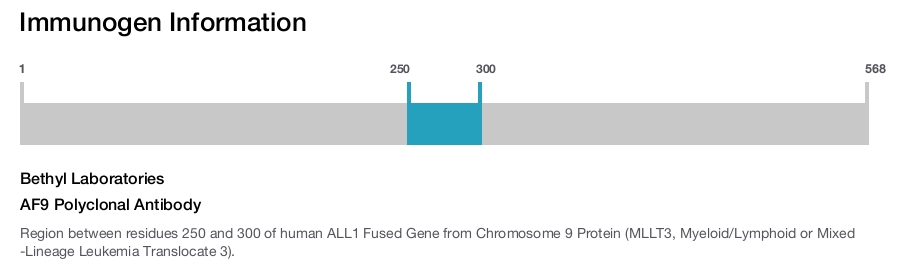
Region between residues 250 and 300 of human ALL1 Fused Gene from Chromosome 9 Protein (MLLT3, Myeloid/Lymphoid or Mixed-Lineage Leukemia Translocate 3).
偶联物
Unconjugated
Unconjugated
Unconjugated
形式
Liquid
浓度
1 mg/mL
规格
100 µg
纯化类型
Antigen affinity chromatography
保存液
tris citrate/phosphate, pH 7-8
内含物
0.09% sodium azide
保存条件
4°C
运输条件
Ambient (domestic); Wet ice (international)
产品详细信息
The recommended shelf life for this product is 1 year from date of receipt.
Application Note: For IHC, epitope retrieval with citrate buffer pH 6.0 is recommended for FFPE tissue sections.
靶标信息
The human AF9 gene is one of the most common fusion partner genes with the ALL1 gene at 11q23 (also called MLL), resulting in the t(9;11)(p22;q23). The AF9 gene is more than 100 kb, and 2 patient breakpoint cluster regions (BCRs) have been identified; BCR1 is within intron 4, previously called site A, whereas BCR2 or site B spans introns 7 and 8. Several different structural elements have been identified in AF9, including a colocalizing in vivo DNA topo II cleavage site and an in vitro DNase I hypersensitive (DNase 1 HS) site in intron 7 in BCR2. Reversibility experiments demonstrated a religation of the topo II cleavage sites. In addition, 2 scaffold associated regions (SARs) are located centromeric to the topo II and DNase I HS cleavage sites and border breakpoint regions in 2 leukemic cells lines: SAR1 is located in intron 4, whereas SAR2 encompasses parts of exons 5-7. The patient breakpoint regions of AF9 share the same structural elements as the MLL BCR. A DNA breakage and repair model for nonhomologous recombination between MLL and its partner genes, particularly AF9, has been proposed.
仅用于科研。不用于诊断过程。未经明确授权不得转售。
篇参考文献 (0)
您是否在文献中引用过该产品?请点击下方按钮邮件告知我们。
生物信息学
蛋白别名: AF-9; AF-9 protein; ALL1-fused gene from chromosome 9 protein; KMT2A/MLLT3 fusion protein; myeloid/lymphoid or mixed-lineage leukemia (trithorax homolog Drosophila); translocated to 3 isoform MLLT3_1; myeloid/lymphoid or mixed-lineage leukemia (trithorax homolog Drosophila); translocated to 3 isoform MLLT3_3; myeloid/lymphoid or mixed-lineage leukemia (trithorax homolog); translocated to, 3; myeloid/lymphoid or mixed-lineage leukemia (trithorax homolog, Drosophila); translocated to, 3; myeloid/lymphoid or mixed-lineage leukemia translocated to chromosome 3 protein; myeloid/lymphoid or mixed-lineage leukemia; translocated to 3; unnamed protein product; YEATS domain-containing protein 3
基因别名: AF9; YEATS3
UniProt ID: (Human) P42568
Entrez Gene ID: (Human) 4300
chromatin organization
positive regulation of transcription, DNA-templated
hematopoietic stem cell differentiation
negative regulation of canonical Wnt signaling pathway
regulation of chromatin organization
regulation of stem cell division
positive regulation of Wnt signaling pathway, planar cell polarity pathway
Disclaimer

Clicking the images or links will redirect you to a website hosted by BenchSci that provides third-party scientific content. Neither the content nor the BenchSci technology and processes for selection have been evaluated by us; we are providing them as-is and without warranty of any kind, including for use or application of the Thermo Fisher Scientific products presented.

