Search
Invitrogen
ALDH18A1 Polyclonal Antibody
{{$productOrderCtrl.translations['antibody.pdp.commerceCard.promotion.promotions']}}
{{$productOrderCtrl.translations['antibody.pdp.commerceCard.promotion.promocode']}}: {{promo.promoCode}} {{promo.promoTitle}} {{promo.promoDescription}}. {{$productOrderCtrl.translations['antibody.pdp.commerceCard.promotion.learnmore']}}
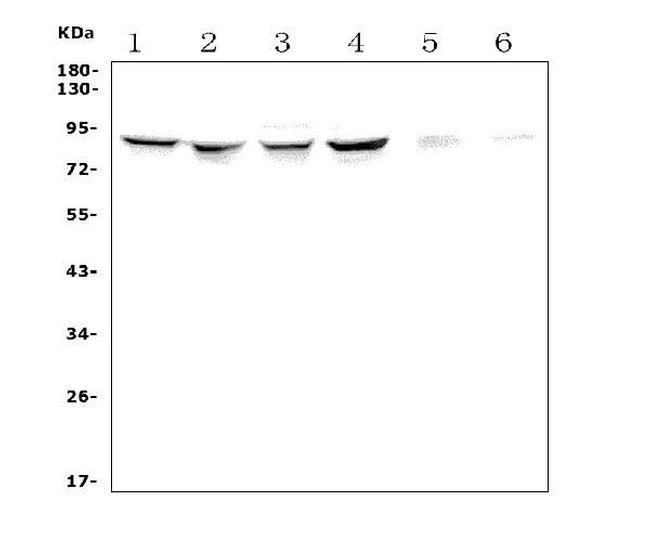
图: 1 / 1
ALDH18A1 Antibody (PA5-114385) in WB
Western blot analysis of ALDH18A1 in the following samples: Lane 1: human HeLA whole cell lysates, Lane 2: human MDA-MB-453 whole cell lysates, Lane 3: human Caco-2 whole cell lysates, Lane 4: human HEK293 whole cell lysates, Lane 5: rat heart tissue lysates, Lane 6: mouse skeletal muscle tissue lysates. Samples consisting of 50 µg (reducing conditions) of protein was separated with 5-20% SDS-PAGE gel (70V, Stacking gel; 90V, Resolving gel; 2-3 hrs.), transferred to a Nitrocellulose membrane (150mA, 50-90 min) and washed with TBS-0.1% Twee... View More
Please note: We are reviewing Western blot images included in the antibody testing data in our catalog, including those provided by third parties. Unless expressly labeled or annotated as “raw-unedited”, Western blot images included in the antibody testing data in our catalog may have been edited, optimized or otherwise adjusted for presentation.

产品信息
PA5-114385
产品规格
种属反应
Human,
Mouse,
Rat
宿主/亚型
Rabbit
/ IgG
分类
Polyclonal
类型
Antibody
抗原
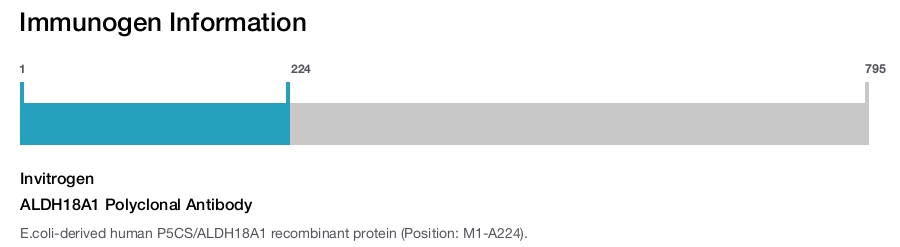
E.coli-derived human P5CS/ALDH18A1 recombinant protein (Position: M1-A224).
偶联物
Unconjugated
Unconjugated
Unconjugated
形式
Lyophilized
浓度
500 µg/mL
规格
100 µg
纯化类型
Affinity chromatography
保存液
PBS with 4mg trehalose
内含物
0.05mg sodium azide
保存条件
-20°C
运输条件
Ambient (domestic); Wet ice (international)
RRID
产品详细信息
Reconstitute with 0.2 mL of distilled water to yield a concentration of 500 µg/mL.
Positive Control - WB: human Hela whole cell, human MDA-MB-453 whole cell, human Caco-2 whole cell, human HEK293 whole cell, rat heart tissue, mouse skeletal muscle tissue .|Store at -20°C for one year from date of receipt. After reconstitution, at 4°C for one month. It can also be aliquotted and stored frozen at -20°C for six months. Avoid repeated freeze-thaw cycles.
靶标信息
This gene is a member of the aldehyde dehydrogenase family and encodes a bifunctional ATP- and NADPH-dependent mitochondrial enzyme with both gamma-glutamyl kinase and gamma-glutamyl phosphate reductase activities. The encoded protein catalyzes the reduction of glutamate to delta1-pyrroline-5-carboxylate, a critical step in the de novo biosynthesis of proline, ornithine and arginine. Mutations in this gene lead to hyperammonemia, hypoornithinemia, hypocitrullinemia, hypoargininemia and hypoprolinemia and may be associated with neurodegeneration, cataracts and connective tissue diseases. Alternatively spliced transcript variants, encoding different isoforms, have been described for this gene.
仅用于科研。不用于诊断过程。未经明确授权不得转售。
篇参考文献 (0)
您是否在文献中引用过该产品?请点击下方按钮邮件告知我们。
生物信息学
蛋白别名: aldehyde dehydrogenase family 18 member A1; delta-1-pyrroline-5-carboxylate synthetase; delta1-pyrroline-5-carboxlate synthetase; glutamate gamma-semialdehyde synthetase; MGC117316; P5CS; P5CSl; P5CSs; pyrroline-5-carboxylate synthetase (glutamate gamma-semialdehyde synthetase); spastic paraplegia 9 (autosomal dominant); Spastic paraplegia-9 (spastic paraparesis with amyotrophy, cataracts and gastroesophageal reflux); unnamed protein product
基因别名: 2810433K04Rik; ADCL3; ARCL3A; GSAS; P5CS; PYCS; SPG9; SPG9A; SPG9B
UniProt ID: (Human) P54886, (Mouse) Q9Z110
Entrez Gene ID: (Human) 5832, (Rat) 361755, (Mouse) 56454
RNA binding
catalytic activity
glutamate 5-kinase activity
glutamate-5-semialdehyde dehydrogenase activity
protein binding
ATP binding
kinase activity
oxidoreductase activity
delta1-pyrroline-5-carboxylate synthetase activity
identical protein binding
oxidoreductase activity, acting on the aldehyde or oxo group of donors, NAD or NADP as acceptor
Disclaimer

Clicking the images or links will redirect you to a website hosted by BenchSci that provides third-party scientific content. Neither the content nor the BenchSci technology and processes for selection have been evaluated by us; we are providing them as-is and without warranty of any kind, including for use or application of the Thermo Fisher Scientific products presented.

