Search
Invitrogen
APEX2 Polyclonal Antibody
{{$productOrderCtrl.translations['antibody.pdp.commerceCard.promotion.promotions']}}
{{$productOrderCtrl.translations['antibody.pdp.commerceCard.promotion.promocode']}}: {{promo.promoCode}} {{promo.promoTitle}} {{promo.promoDescription}}. {{$productOrderCtrl.translations['antibody.pdp.commerceCard.promotion.learnmore']}}
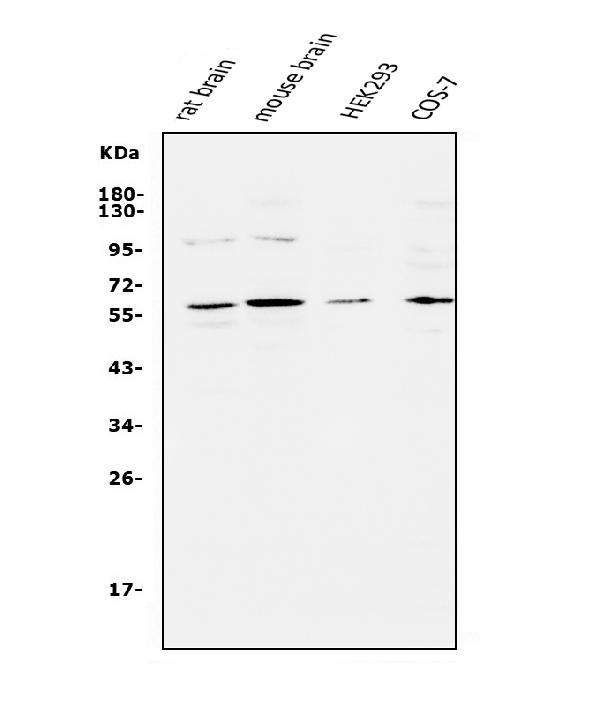
图: 1 / 2
APEX2 Antibody (PA5-78791) in WB
Western blot analysis of APEX2 in, Lane 1: rat brain tissue lysate, Lane 2: mouse brain tissue lysate, Lane 3: HEK293 whole cell lysate, Lane 4: COS-7 whole cell lysate. Electrophoresis was performed on a 5-20% SDS-PAGE gel at 70V (Stacking gel) / 90V (Resolving gel) for 2-3 hours. The sample well of each lane was loaded with 50 µg of sample under reducing conditions. After Electrophoresis, proteins were transferred to a Nitrocellulose membrane at 150mA for 50-90 minutes. The membrane was blocked with 5% Non-fat Milk/ TBS for 1. 5 hour at ... View More
Please note: We are reviewing Western blot images included in the antibody testing data in our catalog, including those provided by third parties. Unless expressly labeled or annotated as “raw-unedited”, Western blot images included in the antibody testing data in our catalog may have been edited, optimized or otherwise adjusted for presentation.


产品信息
PA5-78791
产品规格
种属反应
Human,
Mouse,
Non-human primate,
Rat
宿主/亚型
Rabbit
/ IgG
分类
Polyclonal
类型
Antibody
抗原
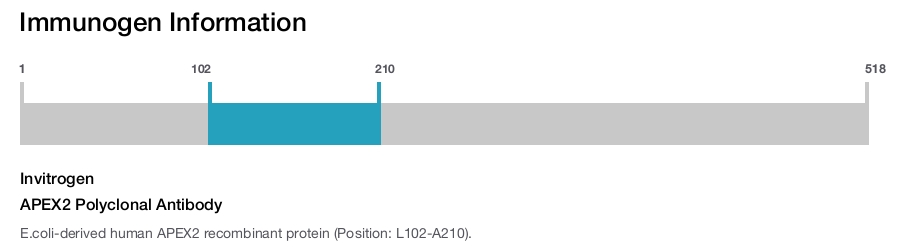
E.coli-derived human APEX2 recombinant protein (Position: L102-A210).
偶联物
Unconjugated
Unconjugated
Unconjugated
形式
Lyophilized
浓度
500 µg/mL
规格
100 µg
纯化类型
Antigen affinity chromatography
保存液
PBS with 4mg trehalose
内含物
0.05mg sodium azide
保存条件
-20°C
运输条件
Ambient (domestic); Wet ice (international)
RRID
产品详细信息
Reconstitute with 0.2 mL of distilled water to yield a concentration of 500 µg/mL.
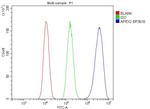
Positive Control - WB: rat brain tissue, mouse brain tissue, HEK293 whole cell, COS-7 whole cell. Flow: A549 cell.
靶标信息
Apurinic/apyrimidinic (AP) sites occur frequently in DNA molecules by spontaneous hydrolysis, by DNA damaging agents or by DNA glycosylases that remove specific abnormal bases. AP sites are pre-mutagenic lesions that can prevent normal DNA replication so the cell contains systems to identify and repair such sites. Class II AP endonucleases cleave the phosphodiester backbone 5' to the AP site. This gene encodes a protein shown to have a weak class II AP endonuclease activity. Most of the encoded protein is located in the nucleus but some is also present in mitochondria. This protein may play an important role in both nuclear and mitochondrial base excision repair (BER).
仅用于科研。不用于诊断过程。未经明确授权不得转售。
篇参考文献 (0)
您是否在文献中引用过该产品?请点击下方按钮邮件告知我们。
生物信息学
蛋白别名: AP endonuclease 2; AP endonuclease XTH2; APEX nuclease (apurinic/apyrimidinic endonuclease) 2; APEX nuclease 2; apurinic endonuclease; apurinic/apyrimidinic endonuclease-like 2; DNA-(apurinic or apyrimidinic site) lyase 2; RP5-884M20.3; unnamed protein product; zinc finger, GRF-type containing 2
基因别名: APE2; APEXL2; C430040P13Rik; XTH2; ZGRF2
UniProt ID: (Human) Q9UBZ4, (Mouse) Q68G58
Entrez Gene ID: (Human) 27301, (Rat) 317628, (Mouse) 77622
Disclaimer

Clicking the images or links will redirect you to a website hosted by BenchSci that provides third-party scientific content. Neither the content nor the BenchSci technology and processes for selection have been evaluated by us; we are providing them as-is and without warranty of any kind, including for use or application of the Thermo Fisher Scientific products presented.

