Search
Invitrogen
APOE Polyclonal Antibody
{{$productOrderCtrl.translations['antibody.pdp.commerceCard.promotion.promotions']}}
{{$productOrderCtrl.translations['antibody.pdp.commerceCard.promotion.promocode']}}: {{promo.promoCode}} {{promo.promoTitle}} {{promo.promoDescription}}. {{$productOrderCtrl.translations['antibody.pdp.commerceCard.promotion.learnmore']}}
{{$ctrl.translations['antibody.pdp.skuNotes.additionalInformation']}}:
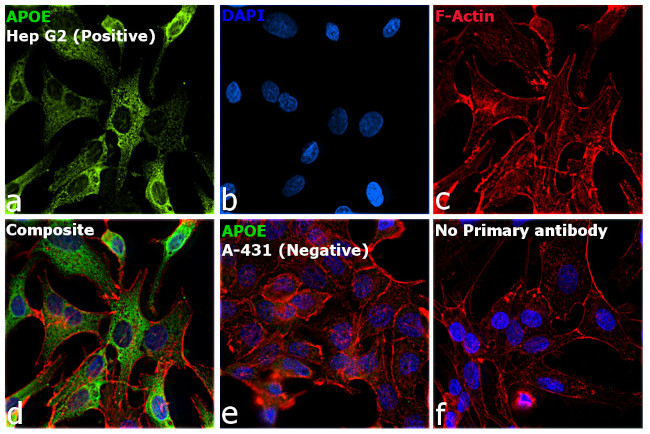
图: 1 / 9
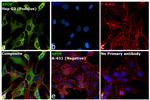
APOE Antibody (PA5-95232) in ICC/IF
Immunofluorescence analysis of APOE was performed using 70% confluent log phase Hep G2 and A-431 cells. The cells were fixed with 4% paraformaldehyde for 10 minutes, permeabilized with 0.1% Triton™ X-100 for 15 minutes, and blocked with 2% BSA for 45 minutes at room temperature. The cells were labeled with APOE Polyclonal Antibody (Product # PA5-95232) at 5 µg/mL in 0.1% BSA, incubated at 4 degree celsius overnight and then labeled with Donkey anti-Rabbit IgG (H+L) Highly Cross-Adsorbed Secondary Antibody, Alexa Fluor Plus 488 (Product # A... View More
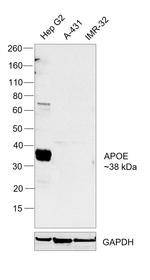
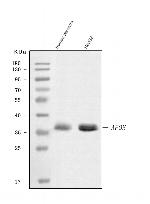
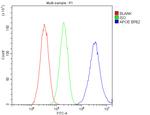
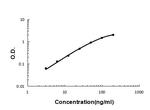
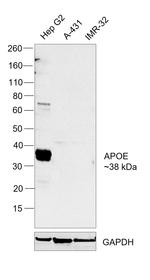
Please note: We are reviewing Western blot images included in the antibody testing data in our catalog, including those provided by third parties. Unless expressly labeled or annotated as “raw-unedited”, Western blot images included in the antibody testing data in our catalog may have been edited, optimized or otherwise adjusted for presentation.


产品信息
PA5-95232
应用
建议稀释比
已发表文章
产品规格
种属反应
Human
宿主/亚型
Rabbit
/ IgG
分类
Polyclonal
类型
Antibody
抗原
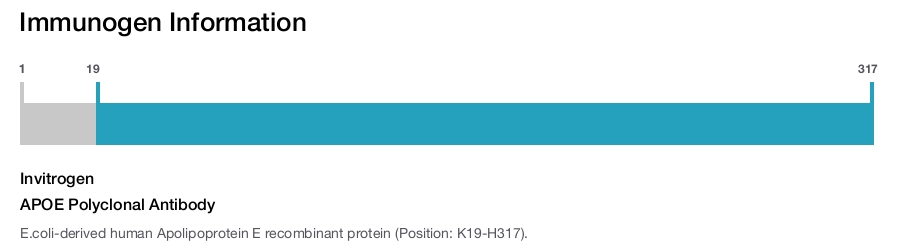
E.coli-derived human Apolipoprotein E recombinant protein (Position: K19-H317).
偶联物
Unconjugated
Unconjugated
Unconjugated
形式
Lyophilized
浓度
500 µg/mL once reconstituted
规格
100 µg
纯化类型
Affinity chromatography
保存液
PBS with 5mg BSA
内含物
0.05mg sodium azide
保存条件
-20°C
运输条件
Ambient (domestic); Wet ice (international)
RRID
产品详细信息
Human Apolipoprotein E shares 73% and 72% amino acid (aa) sequence identity with mouse and rat Apolipoprotein E, respectively.
Reconstitute with 0.2 mL of distilled water to yield a concentration of 500 µg/mL.
Positive Control - WB: human placenta tissue, human HepG2 whole cell. IHC: Human Placenta tissue. Flow: HepG2 cell.|Store at -20°C for one year from date of receipt. After reconstitution, at 4°C for one month. It can also be aliquotted and stored frozen at -20°C for six months. Avoid repeated freeze-thaw cycles.
靶标信息
Apo E (Apolipoprotein E) plays an important role in the metabolism of lipids in the plasma, and is also is a constituent of various plasma lipoprotein-lipid particles. The protein is synthesized in liver, brain, spleen, and the kidney, and concentrations are high in interstitial fluids, where it plays a role in distributing cholesterol from cells where cholesterol is in excess to cells which require cholesterol. Apo E also plays an important role in the formation of very low density lipoprotein and chylomicrons. The Apo E gene is located on chromosome 19 at position 19q13. 2.
仅用于科研。不用于诊断过程。未经明确授权不得转售。
篇参考文献 (0)
您是否在文献中引用过该产品?请点击下方按钮邮件告知我们。
生物信息学
蛋白别名: ApoE4; Apolipoprotein; apolipoprotein E3; apolipoprotein E4; Apoprotein; B2G1; BG; MGC1571; unnamed protein product
基因别名: AD2; APO-E; ApoE4; LDLCQ5; LPG
UniProt ID: (Human) P02649
Entrez Gene ID: (Human) 348
beta-amyloid binding
receptor binding
structural molecule activity
lipid transporter activity
protein binding
phospholipid binding
heparin binding
lipid binding
antioxidant activity
enzyme binding
identical protein binding
protein homodimerization activity
heparan sulfate proteoglycan binding
macromolecular complex binding
metal chelating activity
protein dimerization activity
receptor agonist activity
tau protein binding
low-density lipoprotein particle receptor binding
phosphatidylcholine-sterol O-acyltransferase activator activity
very-low-density lipoprotein particle receptor binding
lipoprotein particle binding
intermembrane cholesterol transfer activity
response to reactive oxygen species
retinoid metabolic process
negative regulation of endothelial cell proliferation
triglyceride metabolic process
lipid transport
receptor-mediated endocytosis
cytoskeleton organization
G-protein coupled receptor signaling pathway
synaptic transmission, cholinergic
long-term memory
cholesterol metabolic process
negative regulation of platelet activation
negative regulation of endothelial cell migration
negative regulation of gene expression
negative regulation of platelet-derived growth factor receptor signaling pathway
positive regulation of cholesterol efflux
lipid transport involved in lipid storage
positive regulation of neuron projection development
negative regulation of neuron projection development
long-chain fatty acid transport
protein import
virion assembly
negative regulation of blood coagulation
regulation of axon extension
neuron projection development
melanosome organization
regulation of Cdc42 protein signal transduction
positive regulation of low-density lipoprotein particle receptor catabolic process
cholesterol efflux
phospholipid efflux
very-low-density lipoprotein particle remodeling
low-density lipoprotein particle remodeling
high-density lipoprotein particle remodeling
high-density lipoprotein particle assembly
chylomicron remnant clearance
high-density lipoprotein particle clearance
very-low-density lipoprotein particle clearance
locomotory exploration behavior
nitric oxide-cGMP-mediated signaling pathway
lipoprotein metabolic process
lipoprotein biosynthetic process
cholesterol homeostasis
regulation of apoptotic process
amyloid precursor protein metabolic process
regulation of protein complex assembly
negative regulation of MAPK cascade
negative regulation of blood vessel endothelial cell migration
reverse cholesterol transport
positive regulation by host of viral process
regulation of innate immune response
positive regulation of nitric oxide biosynthetic process
negative regulation of cholesterol biosynthetic process
positive regulation of endocytosis
positive regulation of transcription, DNA-templated
positive regulation of lipid biosynthetic process
regulation of neuronal synaptic plasticity
negative regulation of smooth muscle cell proliferation
negative regulation of protein secretion
negative regulation of inflammatory response
regulation of synapse organization
positive regulation of membrane protein ectodomain proteolysis
negative regulation of lipid biosynthetic process
regulation of protein metabolic process
negative regulation of protein metabolic process
fatty acid homeostasis
acylglycerol homeostasis
positive regulation of dendritic spine development
negative regulation of dendritic spine development
regulation of proteasomal protein catabolic process
response to caloric restriction
triglyceride homeostasis
positive regulation of ERK1 and ERK2 cascade
cellular response to lipoprotein particle stimulus
triglyceride-rich lipoprotein particle clearance
intermediate-density lipoprotein particle clearance
negative regulation of canonical Wnt signaling pathway
regulation of cholesterol metabolic process
positive regulation of cholesterol metabolic process
negative regulation of cholesterol efflux
regulation of plasma lipoprotein particle levels
AMPA glutamate receptor clustering
NMDA glutamate receptor clustering
cellular oxidant detoxification
positive regulation of lipoprotein transport
regulation of beta-amyloid clearance
positive regulation of beta-amyloid clearance
negative regulation of long-term synaptic potentiation
negative regulation of postsynaptic membrane organization
positive regulation of presynaptic membrane organization
positive regulation of beta-amyloid formation
negative regulation of beta-amyloid formation
negative regulation of dendritic spine maintenance
positive regulation of dendritic spine maintenance
regulation of amyloid precursor protein catabolic process
positive regulation of phospholipid efflux
positive regulation of neurofibrillary tangle assembly
negative regulation of phospholipid efflux
negative regulation of lipid transport across blood brain barrier
positive regulation of lipid transport across blood brain barrier
regulation of cellular response to very-low-density lipoprotein particle stimulus
regulation of amyloid fibril formation
negative regulation of amyloid fibril formation
positive regulation of amyloid fibril formation
regulation of behavioral fear response
Disclaimer

Clicking the images or links will redirect you to a website hosted by BenchSci that provides third-party scientific content. Neither the content nor the BenchSci technology and processes for selection have been evaluated by us; we are providing them as-is and without warranty of any kind, including for use or application of the Thermo Fisher Scientific products presented.

