Search
Abnova
ARNT2 Monoclonal Antibody (1B2)
{{$productOrderCtrl.translations['antibody.pdp.commerceCard.promotion.promotions']}}
{{$productOrderCtrl.translations['antibody.pdp.commerceCard.promotion.promocode']}}: {{promo.promoCode}} {{promo.promoTitle}} {{promo.promoDescription}}. {{$productOrderCtrl.translations['antibody.pdp.commerceCard.promotion.learnmore']}}
Please note: We are reviewing Western blot images included in the antibody testing data in our catalog, including those provided by third parties. Unless expressly labeled or annotated as “raw-unedited”, Western blot images included in the antibody testing data in our catalog may have been edited, optimized or otherwise adjusted for presentation.

产品信息
H00009915-M03
产品规格
种属反应
Human
宿主/亚型
Mouse
/ IgG2b, kappa
分类
Monoclonal
类型
Antibody
克隆号
1B2
抗原
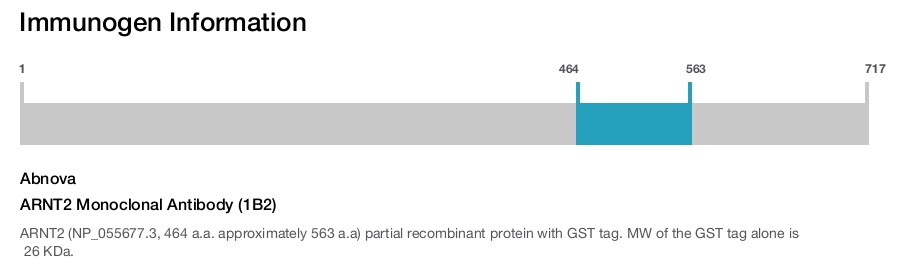
ARNT2 (NP_055677.3, 464 a.a. approximately 563 a.a) partial recombinant protein with GST tag. MW of the GST tag alone is 26 KDa.
偶联物
Unconjugated
Unconjugated
Unconjugated
形式
Liquid
浓度
1 mg/mL
规格
100 µg
纯化类型
Protein A
保存液
PBS, pH 7.4
内含物
no preservative
保存条件
-20°C, Avoid Freeze/Thaw Cycles
运输条件
Ambient (domestic); Wet ice (international)
产品详细信息
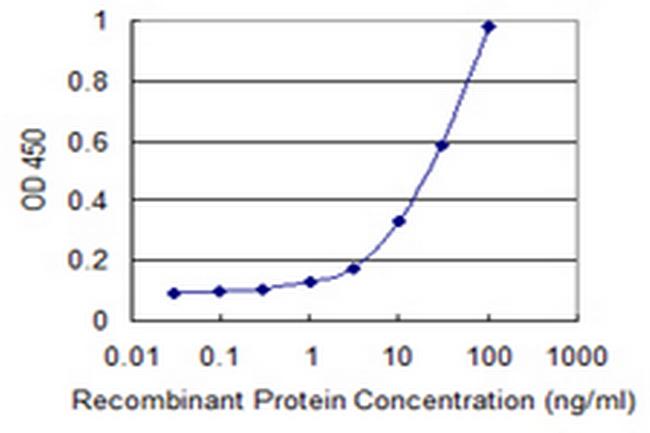
Product may be used with Sandwich ELISA (Recombinant protein).
Immunogen sequence: VPVPNLPAGV HEAGKSVEKA DAIFSQERDP RFAEMFAGIS ASEKKMMSSA SAAGTQQIYS QGSPFPSGHS GKAFSSSVVH VPGVNDIQSS SSTGQNMSQI
靶标信息
AhR, ARNT1, ARNT2 and BMAL1 are members of a family of transcription factors that contain a basic helix-loop-helix motif and a common "PAS" motif. The aromatic (aryl) hydrocarbon receptor, AhR, is a ligand dependent transcription factor that interacts with specific DNA sequences termed xenobiotic responsive elements (XREs) to activate several genes including CYP1A1, glutathione S-transferase Ya subunit and DT-diaphorase. The Ah receptor nuclear translocator proteins (Arnt 1 or Arnt 2) are required for ligand-dependent nuclear translocation of the Ah receptor and are also necessary for Ah receptor binding to the XRE element. BMAL1 (Brain and Muscle Arnt-like protein 1), also designated Arnt 3, TIC, JAP3 or MOP-3, has been shown to dimerize with Clock and bind to the promoter region of mPer1, suggesting that this protein plays a role in regulation of circadian oscillation in mammals.
仅用于科研。不用于诊断过程。未经明确授权不得转售。
篇参考文献 (0)
您是否在文献中引用过该产品?请点击下方按钮邮件告知我们。
生物信息学
蛋白别名: ARNT 2; ARNT protein 2; class E basic helix-loop-helix protein 1; KIAA0307; unnamed protein product
基因别名: bHLHe1; WEDAS
UniProt ID: (Human) Q9HBZ2
Entrez Gene ID: (Human) 9915
RNA polymerase II core promoter proximal region sequence-specific DNA binding
RNA polymerase II transcription factor activity, sequence-specific DNA binding
transcriptional activator activity, RNA polymerase II transcription regulatory region sequence-specific binding
transcription factor activity, sequence-specific DNA binding
protein binding
aryl hydrocarbon receptor binding
macromolecular complex binding
protein heterodimerization activity
protein dimerization activity
sequence-specific double-stranded DNA binding
response to hypoxia
in utero embryonic development
regulation of transcription, DNA-templated
regulation of transcription from RNA polymerase II promoter
xenobiotic metabolic process
central nervous system development
brain development
positive regulation of cell proliferation
response to estradiol
negative regulation of apoptotic process
positive regulation of transcription, DNA-templated
positive regulation of transcription from RNA polymerase II promoter
Disclaimer

Clicking the images or links will redirect you to a website hosted by BenchSci that provides third-party scientific content. Neither the content nor the BenchSci technology and processes for selection have been evaluated by us; we are providing them as-is and without warranty of any kind, including for use or application of the Thermo Fisher Scientific products presented.

