Search
Rockland
ASPP1 Polyclonal Antibody
{{$productOrderCtrl.translations['antibody.pdp.commerceCard.promotion.promotions']}}
{{$productOrderCtrl.translations['antibody.pdp.commerceCard.promotion.promocode']}}: {{promo.promoCode}} {{promo.promoTitle}} {{promo.promoDescription}}. {{$productOrderCtrl.translations['antibody.pdp.commerceCard.promotion.learnmore']}}
{{$ctrl.translations['antibody.pdp.skuNotes.additionalInformation']}}:
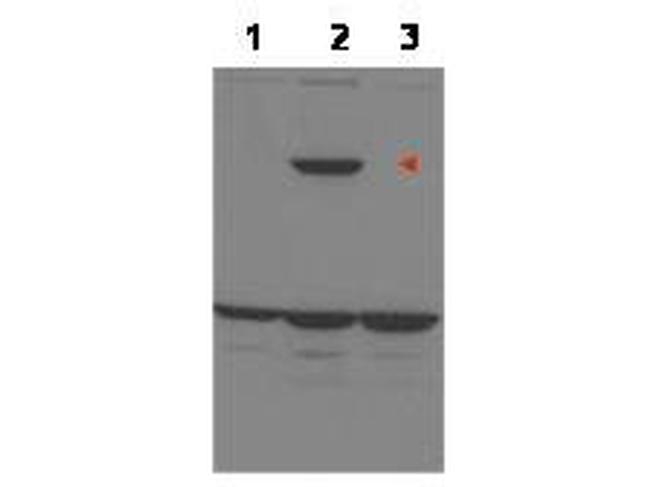
图: 1 / 1
ASPP1 Antibody (600-401-A18) in WB
Western blot using Rocklands affinity purified anti-ASPP1 to detect over-expressed ASPP1 in MCF-7 cells (lane 2, arrowhead). Lane 1 is a non-transfected control. Lane 3 is MCF-7 cells over-expressing ASPP2. Cell extracts were electrophoresed and transferred to nitrocellulose. The membrane was probed with the primary antibody at a 1:1,000 dilution. The identity of the lower MW band at approximately 50kDa is unknown. Primary experimental data indicate that the unknown band intensifies in extracts from p53 siRNA knockdown cells. Personal Com... View More
Please note: We are reviewing Western blot images included in the antibody testing data in our catalog, including those provided by third parties. Unless expressly labeled or annotated as “raw-unedited”, Western blot images included in the antibody testing data in our catalog may have been edited, optimized or otherwise adjusted for presentation.

产品信息
600-401-A18
应用
建议稀释比
已发表文章
产品规格
种属反应
Human
宿主/亚型
Rabbit
/ IgG
分类
Polyclonal
类型
Antibody
抗原
This affinity purified antibody was prepared from whole rabbit serum produced by repeated immunizations with a synthetic peptide corresponding to an internal sequence of human ASPP1.
偶联物
Unconjugated
Unconjugated
Unconjugated
形式
Liquid
浓度
0.33 mg/mL
规格
100 µg
纯化类型
Affinity chromatography
保存液
0.02M potassium phosphate, pH 7.2, with 0.15M NaCl
内含物
0.01% sodium azide
保存条件
-20°C, Avoid Freeze/Thaw Cycles
运输条件
Ambient (domestic); Wet ice (international)
产品详细信息
Store vial at -20° C prior to opening. Aliquot contents and freeze at -20° C or below for extended storage. Avoid cycles of freezing and thawing. Centrifuge product if not completely clear after standing at room temperature. This product is stable for several weeks at 4° C as an undiluted liquid. Dilute only prior to immediate use.
Directed against human ASPP1. Minimal reactivity occurs against ASPP2. A BLAST analysis was used to suggest cross-reactivity with ASPP1 from mouse based on a 92% homology with the immunizing sequence. Reactivity against homologues from other sources is not known.
靶标信息
This gene encodes a member of the ASPP family of p53 interacting proteins. The protein contains four ankyrin repeats and an SH3 domain involved in protein-protein interactions. ASPP proteins are required for the induction of apoptosis by p53-family proteins. They promote DNA binding and transactivation of p53-family proteins on the promoters of proapoptotic genes. Expression of this gene is regulated by the E2F transcription factor.
仅用于科研。不用于诊断过程。未经明确授权不得转售。
篇参考文献 (0)
您是否在文献中引用过该产品?请点击下方按钮邮件告知我们。
生物信息学
蛋白别名: apoptosis-stimulating protein of p53, 1; protein phosphatase 1, regulatory (inhibitor) subunit 13B; unnamed protein product
基因别名: ASPP1; p53BP2-like; p85
UniProt ID: (Human) Q96KQ4
Entrez Gene ID: (Human) 23368
Disclaimer

Clicking the images or links will redirect you to a website hosted by BenchSci that provides third-party scientific content. Neither the content nor the BenchSci technology and processes for selection have been evaluated by us; we are providing them as-is and without warranty of any kind, including for use or application of the Thermo Fisher Scientific products presented.

