Search
Invitrogen
ATG11 Monoclonal Antibody (7C2NB)
{{$productOrderCtrl.translations['antibody.pdp.commerceCard.promotion.promotions']}}
{{$productOrderCtrl.translations['antibody.pdp.commerceCard.promotion.promocode']}}: {{promo.promoCode}} {{promo.promoTitle}} {{promo.promoDescription}}. {{$productOrderCtrl.translations['antibody.pdp.commerceCard.promotion.learnmore']}}
产品信息
MA5-62073
产品规格
种属反应
Yeast
宿主/亚型
Mouse
/ IgM, lambda
分类
Monoclonal
类型
Antibody
克隆号
7C2NB
抗原
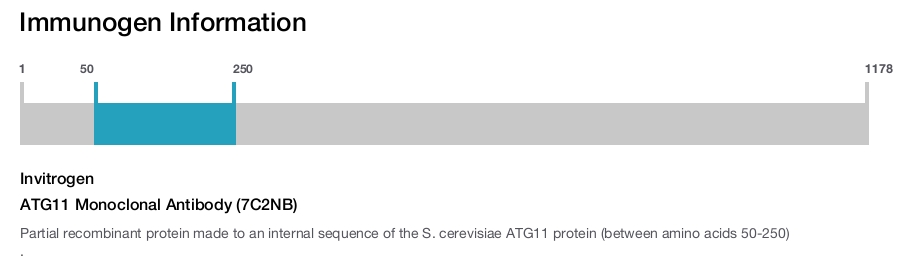
Partial recombinant protein made to an internal sequence of the S. cerevisiae ATG11 protein (between amino acids 50-250).
偶联物
Unconjugated
Unconjugated
Unconjugated
形式
Liquid
浓度
1 mg/mL
规格
100 µg
纯化类型
IgM
保存液
PBS
内含物
0.05% sodium azide
保存条件
Store at 4°C short term. For long term storage, store at -20°C, avoiding freeze/thaw cycles.
运输条件
Ambient (domestic); Wet ice (international)
RRID
靶标信息
ATG11 (Autophagy-Related Gene 11) is a key gene involved in the autophagy process, a cellular degradation and recycling system that is crucial for maintaining cellular homeostasis. Autophagy allows cells to break down and reuse damaged organelles, misfolded proteins, and other cellular debris, especially under conditions of stress or nutrient deprivation. ATG11 encodes a scaffold protein that plays a pivotal role in selective autophagy by facilitating the recruitment and organization of autophagy machinery components to the phagophore assembly site. It is particularly important in the selective degradation of specific organelles, such as peroxisomes (pexophagy) and mitochondria (mitophagy), as well as in the removal of protein aggregates. Dysfunction or mutations in ATG11 can disrupt autophagic processes, leading to the accumulation of cellular waste and contributing to various pathological conditions, including neurodegenerative diseases like Parkinson's and Alzheimer's, as well as certain cancers. Understanding the function and regulation of ATG11 is essential for developing therapeutic strategies aimed at enhancing autophagy to treat these diseases. Research into ATG11 continues to provide valuable insights into the mechanisms of selective autophagy and its broader implications for cellular health and disease management.
仅用于科研。不用于诊断过程。未经明确授权不得转售。
篇参考文献 (0)
您是否在文献中引用过该产品?请点击下方按钮邮件告知我们。
生物信息学
autophagosome assembly
mitophagy
positive regulation of protein phosphorylation
autophagy
protein transport
pexophagy
protein complex localization
CVT pathway
protein localization to pre-autophagosomal structure
ribophagy
piecemeal microautophagy of nucleus
reticulophagy
regulation of cellular response to phosphate starvation
positive regulation of autophagosome assembly
Disclaimer

Clicking the images or links will redirect you to a website hosted by BenchSci that provides third-party scientific content. Neither the content nor the BenchSci technology and processes for selection have been evaluated by us; we are providing them as-is and without warranty of any kind, including for use or application of the Thermo Fisher Scientific products presented.

