Search
Invitrogen
ATP5A1 Monoclonal Antibody (3A6B9)
{{$productOrderCtrl.translations['antibody.pdp.commerceCard.promotion.promotions']}}
{{$productOrderCtrl.translations['antibody.pdp.commerceCard.promotion.promocode']}}: {{promo.promoCode}} {{promo.promoTitle}} {{promo.promoDescription}}. {{$productOrderCtrl.translations['antibody.pdp.commerceCard.promotion.learnmore']}}
{{$ctrl.translations['antibody.pdp.skuNotes.additionalInformation']}}:
产品信息
MA5-48379
应用
建议稀释比
已发表文章
产品规格
种属反应
Human,
Mouse,
Non-human primate,
Rat
宿主/亚型
Mouse
/ IgG1
分类
Monoclonal
类型
Antibody
克隆号
3A6B9
抗原
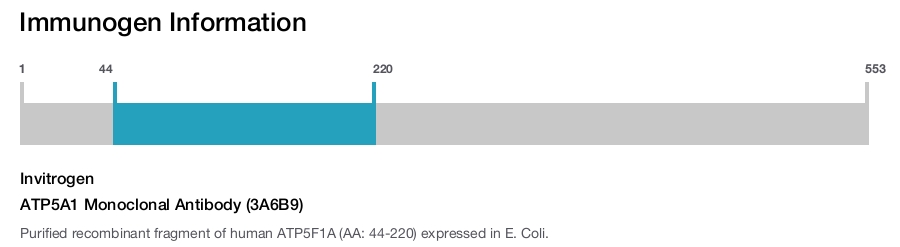
Purified recombinant fragment of human ATP5F1A (AA: 44-220) expressed in E. Coli.
偶联物
Unconjugated
Unconjugated
Unconjugated
形式
Liquid
浓度
1 mg/mL
规格
100 µg
纯化类型
Protein G
保存液
PBS
内含物
0.05% sodium azide
保存条件
Store at 4°C short term. For long term storage, store at -20°C, avoiding freeze/thaw cycles.
运输条件
Ambient (domestic); Wet ice (international)
RRID
靶标信息
The ATP5F1A gene (ATP Synthase F1 Subunit Alpha) is located on chromosome 18q21.33 and encodes a critical component of the mitochondrial ATP synthase complex, specifically the F1 catalytic core. The ATP synthase complex is essential for cellular energy production, facilitating the conversion of ADP to ATP during oxidative phosphorylation. The ATP5F1A subunit is responsible for the catalysis of ATP synthesis driven by the proton gradient across the inner mitochondrial membrane. Dysfunctions or mutations in ATP5F1A can result in mitochondrial disorders and are linked to various metabolic and neurodegenerative diseases. Understanding the structure and function of ATP5F1A is vital for comprehending the bioenergetics of cellular respiration and has implications in studying mitochondrial pathologies.
仅用于科研。不用于诊断过程。未经明确授权不得转售。
篇参考文献 (0)
您是否在文献中引用过该产品?请点击下方按钮邮件告知我们。
生物信息学
蛋白别名: ATP synthase alpha chain, mitochondrial; ATP synthase alpha subunit precursor (EC 3.6.1.3); ATP synthase subunit alpha, mitochondrial; ATP synthase, H+ transporting, mitochondrial F1 complex, alpha subunit 1; ATP synthase, H+ transporting, mitochondrial F1 complex, alpha subunit 1, cardiac muscle; ATP sythase (F1-ATPase) alpha subunit; epididymis secretory sperm binding protein Li 123m; iso; mitochondrial ATP synthetase, oligomycin-resistant; mitochondrial H+-ATP synthase alpha subunit; modifier of Min 2; unnamed protein product
基因别名: ATP5A; ATP5A1; ATP5AL2; ATPM; COXPD22; D18Ertd206e; hATP1; HEL-S-123m; MC5DN4; MC5DN4A; MC5DN4B; MOM2; OMR; ORM
UniProt ID: (Human) P25705, (Rat) P15999, (Mouse) Q03265
Entrez Gene ID: (Human) 498, (Rat) 65262, (Mouse) 11946
negative regulation of endothelial cell proliferation
lipid metabolic process
ATP biosynthetic process
response to muscle activity
ATP synthesis coupled proton transport
mitochondrial ATP synthesis coupled proton transport
positive regulation of blood vessel endothelial cell migration
response to ethanol
ATP metabolic process
cellular response to dexamethasone stimulus
cellular response to nitric oxide
hydrogen ion transmembrane transport
Disclaimer

Clicking the images or links will redirect you to a website hosted by BenchSci that provides third-party scientific content. Neither the content nor the BenchSci technology and processes for selection have been evaluated by us; we are providing them as-is and without warranty of any kind, including for use or application of the Thermo Fisher Scientific products presented.

