Search
Agrisera
ATPase AAA2 domain Polyclonal Antibody
{{$productOrderCtrl.translations['antibody.pdp.commerceCard.promotion.promotions']}}
{{$productOrderCtrl.translations['antibody.pdp.commerceCard.promotion.viewpromo']}}
{{$productOrderCtrl.translations['antibody.pdp.commerceCard.promotion.promocode']}}: {{promo.promoCode}} {{promo.promoTitle}} {{promo.promoDescription}}. {{$productOrderCtrl.translations['antibody.pdp.commerceCard.promotion.learnmore']}}
Additional Information:
{{banner.description}}
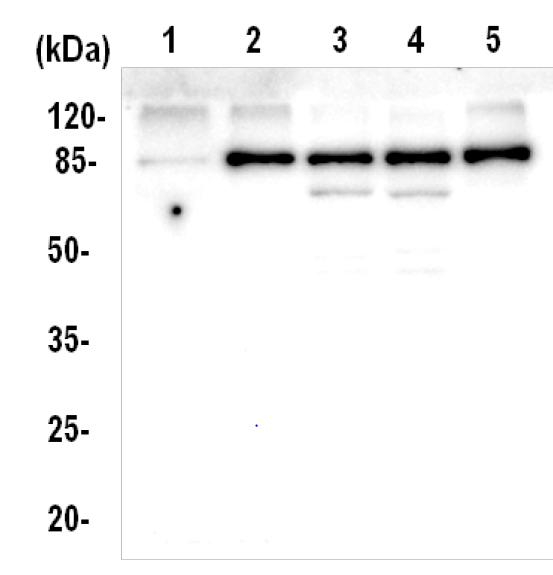
图: 1 / 2
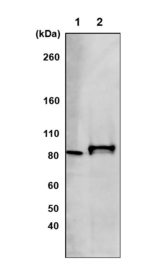
ATPase AAA2 domain Antibody (AS11-1754) in WB
The 20 µg of soluble proteins from 3-week old Solanum tuberosum (1) and Arabidopsis thaliana (2), one-week old Lupinus angustifolius (3), Pisum sativum (4) and Zea mays L. (5) leaves extracted with buffer containing 50 мM Hepes-KOH, p H 7.5,330 мM sorbitol, 2 мM EDTA, 1 мM Mg Cl 2,5 мM ascorbate, 0.05% BSA were mixed with sample buffer and denatured for 5 min at 70°C. Samples were separated on 10% SDS-PAGE and blotted 1 h to nitrocellulose membrane (Amersham Protran) using tank wet-transfer (Bio-Rad) in standard transfer buffer in presence... View More


产品信息
AS11-1754
产品规格
种属反应
Algae,
Bacteria,
Plant
宿主/亚型
Rabbit
分类
Polyclonal
类型
Antibody
抗原
KLH-conjugated synthetic peptide derived from proteins containing AAA2 domain.
偶联物
形式
Lyophilized
保存液
whole serum
内含物
no preservative
保存条件
-20°C, Avoid Freeze/Thaw Cycles
运输条件
Ambient (domestic); Wet ice (international)
产品详细信息
Store lyophilized/reconstituted at -20°C; once reconstituted make aliquots to avoid repeated freeze-thaw cycles. Please remember to spin the tubes briefly prior to opening them to avoid any losses that might occur from material adhering to the cap or sides of the tube.
For reconstitution add 200 µL of sterile water.
Specific Species Reactivity: Arabidopsis thaliana, Chlamydomonas reinhardtii, Lupinus angustifolius, Pisum sativum, Solanum tuberosum, Synechococcus sp. PCC 7942, Zea mays L.
靶标信息
ATPase family AAA domain containing 2 (ATAD2) encodes a predominantly nuclear chromatin-associated AAA+ ATPase that is enriched on chromatin during S phase, where it can localize to replication sites. The ATAD2 protein is a large multidomain factor comprising an N-terminal acidic region followed by two tandem AAA+ ATPase modules (often referred to as AAA1 and AAA2), and a C-terminal bromodomain that adopts the canonical four-helix bromodomain fold and binds acetyl-lysine marks on histones (including di-acetylated histone H4K5ac/K12ac associated with newly synthesized histones). Through its bromodomain-mediated recognition of acetylated histones and ATPase-driven remodeling/chaperone-like activity, ATAD2 functions as a chromatin regulator that promotes chromatin dynamics and supports DNA replication; it also acts as a transcriptional coregulator, including in pathways controlling cell-cycle gene expression, consistent with roles in coupling epigenetic state to proliferation programs.
仅用于科研。不用于诊断过程。未经明确授权不得转售。
篇参考文献 (0)
您是否在文献中引用过该产品?请点击下方按钮邮件告知我们。
生物信息学
蛋白别名: ATHSP101; F1O17.2; F1O17_2; HOT1; HSP101
Disclaimer

Clicking the images or links will redirect you to a website hosted by BenchSci that provides third-party scientific content. Neither the content nor the BenchSci technology and processes for selection have been evaluated by us; we are providing them as-is and without warranty of any kind, including for use or application of the Thermo Fisher Scientific products presented.

