Search
Invitrogen
Alix Polyclonal Antibody
{{$productOrderCtrl.translations['antibody.pdp.commerceCard.promotion.promotions']}}
{{$productOrderCtrl.translations['antibody.pdp.commerceCard.promotion.promocode']}}: {{promo.promoCode}} {{promo.promoTitle}} {{promo.promoDescription}}. {{$productOrderCtrl.translations['antibody.pdp.commerceCard.promotion.learnmore']}}
{{$ctrl.translations['antibody.pdp.skuNotes.additionalInformation']}}:
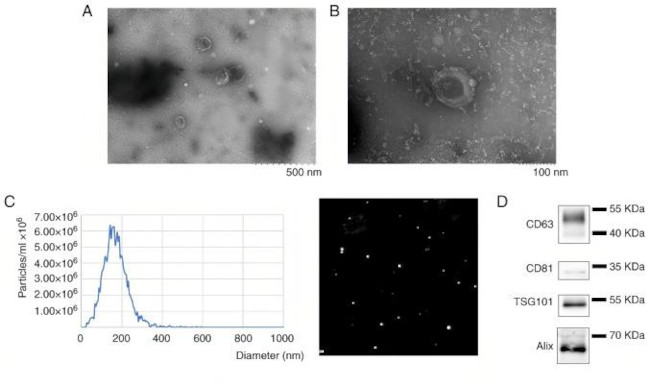
图: 1 / 1
Alix Antibody (PA5-95321) in WB
Oncology letters 2024 -
Figure 1. Identification of plasma EVs. (A and B) Observation of EVs by transmission electron microscopy. (A) Scale bar, 500 nm. (B) Scale bar, 100 nm. (C) Nanoparticle tracking analysis. Left, sample EV particle size distribution map; right, display of particles in the nanoparticle tracking analysis detection window. Maximum area, 1,000 nm; minimum area, 5 nm; minimum brightness, 20 nm. (D) Qualitative det... View More
Please note: We are reviewing Western blot images included in the antibody testing data in our catalog, including those provided by third parties. Unless expressly labeled or annotated as “raw-unedited”, Western blot images included in the antibody testing data in our catalog may have been edited, optimized or otherwise adjusted for presentation.

产品信息
PA5-95321
应用
建议稀释比
已发表文章
产品规格
种属反应
Human,
Mouse,
Rat
已发表种属
Human
宿主/亚型
Rabbit
/ IgG
分类
Polyclonal
类型
Antibody
抗原
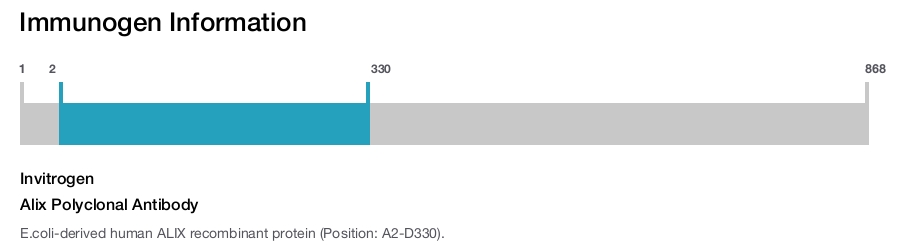
E.coli-derived human ALIX recombinant protein (Position: A2-D330).
偶联物
Unconjugated
Unconjugated
Unconjugated
形式
Lyophilized
浓度
500 µg/mL once reconstituted
规格
100 µg
纯化类型
Affinity chromatography
保存液
PBS with 5mg BSA
内含物
0.05mg sodium azide
保存条件
-20°C
运输条件
Ambient (domestic); Wet ice (international)
RRID
产品详细信息
Human ALIX shares 96.7% and 95.2% amino acid (aa) sequence identity with mouse and rat ALIX, respectively.
Reconstitute with 0.2 mL of distilled water to yield a concentration of 500 µg/mL.
Positive Control - WB: human Hela whole cell, human HepG2 whole cell, human PANC-1 whole cell, rat liver tissue, rat RH35 whole cell, mouse liver tissue, mouse NIH/3T3 whole cell. IHC: rat liver tissue, huamn lung tissue, huamn oesophagus squama tissue, huamn placenta tissue, mouse intestine tissue. ICC/IF: T-47D cell.|Store at -20°C for one year from date of receipt. After reconstitution, at 4°C for one month. It can also be aliquotted and stored frozen at -20°C for six months. Avoid repeated freeze-thaw cycles.
靶标信息
Apoptotic linked-gene-product 2 (ALG-2) interacting protein X (ALIX) is a conserved adaptor protein which is ubiquitously expressed. Alix was originally reported to play a role in apoptosis but has recently been shown to be involved in other cellular mechanisms including endosomal sorting, endocytosis, viral budding and actin cytoskeleton assembly.
仅用于科研。不用于诊断过程。未经明确授权不得转售。
生物信息学
蛋白别名: AIP1; ALG-2 interacting protein; ALG-2 interacting protein 1; ALG-2 interacting protein X; ALG-2-interacting protein 1; ALG-2-interacting protein X; Alg2-interacting protein 1; Alg2-interacting protein X; apoptosis-linked gene 2-interacting protein X; dopamine receptor interacting protein 4; E2f1-inducible protein; MGC17003; PDCD6-interacting protein; similar to XP95; possible role in signal transduction and cell growth/death; unnamed protein product
基因别名: AIP1; ALIX; DRIP4; Eig2; HP95; MCPH29; mKIAA1375; RGD1561176
UniProt ID: (Human) Q8WUM4, (Mouse) Q9WU78, (Rat) Q9QZA2
Entrez Gene ID: (Human) 10015, (Mouse) 18571, (Rat) 501083
mitotic cytokinesis
actomyosin contractile ring assembly
nucleus organization
mitotic metaphase plate congression
regulation of centrosome duplication
macroautophagy
endosome transport via multivesicular body sorting pathway
multivesicular body assembly
viral budding via host ESCRT complex
maintenance of epithelial cell apical/basal polarity
viral budding
protein homooligomerization
midbody abscission
bicellular tight junction assembly
regulation of membrane permeability
extracellular exosome biogenesis
regulation of mitotic spindle assembly
positive regulation of exosomal secretion
regulation of extracellular exosome assembly
positive regulation of extracellular exosome assembly
apoptotic process
Disclaimer

Clicking the images or links will redirect you to a website hosted by BenchSci that provides third-party scientific content. Neither the content nor the BenchSci technology and processes for selection have been evaluated by us; we are providing them as-is and without warranty of any kind, including for use or application of the Thermo Fisher Scientific products presented.

