Search
Invitrogen
Androgen Receptor (ARv7 Splice Variant) Recombinant Rabbit Monoclonal Antibody (HL1239)
{{$productOrderCtrl.translations['antibody.pdp.commerceCard.promotion.promotions']}}
{{$productOrderCtrl.translations['antibody.pdp.commerceCard.promotion.promocode']}}: {{promo.promoCode}} {{promo.promoTitle}} {{promo.promoDescription}}. {{$productOrderCtrl.translations['antibody.pdp.commerceCard.promotion.learnmore']}}
{{$ctrl.translations['antibody.pdp.skuNotes.additionalInformation']}}:
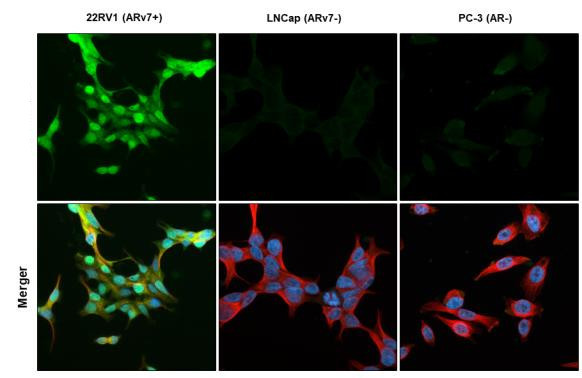
图: 1 / 4
Androgen Receptor (ARv7 Splice Variant) Antibody (MA5-46970) in ICC/IF
Immunofluorescent analysis of Androgen Receptor (ARv7 Splice Variant) in 22RV1, LNCap and PC-3 cells. Cells were fixed in 4% paraformaldehyde at RT for 15 min. Green: Androgen Receptor (ARv7 Splice Variant) stained by Androgen Receptor (ARv7 Splice Variant) monoclonal antibody (Product # MA5-46970) diluted at 1:500. Red: alpha Tubulin, a cytoskeleton marker, stained by alpha Tubulin antibody [GT114] diluted... View More
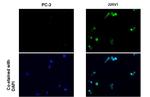
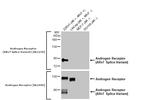
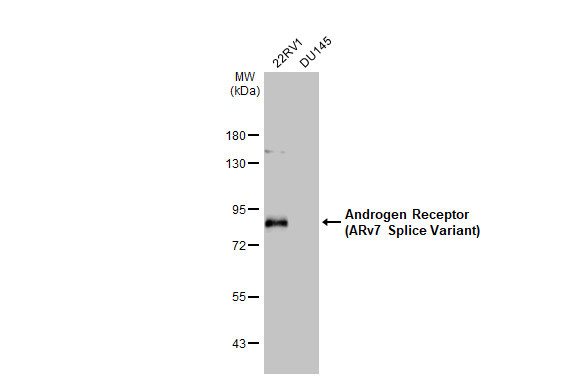
Please note: We are reviewing Western blot images included in the antibody testing data in our catalog, including those provided by third parties. Unless expressly labeled or annotated as “raw-unedited”, Western blot images included in the antibody testing data in our catalog may have been edited, optimized or otherwise adjusted for presentation.


产品信息
MA5-46970
应用
建议稀释比
已发表文章
产品规格
种属反应
Human
宿主/亚型
Rabbit
/ IgG
Expression System
HEK293 cells
分类
Recombinant Monoclonal
类型
Antibody
克隆号
HL1239
抗原
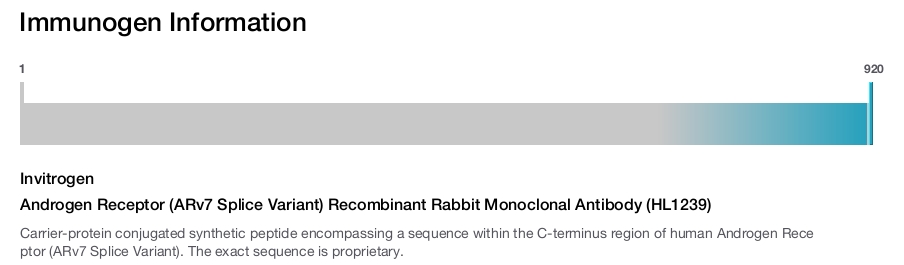
Carrier-protein conjugated synthetic peptide encompassing a sequence within the C-terminus region of human Androgen Receptor (ARv7 Splice Variant). The exact sequence is proprietary.
偶联物
Unconjugated
Unconjugated
Unconjugated
形式
Liquid
浓度
1 mg/mL
规格
100 µg
纯化类型
Protein A
保存液
PBS
内含物
no preservative
保存条件
Store at 4°C short term. For long term storage, store at -20°C, avoiding freeze/thaw cycles.
运输条件
Ambient (domestic); Wet ice (international)
RRID
产品详细信息
Store as concentrated solution.
Centrifuge briefly prior to opening vial.
靶标信息
The androgen receptor gene is more than 90 kb long and codes for a protein that has 3 major functional domains: the N-terminal domain, DNA-binding domain, and androgen-binding domain. The protein functions as a steroid-hormone activated transcription factor. Upon binding the hormone ligand, the receptor dissociates from accessory proteins, translocates into the nucleus, dimerizes, and then stimulates transcription of androgen responsive genes. This gene contains 2 polymorphic trinucleotide repeat segments that encode polyglutamine and polyglycine tracts in the N-terminal transactivation domain of its protein. Expansion of the polyglutamine tract from the normal 9-34 repeats to the pathogenic 38-62 repeats causes spinal bulbar muscular atrophy (SBMA, also known as Kennedy's disease). Mutations in this gene are also associated with complete androgen insensitivity (CAIS). Alternative splicing results in multiple transcript variants encoding different isoforms. [provided by RefSeq, Jan 2017]
仅用于科研。不用于诊断过程。未经明确授权不得转售。
篇参考文献 (0)
您是否在文献中引用过该产品?请点击下方按钮邮件告知我们。
生物信息学
蛋白别名: AIS; androgen receptor; androgen-receptor; AR8; DHTR; dihydrotestosterone receptor; HUMARA; HYSP1; KD; NR3C4; nuclear receptor; nuclear receptor subfamily 3 group C member 4; nuclear receptor; AR3 is also known as AR-V7; SBMA; SMAX1; splice variant 8; steroid hormone receptor; steroid hormone receptor; AR; TFM
基因别名: AIS; AR8; DHTR; HPCX3; HUMARA; HYSP1; KD; NR3C4; SBMA; SMAX1; TFM
UniProt ID: (Human) P10275
Entrez Gene ID: (Human) 367
transcription regulatory region sequence-specific DNA binding
RNA polymerase II regulatory region sequence-specific DNA binding
RNA polymerase II core promoter proximal region sequence-specific DNA binding
RNA polymerase II core promoter sequence-specific DNA binding
RNA polymerase II transcription factor activity, sequence-specific DNA binding
RNA polymerase II general transcription initiation factor binding
transcription coactivator binding
transcriptional activator activity, RNA polymerase II transcription regulatory region sequence-specific binding
DNA binding
chromatin binding
transcription factor activity, sequence-specific DNA binding
steroid hormone receptor activity
RNA polymerase II transcription factor activity, ligand-activated sequence-specific DNA binding
receptor binding
steroid binding
androgen binding
protein binding
beta-catenin binding
zinc ion binding
enzyme binding
estrogen response element binding
sequence-specific DNA binding
ATPase binding
binding, bridging
RNA polymerase II sequence-specific DNA binding transcription factor binding
POU domain binding
molecular condensate scaffold activity
sequence-specific double-stranded DNA binding
negative regulation of transcription from RNA polymerase II promoter
regulation of transcription, DNA-templated
signal transduction
cell-cell signaling
spermatogenesis
positive regulation of cell proliferation
negative regulation of cell proliferation
male gonad development
positive regulation of gene expression
intracellular estrogen receptor signaling pathway
androgen receptor signaling pathway
intracellular receptor signaling pathway
response to testosterone
positive regulation of cell differentiation
positive regulation of integrin biosynthetic process
positive regulation of transcription, DNA-templated
positive regulation of transcription from RNA polymerase II promoter
positive regulation of transcription from RNA polymerase III promoter
cellular response to steroid hormone stimulus
cellular response to estrogen stimulus
cellular response to testosterone stimulus
membraneless organelle assembly
positive regulation of pri-miRNA transcription from RNA polymerase II promoter
regulation of protein localization to plasma membrane
negative regulation of extrinsic apoptotic signaling pathway
Disclaimer

Clicking the images or links will redirect you to a website hosted by BenchSci that provides third-party scientific content. Neither the content nor the BenchSci technology and processes for selection have been evaluated by us; we are providing them as-is and without warranty of any kind, including for use or application of the Thermo Fisher Scientific products presented.

