Search
Invitrogen
Angiogenin Polyclonal Antibody
{{$productOrderCtrl.translations['antibody.pdp.commerceCard.promotion.promotions']}}
{{$productOrderCtrl.translations['antibody.pdp.commerceCard.promotion.promocode']}}: {{promo.promoCode}} {{promo.promoTitle}} {{promo.promoDescription}}. {{$productOrderCtrl.translations['antibody.pdp.commerceCard.promotion.learnmore']}}
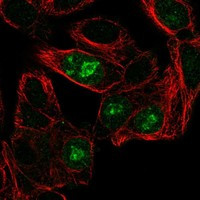
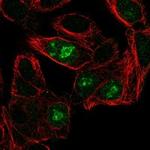
Please note: We are reviewing Western blot images included in the antibody testing data in our catalog, including those provided by third parties. Unless expressly labeled or annotated as “raw-unedited”, Western blot images included in the antibody testing data in our catalog may have been edited, optimized or otherwise adjusted for presentation.

产品信息
PA5-139827
产品规格
种属反应
Human
宿主/亚型
Rabbit
/ IgG
分类
Polyclonal
类型
Antibody
抗原
偶联物
Unconjugated
Unconjugated
Unconjugated
形式
Liquid
浓度
0.05 mg/mL
规格
5 µg
纯化类型
Antigen affinity chromatography
保存液
PBS, pH 7.2, with 40% glycerol
内含物
0.02% sodium azide
保存条件
Store at 4°C short term. For long term storage, store at -20°C, avoiding freeze/thaw cycles.
运输条件
Ambient (domestic); Wet ice (international)
RRID
产品详细信息
Gently mix before use. Optimal concentrations and conditions for each application should be determined by the user.
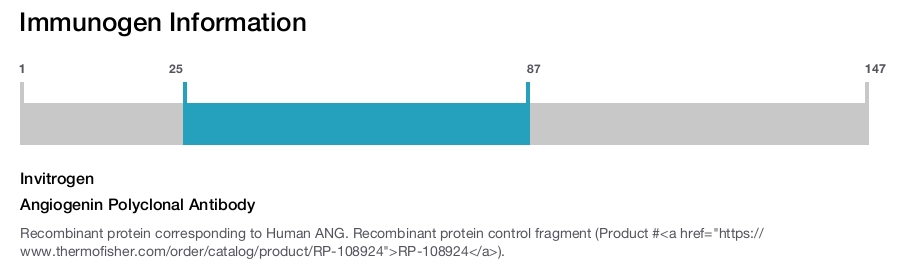
Immunogen sequence: QDNSRYTHFL TQHYDAKPQG RDDRYCESIM RRRGLTSPCK DINTFIHGNK RSIKAICENK NGN
Highest antigen sequence indentity to the following orthologs: Rat - 73%, Mouse - 73%.
靶标信息
Angiogenin (ANG or ANG I) is important for the process of neovascularization and formation of new blood vessels. ANG is similar to pancreatic ribonuclease A and functions as a tRNA-specific ribonuclease that abolishes protein synthesis by specifically hydrolyzing cellular tRNAs. It interacts with endothelial cell-surface actin and may cause changes in the cell cytoskeleton. ANG is thought to be involved in the development of solid tumors and its antagonists are capable of inhibiting tumor growth. Defects in ANG are the cause of susceptibility to amyotrophic lateral sclerosis type 9 (ALS9). Angiogenin is a genetic link between ALS and PD.
仅用于科研。不用于诊断过程。未经明确授权不得转售。
篇参考文献 (0)
您是否在文献中引用过该产品?请点击下方按钮邮件告知我们。
生物信息学
蛋白别名: angiogenin, ribonuclease, RNase A family, 5; epididymis luminal protein 168; Homo sapiens epididymis luminal protein 168; MGC22466; MGC71966; ribonuclease 5; ribonuclease A A1; ribonuclease A family member 5; RNase 5; RNASE4; unnamed protein product
基因别名: ALS9; HEL168; RAA1; RNASE4; RNASE5
UniProt ID: (Human) P03950
Entrez Gene ID: (Human) 283
nucleic acid binding
DNA binding
actin binding
endonuclease activity
endoribonuclease activity
ribonuclease activity
tRNA-specific ribonuclease activity
receptor binding
copper ion binding
protein binding
heparin binding
rRNA binding
peptide binding
protein homodimerization activity
ribosome binding
receptor agonist activity
angiogenesis
ovarian follicle development
oocyte maturation
response to hypoxia
response to yeast
placenta development
positive regulation of endothelial cell proliferation
cell communication
signal transduction
rRNA transcription
response to hormone
tRNA catabolic process
cell migration
antibacterial humoral response
antifungal humoral response
signaling
actin filament polymerization
negative regulation of translation in response to stress
stress granule assembly
positive regulation of phosphorylation
homeostatic process
negative regulation of apoptotic process
innate immune response
negative regulation of smooth muscle cell proliferation
positive regulation of protein secretion
defense response to Gram-positive bacterium
antimicrobial humoral immune response mediated by antimicrobial peptide
hematopoietic stem cell proliferation
Disclaimer

Clicking the images or links will redirect you to a website hosted by BenchSci that provides third-party scientific content. Neither the content nor the BenchSci technology and processes for selection have been evaluated by us; we are providing them as-is and without warranty of any kind, including for use or application of the Thermo Fisher Scientific products presented.

