Search
Invitrogen
Artemin Polyclonal Antibody, PeproTech®
{{$productOrderCtrl.translations['antibody.pdp.commerceCard.promotion.promotions']}}
{{$productOrderCtrl.translations['antibody.pdp.commerceCard.promotion.promocode']}}: {{promo.promoCode}} {{promo.promoTitle}} {{promo.promoDescription}}. {{$productOrderCtrl.translations['antibody.pdp.commerceCard.promotion.learnmore']}}
{{$ctrl.translations['antibody.pdp.skuNotes.additionalInformation']}}:
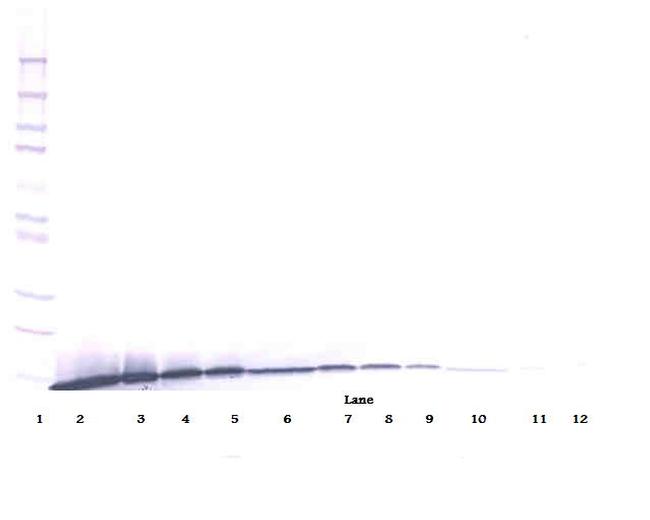
图: 1 / 3
Artemin Antibody (500-P245-1MG) in WB
Western Blot: To detect Human Artemin by Western Blot analysis Artemin Polyclonal Antibody (Product # 500-P245-1MG) can be used at a concentration of 0.1-0.2 µg/mL. Used in conjunction with compatible secondary reagents the detection limit for Recombinant Human Artemin is 1.5-3.0 ng/lane, under either reducing or non-reducing conditions.
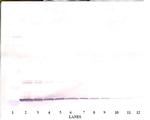
Please note: We are reviewing Western blot images included in the antibody testing data in our catalog, including those provided by third parties. Unless expressly labeled or annotated as “raw-unedited”, Western blot images included in the antibody testing data in our catalog may have been edited, optimized or otherwise adjusted for presentation.


产品信息
500-P245-1MG
产品规格
种属反应
Human
宿主/亚型
Rabbit
分类
Polyclonal
类型
Antibody
抗原
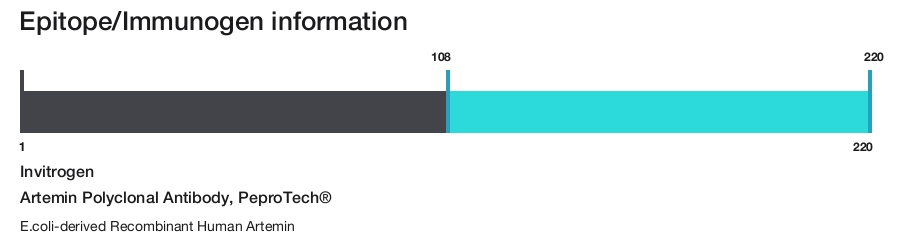
E.coli-derived Recombinant Human Artemin
偶联物
Unconjugated
Unconjugated
Unconjugated
形式
Lyophilized
浓度
0.1-1.0 mg/mL once reconstituted
规格
1 mg
纯化类型
Antigen affinity chromatography
保存液
PBS
内含物
no preservative
保存条件
-20°C
运输条件
Ambient
RRID
产品详细信息
AA Sequence of recombinant protein: AGGPGSRARA AGARGCRLRS QLVPVRALGL GHRSDELVRF RFCSGSCRRA RSPHDLSLAS LLGAGALRPP PGSRPVSQPC CRPTRYEAVS FMDVNSTWRT VDRLSATACG CLG.
Preparation: Produced from sera of rabbits immunized with highly pure Recombinant Human Artemin. Anti-Human Artemin-specific antibody was purified by affinity chromatography employing an immobilized Human Artemin matrix.
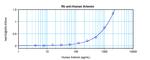
Sandwich ELISA: To detect Human Artemin by sandwich ELISA (using 100 µL/well antibody solution) a concentration of 0.5-2.0 µg/mL of this antibody is required. This antigen affinity purified antibody, in conjunction with PeproTech Biotinylated Anti-Human Artemin (500-P245Bt) as a detection antibody, allows the detection of at least 0.2-0.4 ng/well of Recombinant Human Artemin.
Western Blot: To detect Human Artemin by Western Blot analysis this antibody can be used at a concentration of 0.1-0.2 µg/mL. Used in conjunction with compatible secondary reagents the detection limit for Recombinant Human Artemin is 1.5-3.0 ng/lane, under either reducing or non-reducing conditions.
靶标信息
The protein encoded by this gene is a member of the glial cell line-derived neurotophic factor (GDNF) family of ligands which are a group of ligands within the TGF-beta superfamily of signaling molecules. GDNFs are unique in having neurotrophic properties and have potential use for gene therapy in neurodegenerative disease. Artemin has been shown in culture to support the survival of a number of peripheral neuron populations and at least one population of dopaminergic CNS neurons. Its role in the PNS and CNS is further substantiated by its expression pattern in the proximity of these neurons. This protein is a ligand for the RET receptor and uses GFR-alpha 3 as a coreceptor. Multiple transcript variants encoding different isoforms have been found for this gene.
仅用于科研。不用于诊断过程。未经明确授权不得转售。
篇参考文献 (0)
您是否在文献中引用过该产品?请点击下方按钮邮件告知我们。
生物信息学
蛋白别名: glial cell line-derived (GDNF) neurotrophic factor family member; glial cell line-derived neurotrophic factor ligand family member; neublastin
基因别名: ART; ENOVIN; EVN; NBN
UniProt ID: (Human) Q5T4W7
Entrez Gene ID: (Human) 9048
Disclaimer

Clicking the images or links will redirect you to a website hosted by BenchSci that provides third-party scientific content. Neither the content nor the BenchSci technology and processes for selection have been evaluated by us; we are providing them as-is and without warranty of any kind, including for use or application of the Thermo Fisher Scientific products presented.

