Search
Agrisera
AtpG/ATPsynthase subunit II b (chloroplastic) Polyclonal Antibody
{{$productOrderCtrl.translations['antibody.pdp.commerceCard.promotion.promotions']}}
{{$productOrderCtrl.translations['antibody.pdp.commerceCard.promotion.viewpromo']}}
{{$productOrderCtrl.translations['antibody.pdp.commerceCard.promotion.promocode']}}: {{promo.promoCode}} {{promo.promoTitle}} {{promo.promoDescription}}. {{$productOrderCtrl.translations['antibody.pdp.commerceCard.promotion.learnmore']}}
Additional Information:
{{banner.description}}
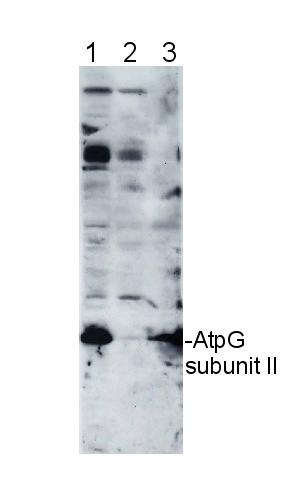
图: 1 / 1
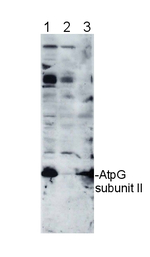
AtpG/ATPsynthase subunit II b (chloroplastic) Antibody (AS09-457) in WB
10 µg of chlorophyll/well of Chlamydomonas reinhardtii total cell extract (1), Chlamydomonas reinhardtii subunit II deletion mutant thylakoid membrane fraction (2), Arabidopsis thaliana thylakoid membrane fraction (3), were separated on 12-18% acrylamide-8 M urea gel and blotted to nitrocellulose membrane. Filters were blocked 1 h with 5% dry milk in 1 x PBS and probed with anti-ATP synthase subunit gamma a... View More

产品信息
AS09-457
产品规格
种属反应
Algae,
Plant
宿主/亚型
Rabbit
分类
Polyclonal
类型
Antibody
抗原
KLH-conjugated mix of synthetic peptide derived from Arabidopsis thaliana AtpG and Chlamydomonas reinhardtii ATP synthase subunit b.
偶联物
Unconjugated
Unconjugated
Unconjugated
形式
Lyophilized
保存液
whole serum
内含物
no preservative
保存条件
-20°C, Avoid Freeze/Thaw Cycles
运输条件
Ambient (domestic); Wet ice (international)
产品详细信息
Store lyophilized/reconstituted at -20°C; once reconstituted make aliquots to avoid repeated freeze-thaw cycles. Please remember to spin the tubes briefly prior to opening them to avoid any losses that might occur from material adhering to the cap or sides of the tube.
For reconstitution add 100 µL of sterile water.
Specific Species Reactivity: Arabidopsis thaliana, Chlamydomonas reinhardtii
靶标信息
This gene encodes a subunit of mitochondrial ATP synthase. Mitochondrial ATP synthase catalyzes ATP synthesis, utilizing an electrochemical gradient of protons across the inner membrane during oxidative phosphorylation. ATP synthase is composed of two linked multi-subunit complexes: the soluble catalytic core, F1, and the membrane-spanning component, Fo, comprising the proton channel. The catalytic portion of mitochondrial ATP synthase consists of 5 different subunits (alpha, beta, gamma, delta, and epsilon) assembled with a stoichiometry of 3 alpha, 3 beta, and a single representative of the other 3. The proton channel consists of three main subunits (a, b, c). This gene encodes the gamma subunit of the catalytic core. Alternatively spliced transcript variants encoding different isoforms have been identified. This gene also has a pseudogene on chromosome 14.
仅用于科研。不用于诊断过程。未经明确授权不得转售。
篇参考文献 (0)
您是否在文献中引用过该产品?请点击下方按钮邮件告知我们。
生物信息学
蛋白别名: ATP5C; ATP5C1; ATP5CL1; ATP5F1C; ATPC1; atpC2; T19J18.4; T19J18_4; wu:fk34c05; zgc:73209
Disclaimer

Clicking the images or links will redirect you to a website hosted by BenchSci that provides third-party scientific content. Neither the content nor the BenchSci technology and processes for selection have been evaluated by us; we are providing them as-is and without warranty of any kind, including for use or application of the Thermo Fisher Scientific products presented.

