Search
Invitrogen
BBS12 Polyclonal Antibody
{{$productOrderCtrl.translations['antibody.pdp.commerceCard.promotion.promotions']}}
{{$productOrderCtrl.translations['antibody.pdp.commerceCard.promotion.promocode']}}: {{promo.promoCode}} {{promo.promoTitle}} {{promo.promoDescription}}. {{$productOrderCtrl.translations['antibody.pdp.commerceCard.promotion.learnmore']}}
{{$ctrl.translations['antibody.pdp.skuNotes.additionalInformation']}}:
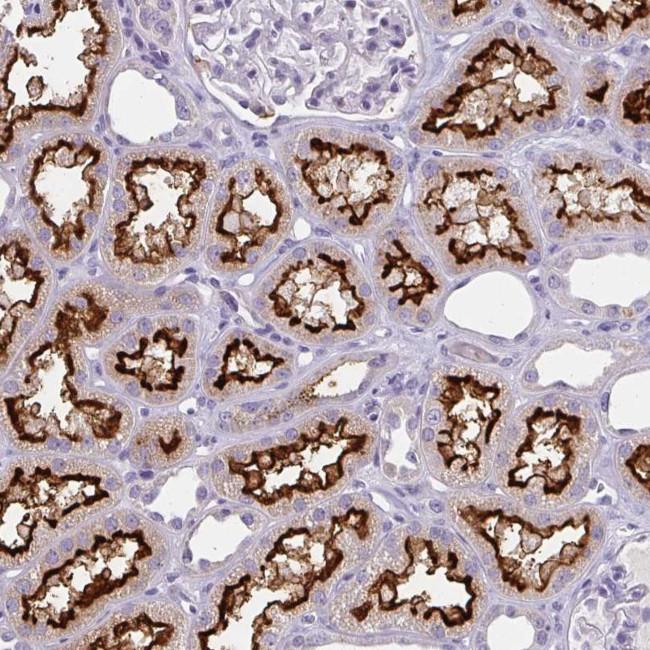
Please note: We are reviewing Western blot images included in the antibody testing data in our catalog, including those provided by third parties. Unless expressly labeled or annotated as “raw-unedited”, Western blot images included in the antibody testing data in our catalog may have been edited, optimized or otherwise adjusted for presentation.

产品信息
PA5-63989
产品规格
种属反应
Human
宿主/亚型
Rabbit
/ IgG
分类
Polyclonal
类型
Antibody
抗原
偶联物
Unconjugated
Unconjugated
Unconjugated
形式
Liquid
浓度
0.05 mg/mL
规格
5 µg
纯化类型
Antigen affinity chromatography
保存液
PBS, pH 7.2, with 40% glycerol
内含物
0.02% sodium azide
保存条件
Store at 4°C short term. For long term storage, store at -20°C, avoiding freeze/thaw cycles.
运输条件
Ambient (domestic); Wet ice (international)
RRID
产品详细信息
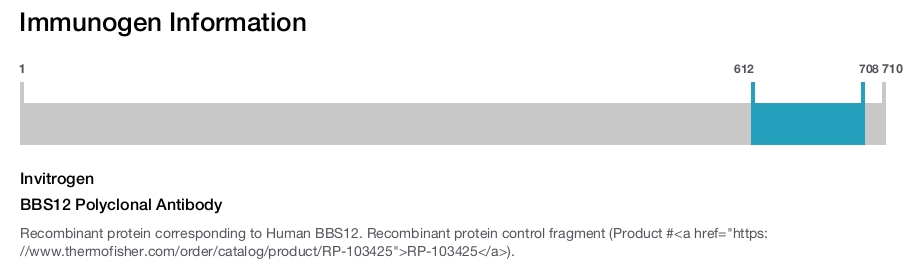
Immunogen sequence: EFEASTYIQH HLQNATDSGS PSSYILNEYS KLNSRIFNSD ISNKLEQIPR VYDVVTPKIE AWRRALDLVL LVLQTDSEII TGHGHTQINS QELTGFL
Highest antigen sequence identity to the following orthologs: Mouse - 74%, Rat - 78%.
靶标信息
The BBS12 gene is a key contributor to Bardet-Biedl Syndrome (BBS), a rare genetic disorder characterized by primary cilia dysfunction, leading to diverse clinical manifestations such as retinal degeneration, obesity, polydactyly, renal abnormalities, and learning difficulties. BBS12 is located on chromosome 4q27 and encodes a vertebrate-specific chaperonin-like protein. Together with BBS6 and BBS10, BBS12 forms a part of a complex associated with the CCT/TRiC family of chaperonins, which are essential for the proper assembly of the BBSome complex. This complex plays a critical role in the trafficking of vesicles to cilia and is crucial for ciliary function and structure. Mutations in BBS12 are responsible for approximately 5% of BBS cases, underscoring its significant role in the pathophysiology of the syndrome. These mutations often lead to disruptions in ciliary functions, which are pivotal for the syndrome's manifestation.
仅用于科研。不用于诊断过程。未经明确授权不得转售。
篇参考文献 (0)
您是否在文献中引用过该产品?请点击下方按钮邮件告知我们。
生物信息学
蛋白别名: unnamed protein product
基因别名: C4orf24
UniProt ID: (Human) Q6ZW61
Entrez Gene ID: (Human) 166379
Disclaimer

Clicking the images or links will redirect you to a website hosted by BenchSci that provides third-party scientific content. Neither the content nor the BenchSci technology and processes for selection have been evaluated by us; we are providing them as-is and without warranty of any kind, including for use or application of the Thermo Fisher Scientific products presented.

