Search
Invitrogen
Bi-1 Monoclonal Antibody (20F430)
{{$productOrderCtrl.translations['antibody.pdp.commerceCard.promotion.promotions']}}
{{$productOrderCtrl.translations['antibody.pdp.commerceCard.promotion.promocode']}}: {{promo.promoCode}} {{promo.promoTitle}} {{promo.promoDescription}}. {{$productOrderCtrl.translations['antibody.pdp.commerceCard.promotion.learnmore']}}
{{$ctrl.translations['antibody.pdp.skuNotes.additionalInformation']}}:
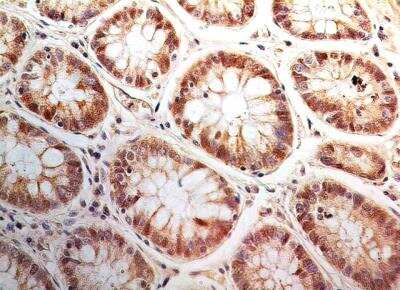
图: 1 / 6
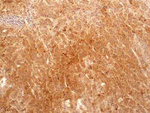
Bi-1 Antibody (MA1-41108) in IHC (P)
Immunohistochemistry analysis of Bi-1 in formalin-fixed, paraffin-embedded human adenocarcinoma of the rectum. Samples were incubated with Bi-1 monoclonal antibody (Product # MA1-41108) using a dilution of 5 µg/mL. Peroxidase-conjugate and DAB chromogen. Staining of formalin-fixed tissues is enhanced by boiling tissue sections in 10 mM sodium citrate buffer, pH 6.0 for 10-20 min followed by cooling at RT fo... View More
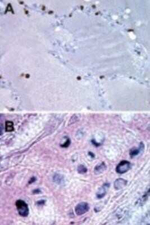
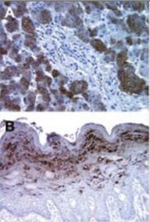
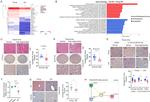
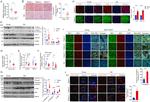
Please note: We are reviewing Western blot images included in the antibody testing data in our catalog, including those provided by third parties. Unless expressly labeled or annotated as “raw-unedited”, Western blot images included in the antibody testing data in our catalog may have been edited, optimized or otherwise adjusted for presentation.


产品信息
MA1-41108
产品规格
种属反应
Human,
Mouse,
Rat
已发表种属
Human,
Mouse
宿主/亚型
Mouse
/ IgG2b, kappa
分类
Monoclonal
类型
Antibody
克隆号
20F430
抗原
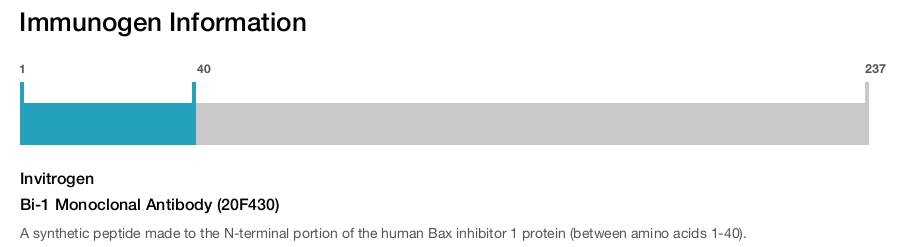
A synthetic peptide made to the N-terminal portion of the human Bax inhibitor 1 protein (between amino acids 1-40).
偶联物
Unconjugated
Unconjugated
Unconjugated
形式
Liquid
浓度
1.0 mg/mL
规格
100 µg
纯化类型
Protein G
保存液
PBS with 0.2% gelatin
内含物
0.05% sodium azide
保存条件
Store at 4°C short term. For long term storage, store at -20°C, avoiding freeze/thaw cycles.
运输条件
Ambient (domestic); Wet ice (international)
RRID
产品详细信息
Epitope mapping indicates that the antibody recognizes an epitope in the N-terminal region of Bi-1.
靶标信息
BI-1 (Bax Inhibitor 1) is in anti-apoptotic protein that has been linked to protection from apoptosis induced endoplasmic reticulum (ER) stress (reviewed in Bailley-Maitre et al, 2007). BI-1 contains several transmembrane domains, localizes to ER membranes, and has cytoprotective functions that are conserved in both animals and plants. BI-1 suppresses apoptosis induced by ectopic expression of the proapoptotic protein Bax as well as other types of stimuli. Cells from BI-1 knockout (KO) mice are hypersensitivite to apoptosis induced by ER stress-causing chemical agents (thapsigargin, tunicamycin, and brefeldin A) or by ischemia-reperfusion (IR) injury. Conversely, overexpression of BI-1 protects against apoptosis induced by ER stress and IR. The mechanism by which BI-1 protects cells from ER-stress induced apoptosis remains to be fully elucidated, itis thought to involve regulation of Ca2+ handling by the ER.
仅用于科研。不用于诊断过程。未经明确授权不得转售。
生物信息学
蛋白别名: Bax inhibitor-1; BI-1; liver regeneration-related protein LRRG018; liver regeneration-related protein LRRG163; TEGT; testis enhanced gene transcript; testis-enhanced gene transcript protein; testis-enhanced gene transcript protein; integral membrane protein; transmembrane BAX inhibitor motif-containing protein 6; unnamed protein product
基因别名: 5031406P05Rik; Ab1-011; Ac1-149; BAXI1; BI-1; Bi1; Cc1-27; TEGT
UniProt ID: (Human) P55061, (Mouse) Q9D2C7, (Rat) P55062
Entrez Gene ID: (Human) 7009, (Mouse) 110213, (Rat) 24822
negative regulation of transcription from RNA polymerase II promoter
negative regulation of immunoglobulin production
negative regulation of calcium ion transport into cytosol
endoplasmic reticulum calcium ion homeostasis
negative regulation of RNA splicing
cellular response to unfolded protein
response to endoplasmic reticulum stress
IRE1-mediated unfolded protein response
negative regulation of apoptotic process
intrinsic apoptotic signaling pathway in response to endoplasmic reticulum stress
calcium ion transmembrane transport
response to L-glutamate
negative regulation of endoplasmic reticulum stress-induced intrinsic apoptotic signaling pathway
negative regulation of hypoxia-induced intrinsic apoptotic signaling pathway
negative regulation of IRE1-mediated unfolded protein response
negative regulation of apoptotic signaling pathway
spermatogenesis
lung development
Disclaimer

Clicking the images or links will redirect you to a website hosted by BenchSci that provides third-party scientific content. Neither the content nor the BenchSci technology and processes for selection have been evaluated by us; we are providing them as-is and without warranty of any kind, including for use or application of the Thermo Fisher Scientific products presented.

