Search
Invitrogen
C. tetani TeNT Light Chain Monoclonal Antibody (604023)
{{$productOrderCtrl.translations['antibody.pdp.commerceCard.promotion.promotions']}}
{{$productOrderCtrl.translations['antibody.pdp.commerceCard.promotion.promocode']}}: {{promo.promoCode}} {{promo.promoTitle}} {{promo.promoDescription}}. {{$productOrderCtrl.translations['antibody.pdp.commerceCard.promotion.learnmore']}}
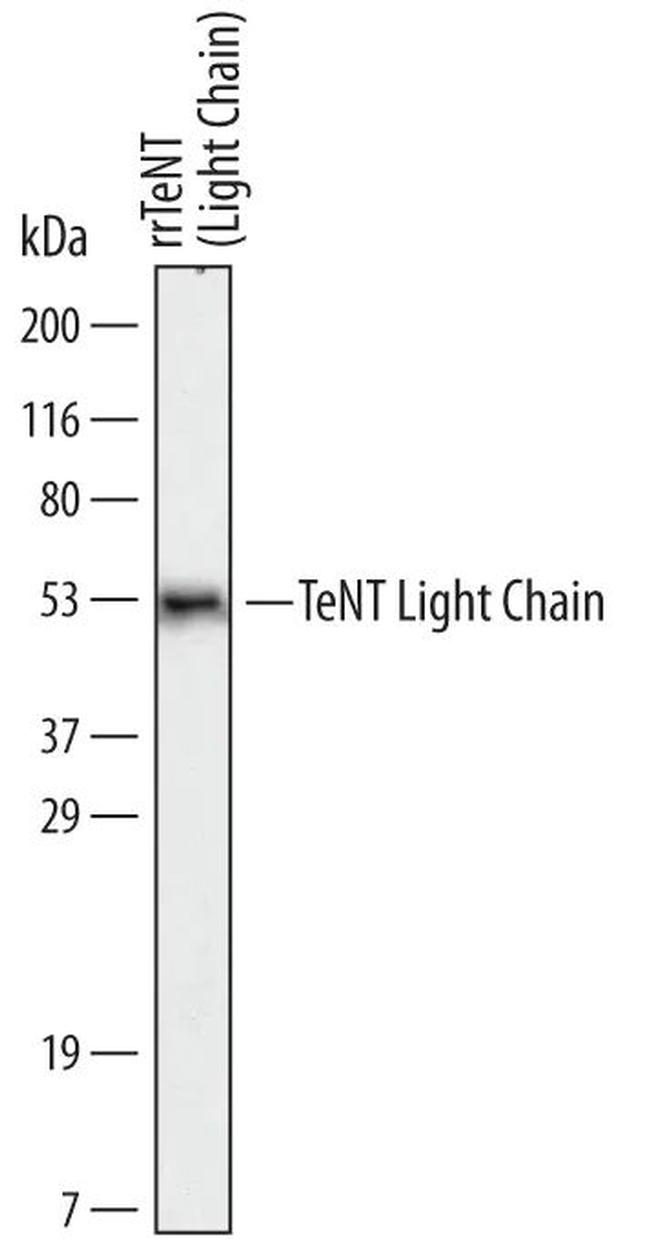
图: 1 / 1
C. tetani TeNT Light Chain Antibody (MA5-24273) in WB
Western blot analysis of C. tetani TeNT Light Chain in recombinant C. tetani TeNT Light Chain. Samples were incubated in C. tetani TeNT Light Chain monoclonal antibody (Product # MA5-24273) using a dilution of 2 µg/mL followed by a HRP-conjugated Anti-Mouse IgG secondary antibody. A specific band was detected for TeNT Light Chain at approximately 53 kDa (as indicated). This experiment was conducted under re... View More
Please note: We are reviewing Western blot images included in the antibody testing data in our catalog, including those provided by third parties. Unless expressly labeled or annotated as “raw-unedited”, Western blot images included in the antibody testing data in our catalog may have been edited, optimized or otherwise adjusted for presentation.

产品信息
MA5-24273
应用
建议稀释比
已发表文章
产品规格
种属反应
Bacteria
已发表种属
Bacteria
宿主/亚型
Mouse
/ IgG1
分类
Monoclonal
类型
Antibody
克隆号
604023
抗原
E. coli-derived recombinant C. tetani TeNT Light Chain Pro2-Gly430
偶联物
Unconjugated
Unconjugated
Unconjugated
形式
Lyophilized
浓度
0.5 mg/mL
规格
100 µg
纯化类型
Protein A/G
保存液
PBS with 5% trehalose
内含物
No Preservative
保存条件
-20°C, Avoid Freeze/Thaw Cycles
运输条件
Ambient (domestic); Wet ice (international)
RRID
产品详细信息
In direct ELISAs and Western blots, no cross-reactivity with recombinant TeNT Heavy Chain is observed.
Reconstitute in sterile PBS to a final concentration of 0.5 mg/mL.
靶标信息
Tetanus toxin, a member of the peptidase M27 family of proteins, is produced by the anaerobic spore-forming bacteria Clostridium tetani as a single-chain polypeptide that is 1315 amino acids (aa) in length. The protein is subsequently cleaved by an endogenous protease to yield the 52 kDa tetanus toxin light chain (TeNT-LC), which is 457 aa in length, and the 98 kDa tetanus toxin heavy chain that is 858 aa long. The light and heavy chains are linked by a disulfide bridge and are non-toxic after separation. Tetanus toxin acts by inhibiting neurotransmitter release. It binds to peripheral neural synapses, is internalized and moves by retrograde transport up the axon into the spinal cord where it can move between postsynaptic and presynaptic neurons. It inhibits neurotransmitter release by acting as a zinc endopeptidase that catalyzes the hydrolysis of the '76-Gln- -Phe-77' bond of synaptobrevin-2.
仅用于科研。不用于诊断过程。未经明确授权不得转售。
生物信息学
蛋白别名: TeNT-LC; Tentoxylysin; tetX
Disclaimer

Clicking the images or links will redirect you to a website hosted by BenchSci that provides third-party scientific content. Neither the content nor the BenchSci technology and processes for selection have been evaluated by us; we are providing them as-is and without warranty of any kind, including for use or application of the Thermo Fisher Scientific products presented.

