Search
Abnova
CCBL1 Monoclonal Antibody (1B12)
{{$productOrderCtrl.translations['antibody.pdp.commerceCard.promotion.promotions']}}
{{$productOrderCtrl.translations['antibody.pdp.commerceCard.promotion.viewpromo']}}
{{$productOrderCtrl.translations['antibody.pdp.commerceCard.promotion.promocode']}}: {{promo.promoCode}} {{promo.promoTitle}} {{promo.promoDescription}}. {{$productOrderCtrl.translations['antibody.pdp.commerceCard.promotion.learnmore']}}
Additional Information:
{{banner.description}}



产品信息
H00000883-M02
产品规格
宿主/亚型
Mouse
/ IgG2a, kappa
分类
Monoclonal
类型
Antibody
克隆号
1B12
抗原
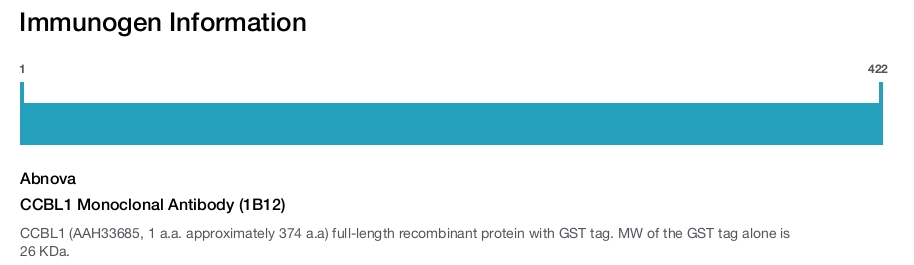
CCBL1 (AAH33685, 1 a.a. approximately 374 a.a) full-length recombinant protein with GST tag. MW of the GST tag alone is 26 KDa.
偶联物
Unconjugated
Unconjugated
Unconjugated
形式
Liquid
浓度
See Label
规格
100 µg
保存条件
-20°C, Avoid Freeze/Thaw Cycles
运输条件
Ambient (domestic); Wet ice (international)
产品详细信息
Sequence of this protein is as follows: MAKQLQARRL DGIDYNPWVE FVKLASEHDV VNLGQGFPDF PPPDFAVEAF QHAVSGDFML NQYTKTFVII IEPFFDCYEP MTMMAGGRPV FVSLKPGPIQ NGELGSSSNW QLDPMELAGK FTSRTKALVL NTPNNPLGKV FSREELELVA SLCQQHDVVC ITDEVYQWMV YDGHQHISIA SLPGMWERTL TIGSAGKTFS ATGWKVGWVL GPDHIMKHLR TVHQNSVFHC PTQSQAAVAE SFEREQLLFR QPSSYFVQFP QAMQRCRDHM IRSLQSVGLK PIIPQGSYFL ITDISDFKRK MPDLPGAVDE PYDRRFVKWM IKNKGLVAIP VSIFYSVPHQ KHFDHYIRFC FVKDEATLQA MDEKLRKWKV ELWP
靶标信息
Kynurenine aminotransferases KAT I, KAT II, and KAT III belong to the class-I pyridoxal-phosphate-dependent aminotransferase family. KAT I is a cytoplasmic protein involved in glutamine catabolism. KAT I functions in the catalysis of the transamination of L-kinurenine to form kynurenic acid, a neuroprotective and anticonvulsant metabolite of tryptophan. Kynurenic acid is involved in synaptic transmission and has been implicated in a number of neurological disorders including schizophrenia and Huntington's disease. KAT I also functions in the metabolism of cysteine conjugates in some halogenated alkenes and alkanes to form reactive metabolites. KAT I has three isoforms. Isoform 1is the full length protein, isoform 2 lacks amino acids 68-117 and isoform 3 lacks amino acids 251-422. Based on sequence similarity, KAT I is thought to function as a homodimer.
仅用于科研。不用于诊断过程。未经明确授权不得转售。
篇参考文献 (0)
您是否在文献中引用过该产品?请点击下方按钮邮件告知我们。
Disclaimer

Clicking the images or links will redirect you to a website hosted by BenchSci that provides third-party scientific content. Neither the content nor the BenchSci technology and processes for selection have been evaluated by us; we are providing them as-is and without warranty of any kind, including for use or application of the Thermo Fisher Scientific products presented.

