Search
Invitrogen
CD10 Recombinant Rabbit Monoclonal Antibody (RM337)
{{$productOrderCtrl.translations['antibody.pdp.commerceCard.promotion.promotions']}}
{{$productOrderCtrl.translations['antibody.pdp.commerceCard.promotion.promocode']}}: {{promo.promoCode}} {{promo.promoTitle}} {{promo.promoDescription}}. {{$productOrderCtrl.translations['antibody.pdp.commerceCard.promotion.learnmore']}}
{{$ctrl.translations['antibody.pdp.skuNotes.additionalInformation']}}:
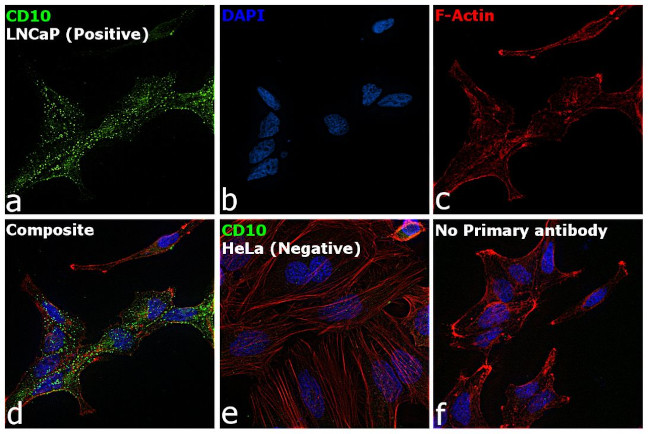
图: 1 / 9
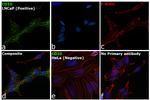
CD10 Antibody (MA5-27893) in ICC/IF
Immunofluorescence analysis of CD10 was performed using LNCaP and HeLa cells. The cells were fixed with 4% paraformaldehyde for 10 minutes, permeabilized with 0.1% Triton™ X-100 for 15 minutes, and blocked with 2% BSA for 1 hour at room temperature. The cells were labeled with CD10 Rabbit Monoclonal Antibody (Product # MA5-27893) at 1:100 dilution in 0.1% BSA and incubated overnight at 4 degree and then labeled with Goat anti-Rabbit IgG (H+L) Highly Cross-Adsorbed Secondary Antibody, Alexa Fluor Plus 488 (Product # A32731) at a dilution of... View More
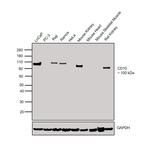
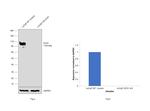
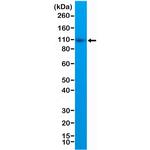
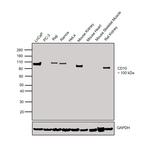
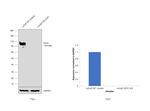
Please note: We are reviewing Western blot images included in the antibody testing data in our catalog, including those provided by third parties. Unless expressly labeled or annotated as “raw-unedited”, Western blot images included in the antibody testing data in our catalog may have been edited, optimized or otherwise adjusted for presentation.


产品信息
MA5-27893
产品规格
种属反应
Human,
Mouse,
Rat
宿主/亚型
Rabbit
/ IgG
Expression System
HEK293 cells
分类
Recombinant Monoclonal
类型
Antibody
克隆号
RM337
抗原
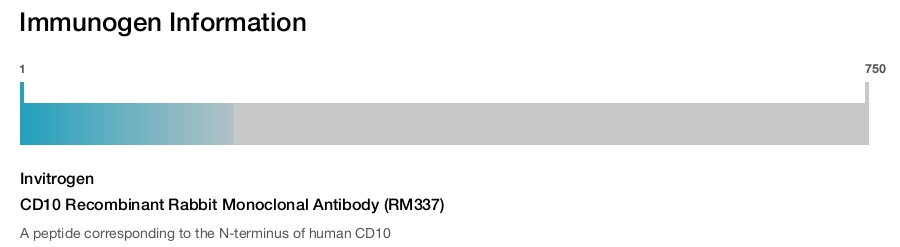
A peptide corresponding to the N-terminus of human CD10
偶联物
Unconjugated
Unconjugated
Unconjugated
形式
Liquid
浓度
0.1 mg/mL
规格
10 µg
纯化类型
Protein A
保存液
PBS with 1% BSA, 50% glycerol
内含物
0.09% sodium azide
保存条件
-20°C
运输条件
Ambient (domestic); Wet ice (international)
RRID
产品详细信息
Recombinant rabbit monoclonal antibodies are produced using in vitro expression systems. The expression systems are developed by cloning in the specific antibody DNA sequences from immunoreactive rabbits. Then, individual clones are screened to select the best candidates for production. The advantages of using recombinant rabbit monoclonal antibodies include: better specificity and sensitivity, lot-to-lot consistency, animal origin-free formulations, and broader immunoreactivity to diverse targets due to larger rabbit immune repertoire.
靶标信息
CD10, also known as the Common Acute Lymphocytic Leukemia Antigen (CALLA) and neutral endopeptidase (NEP), is a Zn2+-dependent metallo-peptidase with neutral metalloendopeptidase activity. It is a 100 kDa type II transmembrane glycoprotein encoded by a gene that exists in a single copy of greater than 45 kb. The 5' untranslated region of the CD10 gene is alternatively spliced, resulting in four separate mRNA transcripts, although the coding region remains unaffected by alternative splicing. CD10 is involved in the regulation of chemotactic and inflammatory processes involving neutrophils and plays a role in stromal cell-dependent B lymphopoiesis. It is expressed on immature B cells in adult bone marrow, mature B cells in germinal centers, and cells from patients with chronic myelocytic leukemia (CML). Additionally, CD10 is present on the cells of lymphoblastic, Burkitt's, and follicular germinal center lymphomas. Beyond the hematopoietic compartment, CD10 is highly expressed on the brush border of enterocytes and renal tubules and glomeruli, as well as on breast myoepithelial cells, bile canaliculi, and fibroblasts. CD10 cleaves peptides at the amino side of hydrophobic residues, inactivating several biologically active peptides, including endothelin, glucagon, gastrin, neurotensin, bradykinin, enkephalins, substance P, oxytocin, and others. Diseases associated with CD10 dysfunction include spinocerebellar ataxia 43 and Charcot-Marie Tooth Disease, highlighting its significance in both normal physiological processes and disease states.
仅用于科研。不用于诊断过程。未经明确授权不得转售。
篇参考文献 (0)
您是否在文献中引用过该产品?请点击下方按钮邮件告知我们。
生物信息学
蛋白别名: atriopeptidase; common acute lymphoblastic leukemia antigen; common acute lymphoblastic leukemia antigen precursor; common acute lymphocytic leukemia antigen; enkephalinase; enkephalinase precursor (EC 3.4.24.11); membrane metallo-endopeptidase (neutral endopeptidase, enkephalinase, CALLA, CD10); membrane metallo-endopeptidase (neutral endopeptidase/enkephalinase); NEP-390; NEP-411; neprilysin-390; neprilysin-411; neutral endopeptidase 24.11; skin fibroblast elastase; unnamed protein product
基因别名: 6030454K05Rik; CALLA; CD10; CMT2T; NEP; SCA43; SFE
UniProt ID: (Human) P08473, (Rat) P07861, (Mouse) Q61391
Entrez Gene ID: (Human) 4311, (Rat) 24590, (Mouse) 17380
phosphatidylserine binding
endopeptidase activity
metallocarboxypeptidase activity
metalloendopeptidase activity
protein binding
peptidase activity
metallopeptidase activity
exopeptidase activity
zinc ion binding
peptide binding
protein homodimerization activity
oligopeptidase activity
cardiolipin binding
kidney development
placenta development
angiotensin maturation
proteolysis
peptide metabolic process
learning or memory
substance P catabolic process
bradykinin catabolic process
protein processing
sensory perception of pain
protein catabolic process
lung development
hormone catabolic process
response to estrogen
creatinine metabolic process
beta-amyloid metabolic process
positive regulation of neurogenesis
neuropeptide processing
cellular response to cytokine stimulus
cellular response to UV-A
cellular response to UV-B
replicative senescence
beta-amyloid clearance
amyloid-beta clearance by cellular catabolic process
positive regulation of long-term synaptic potentiation
memory
amygdala development
hippocampus development
multicellular organism growth
Disclaimer

Clicking the images or links will redirect you to a website hosted by BenchSci that provides third-party scientific content. Neither the content nor the BenchSci technology and processes for selection have been evaluated by us; we are providing them as-is and without warranty of any kind, including for use or application of the Thermo Fisher Scientific products presented.

