Search
Invitrogen
CD134 (OX40) Monoclonal Antibody (ACT35 (ACT-35)), eBioscience™
{{$productOrderCtrl.translations['antibody.pdp.commerceCard.promotion.promotions']}}
{{$productOrderCtrl.translations['antibody.pdp.commerceCard.promotion.promocode']}}: {{promo.promoCode}} {{promo.promoTitle}} {{promo.promoDescription}}. {{$productOrderCtrl.translations['antibody.pdp.commerceCard.promotion.learnmore']}}
{{$ctrl.translations['antibody.pdp.skuNotes.additionalInformation']}}:
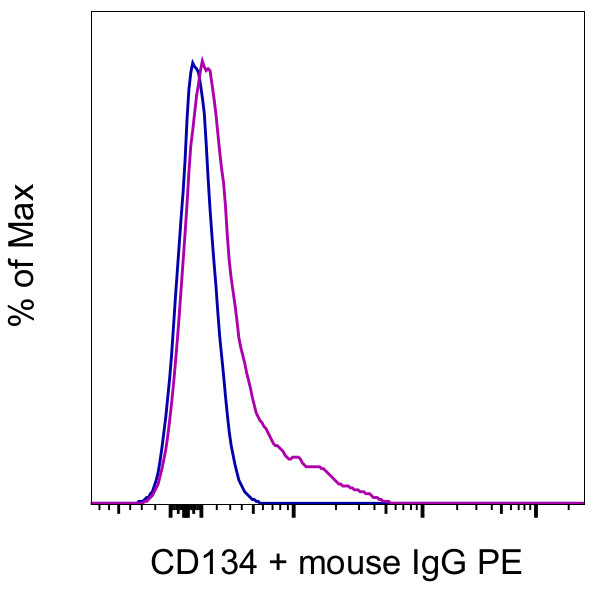
图: 1 / 3
CD134 (OX40) Antibody (14-1347-82) in Flow
Staining of 2-day PHA-L (Product # 00-4977-93)-stimulated normal human peripheral blood cells with 0.125 µg of Mouse IgG1 kappa Isotype Control (Product # 14-4714-85) (blue histogram) or 0.125 µg of CD134 (OX40) Monoclonal Antibody (purple histogram) followed by IgG Polyclonal Antibody, PE (Product # 12-4010-87). Total viable cells were used for analysis, as determined by 7-AAD (Product # 00-6993-50).
Please note: We are reviewing Western blot images included in the antibody testing data in our catalog, including those provided by third parties. Unless expressly labeled or annotated as “raw-unedited”, Western blot images included in the antibody testing data in our catalog may have been edited, optimized or otherwise adjusted for presentation.


产品信息
14-1347-82
应用
建议稀释比
已发表文章
产品规格
种属反应
Human
已发表种属
Human
宿主/亚型
Mouse
/ IgG1, kappa
分类
Monoclonal
类型
Antibody
克隆号
ACT35 (ACT-35)
偶联物
Unconjugated
Unconjugated
Unconjugated
形式
Liquid
浓度
0.5 mg/mL
规格
100 µg
纯化类型
Affinity chromatography
保存液
PBS, pH 7.2
内含物
0.09% sodium azide
保存条件
4°C
运输条件
Ambient (domestic); Wet ice (international)
RRID
产品详细信息
Description: The ACT35 monoclonal antibody reacts with human CD134, also known as OX-40. A member of the TNF receptor superfamily, CD134/OX-40 is a 50 kDa type I membrane glycoprotein expressed by activated T lymphocytes. The interaction of CD134 with OX-40L has been implicated in T cell-dependent humoral response, regulation of primary T cell expansion, survival of T cells, size of the memory T cell pool and regulation of tolerance in the CD4^+ T cell compartment.
Applications Reported: This ACT35 (ACT-35) antibody has been reported for use in flow cytometric analysis, immunohistology staining of frozen tissue sections, and immunohistology staining of paraffin embedded tissue sections.
Applications Tested: The ACT35 (ACT-35) antibody has been tested by flow cytometric analysis of 3-day PHA activated human normal human peripheral blood cells. This can be used at less than or equal to 1 µg per test. A test is defined as the amount (µg) of antibody that will stain a cell sample in a final volume of 100 µL. Cell number should be determined empirically but can range from 10^5 to 10^8 cells/test. It is recommended that the antibody be carefully titrated for optimal performance in the assay of interest.
Purity: Greater than 90%, as determined by SDS-PAGE.
Aggregation: Less than 10%, as determined by HPLC.
Filtration: 0.2 µm post-manufacturing filtered.
靶标信息
OX40 is a protein receptor found on the surface of T cells, a type of white blood cell that plays a crucial role in the immune system. When activated, OX40 promotes the proliferation and survival of T cells, leading to a stronger immune response against cancer cells and infectious agents. OX40 agonists, which are drugs that activate OX40, have shown promising results in preclinical and clinical studies as a potential immunotherapy for cancer. They can enhance the efficacy of other cancer treatments such as chemotherapy and checkpoint inhibitors, and may also have applications in autoimmune diseases and allergies.
仅用于科研。不用于诊断过程。未经明确授权不得转售。
生物信息学
蛋白别名: ACT35 antigen; ATC35 antigen; CD134 antigen; cell surface antigen; lymphoid activation antigene ACT35; OX40 antigen; OX40 cell surface antigen; OX40 homologue; OX40L receptor; TAX transcriptionally-activated glycoprotein 1 receptor; tax-transcriptionally activated glycoprotein 1 receptor
基因别名: ACT35; CD134; IMD16; OX40; TXGP1L
UniProt ID: (Human) P43489
Entrez Gene ID: (Human) 7293
Disclaimer

Clicking the images or links will redirect you to a website hosted by BenchSci that provides third-party scientific content. Neither the content nor the BenchSci technology and processes for selection have been evaluated by us; we are providing them as-is and without warranty of any kind, including for use or application of the Thermo Fisher Scientific products presented.

