Search
Invitrogen
CD19/CD47 (Zeripatamig Biosimilar) Recombinant Human Monoclonal Antibody
{{$productOrderCtrl.translations['antibody.pdp.commerceCard.promotion.promotions']}}
{{$productOrderCtrl.translations['antibody.pdp.commerceCard.promotion.promocode']}}: {{promo.promoCode}} {{promo.promoTitle}} {{promo.promoDescription}}. {{$productOrderCtrl.translations['antibody.pdp.commerceCard.promotion.learnmore']}}
{{$ctrl.translations['antibody.pdp.skuNotes.additionalInformation']}}:
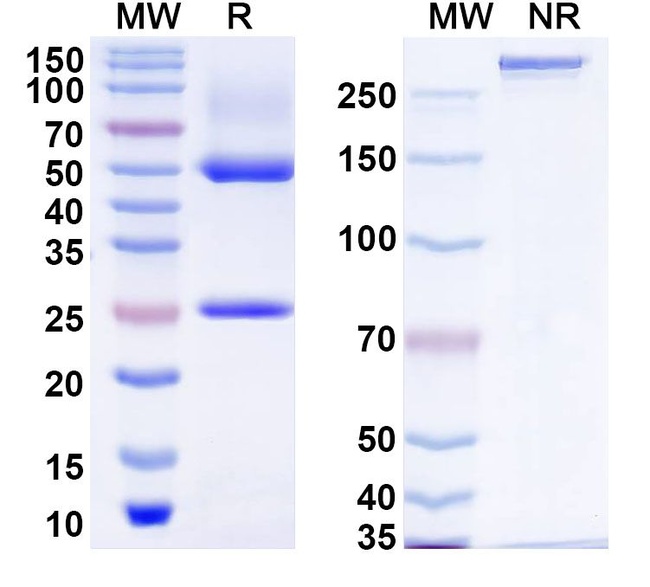
图: 1 / 1
CD19/CD47 (Zeripatamig Biosimilar) Antibody (MA562504) in SDS-PAGE
SDS-PAGE analysis of CD19/CD47 (Zeripatamig Biosimilar). Samples were run under reducing (R) and non-reducing (NR) conditions using CD19/CD47 (Zeripatamig Biosimilar) (Product # MA562504) monoclonal antibody. The purity of the protein is greater than 95%.
Please note: We are reviewing Western blot images included in the antibody testing data in our catalog, including those provided by third parties. Unless expressly labeled or annotated as “raw-unedited”, Western blot images included in the antibody testing data in our catalog may have been edited, optimized or otherwise adjusted for presentation.

产品信息
MA562504
应用
建议稀释比
已发表文章
产品规格
种属反应
Human
宿主/亚型
Human
/ IgG1, kappa/IgG1, lambda
Expression System
CHO cells
分类
Recombinant Monoclonal
类型
Antibody
偶联物
Unconjugated
Unconjugated
Unconjugated
形式
Liquid
浓度
1 mg/mL
规格
100 µg
纯化类型
Protein A/G
保存液
PBS, pH 7.4
内含物
no preservative
保存条件
Store at 4°C short term. For long term storage, store at -20°C, avoiding freeze/thaw cycles.
运输条件
Ambient (domestic); Wet ice (international)
RRID
靶标信息
CD19 is an immunoglobulin superfamily protein with two Ig-like domains. It is expressed on B cells at all stages of development except terminal plasma cells, and is also found on follicular dendritic cells and some myeloid leukemia cells. As the earliest and most broadly expressed B cell marker, CD19 is present in all B cell precursor leukemias. CD19 forms a signaling complex with CD21, CD81, Leu13, MHC class II, and the B cell receptor (BCR). It functions as a key BCR co-receptor, amplifying signals and lowering the activation threshold, allowing B cells to respond even to low-affinity antigens. CD19 signaling triggers tyrosine phosphorylation, calcium mobilization, and B cell proliferation. It can also act independently as a central signaling regulator integrating multiple pathways. CD19 is essential for normal immune responses and malignant B cell growth. Mutations can cause hypogammaglobulinemia (low antibody levels), while overexpression may lead to B cell hyperactivity. It is expressed on virtually all peripheral B cells.
CD47, also known as integrin-associated protein (IAP), is a widely expressed glycosylated transmembrane protein found on hematopoietic cells (T cells, B cells, monocytes, platelets, erythrocytes) and many non-hematopoietic cells. It interacts with integrins and serves as a receptor for thrombospondin, influencing cell signaling, migration, and synaptic activity. CD47 binds to SIRPα (CD172a) on macrophages, delivering a “don’t eat me” signal that inhibits phagocytosis of CD47-positive cells. CD47 also regulates B cell adhesion, T cell activation, neuronal development, and responses to mechanical stress in cartilage. In T cells, thrombospondin binding can promote activation or apoptosis. Antibody engagement of CD47 can induce suppressive T cell activity and increase Foxp3 expression. Its broad distribution and signaling roles highlight its importance in immune regulation and other physiological processes.
仅用于科研。不用于诊断过程。未经明确授权不得转售。
篇参考文献 (0)
您是否在文献中引用过该产品?请点击下方按钮邮件告知我们。
Disclaimer

Clicking the images or links will redirect you to a website hosted by BenchSci that provides third-party scientific content. Neither the content nor the BenchSci technology and processes for selection have been evaluated by us; we are providing them as-is and without warranty of any kind, including for use or application of the Thermo Fisher Scientific products presented.

