Search
Invitrogen
CD1d Monoclonal Antibody (703335)
{{$productOrderCtrl.translations['antibody.pdp.commerceCard.promotion.promotions']}}
{{$productOrderCtrl.translations['antibody.pdp.commerceCard.promotion.promocode']}}: {{promo.promoCode}} {{promo.promoTitle}} {{promo.promoDescription}}. {{$productOrderCtrl.translations['antibody.pdp.commerceCard.promotion.learnmore']}}
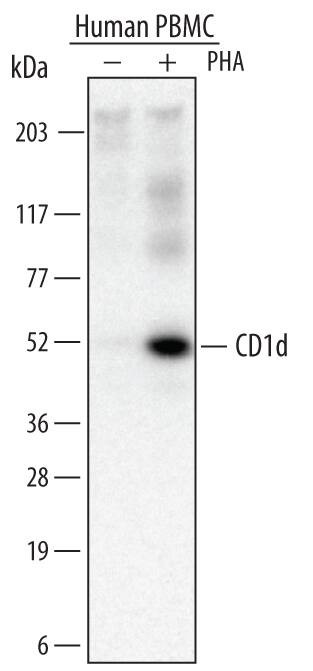
Please note: We are reviewing Western blot images included in the antibody testing data in our catalog, including those provided by third parties. Unless expressly labeled or annotated as “raw-unedited”, Western blot images included in the antibody testing data in our catalog may have been edited, optimized or otherwise adjusted for presentation.

产品信息
MA5-61748
产品规格
种属反应
Human
宿主/亚型
Mouse
/ IgG2b
分类
Monoclonal
类型
Antibody
克隆号
703335
抗原
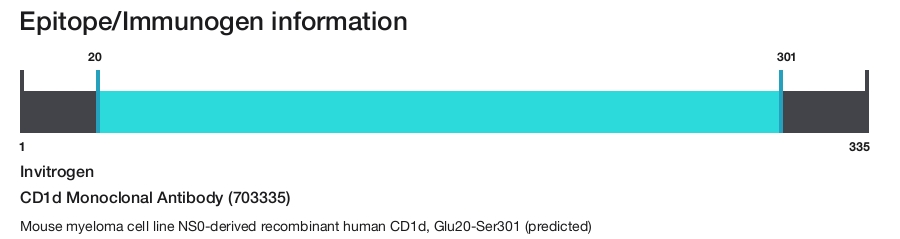
Mouse myeloma cell line NS0-derived recombinant human CD1d, Glu20-Ser301 (predicted)
偶联物
Unconjugated
Unconjugated
Unconjugated
形式
Lyophilized
浓度
0.5 mg/mL
规格
100 µg
纯化类型
Protein A/G
保存液
PBS with trehalose
内含物
no preservative
保存条件
Store at 4°C short term. For long term storage, store at -20°C, avoiding freeze/thaw cycles.
运输条件
Ambient (domestic); Wet ice (international)
RRID
产品详细信息
Reconstitute with sterile PBS to a final concentration of 0.5 mg/mL.
靶标信息
CD1d is a heavy chain associated with Beta 2 microglobulin on cortical thymocytes. Beta 2 microglobulin independent expression of CD1d has also been demonstrated on human intestinal epithelial cells. CD1d is the sole group 2 member of the CD1 family of major histocompatibility (MHC) like glycoproteins. The CD1d gene encodes a divergent member of the CD1 family of transmembrane glycoproteins, which are structurally related to the major histocompatibility complex (MHC) proteins and form heterodimers with beta-2-microglobulin. The CD1 proteins mediate the presentation of primarily lipid and glycolipid antigens of self or microbial origin to T cells. The human genome contains five CD1 family genes organized in a cluster on chromosome 1. The CD1 family members are thought to differ in their cellular localization and specificity for particular lipid ligands. The protein encoded by the CD1d gene localizes to late endosomes and lysosomes via a tyrosine-based motif in the cytoplasmic tail. Diseases associated with CD1D include Mycobacterium Malmoense and Autoimmune Disease.
仅用于科研。不用于诊断过程。未经明确授权不得转售。
篇参考文献 (0)
您是否在文献中引用过该产品?请点击下方按钮邮件告知我们。
生物信息学
蛋白别名: CD1D antigen, d polypeptide; HMC class I antigen-like glycoprotein CD1D; T-cell surface glycoprotein CD1d; thymocyte antigen CD1D
基因别名: R3; R3G1
UniProt ID: (Human) P15813
Entrez Gene ID: (Human) 912
positive regulation of T cell mediated cytotoxicity
immune response
detection of bacterium
heterotypic cell-cell adhesion
positive regulation of T cell proliferation
T cell selection
positive regulation of innate immune response
antigen processing and presentation, endogenous lipid antigen via MHC class Ib
antigen processing and presentation, exogenous lipid antigen via MHC class Ib
Disclaimer

Clicking the images or links will redirect you to a website hosted by BenchSci that provides third-party scientific content. Neither the content nor the BenchSci technology and processes for selection have been evaluated by us; we are providing them as-is and without warranty of any kind, including for use or application of the Thermo Fisher Scientific products presented.

