Search
NeoBiotechnologies
CD44v4/5 (Marker of Tumor Metastasis) Monoclonal Antibody (3D2)
{{$productOrderCtrl.translations['antibody.pdp.commerceCard.promotion.promotions']}}
{{$productOrderCtrl.translations['antibody.pdp.commerceCard.promotion.promocode']}}: {{promo.promoCode}} {{promo.promoTitle}} {{promo.promoDescription}}. {{$productOrderCtrl.translations['antibody.pdp.commerceCard.promotion.learnmore']}}
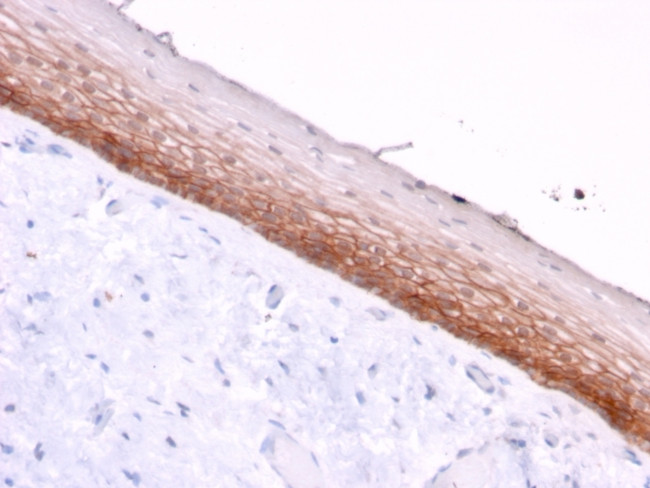
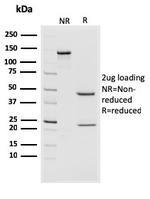
Please note: We are reviewing Western blot images included in the antibody testing data in our catalog, including those provided by third parties. Unless expressly labeled or annotated as “raw-unedited”, Western blot images included in the antibody testing data in our catalog may have been edited, optimized or otherwise adjusted for presentation.


产品信息
960-MSM19-P0
应用
建议稀释比
已发表文章
产品规格
种属反应
Human
宿主/亚型
Mouse
/ IgG1, kappa
分类
Monoclonal
类型
Antibody
克隆号
3D2
抗原
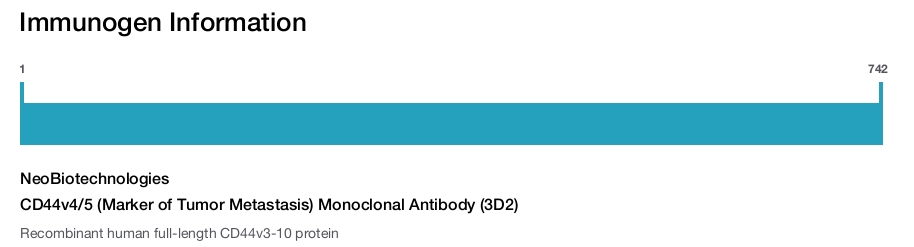
Recombinant human full-length CD44v3-10 protein
偶联物
Unconjugated
Unconjugated
Unconjugated
形式
Liquid
浓度
200 µg/mL
规格
20 µg
纯化类型
Protein A/G
保存液
PBS, pH 7.4, with 0.05% BSA
内含物
0.05% sodium azide
保存条件
4°C, do not freeze
运输条件
Ambient (domestic); Wet ice (international)
靶标信息
This antibody recognizes an epitope encoded by exon v9 on the variant portion of human CD44. The CD44 molecule belongs to a family of cellular adhesion molecules found on a wide range of normal and malignant cells in epithelial, mesothelial and hemopoiesis tissues. CD44 is a single gene with 20 exons, of which 10 are normally expressed to encode the basic CD44 (H-CAM) molecule. The additional 10 exons (v1 to v10) are only expressed by alternative splicing of the nuclear RNA.The expression of specific cell adhesion molecule CD44 splice variants has been reported to be associated with metastasis in certain human malignancies.
仅用于科研。不用于诊断过程。未经明确授权不得转售。
篇参考文献 (0)
您是否在文献中引用过该产品?请点击下方按钮邮件告知我们。
生物信息学
蛋白别名: CD44 molecule (Indian blood group); CD44R1; CD44v4; CD44v5; CDw44 antigen precursor; cell surface glycoprotein CD44; cell-cell and cell-matrix adhesion interaction glycoprotein isoform; cell-surface glycoprotein; chondroitin sulfate proteoglycan 8; CSPG8; epican; extracellular matrix receptor III; GP90 lymphocyte homing/adhesion receptor; hematopoietic cell E- and L-selectin ligand; heparan sulfate proteoglycan; Hermes antigen; Hermes antigen gp90 homing receptor precursor; homing cell adhesion molecule; homing function and Indian blood group system; homing receptor; hyaluronan-binding protein; hyaluronate receptor; In(Lu) related-p80; Indian blood group antigen; LHR; phagocyte glycoprotein 1; phagocytic glycoprotein 1; soluble CD44; unnamed protein product
基因别名: CDW44; CSPG8; ECM-III; ECMR-III; H-CAM; HCELL; Hermes-1; HUTCH-1; HUTCH-I; LHR; MC56; MDU2; MDU3; MIC4; Pgp1
UniProt ID: (Human) P16070
Entrez Gene ID: (Human) 960
endocytosis
inflammatory response
cell adhesion
cell-matrix adhesion
anatomical structure morphogenesis
cell migration
cytokine-mediated signaling pathway
hyaluronan catabolic process
positive regulation of heterotypic cell-cell adhesion
T cell activation
regulation of apoptotic process
negative regulation of apoptotic process
negative regulation of DNA damage response, signal transduction by p53 class mediator
wound healing, spreading of cells
cellular response to fibroblast growth factor stimulus
system development
NK T cell activation
cartilage development
positive regulation of ERK1 and ERK2 cascade
monocyte aggregation
cell-cell adhesion
positive regulation of monocyte aggregation
carbohydrate derivative transport
negative regulation of intrinsic apoptotic signaling pathway in response to DNA damage by p53 class mediator
regulation of lamellipodium morphogenesis
Disclaimer

Clicking the images or links will redirect you to a website hosted by BenchSci that provides third-party scientific content. Neither the content nor the BenchSci technology and processes for selection have been evaluated by us; we are providing them as-is and without warranty of any kind, including for use or application of the Thermo Fisher Scientific products presented.

