Search
Invitrogen
CD45R (B220) Recombinant Rat Monoclonal Antibody (RA3-6B2)
{{$productOrderCtrl.translations['antibody.pdp.commerceCard.promotion.promotions']}}
{{$productOrderCtrl.translations['antibody.pdp.commerceCard.promotion.promocode']}}: {{promo.promoCode}} {{promo.promoTitle}} {{promo.promoDescription}}. {{$productOrderCtrl.translations['antibody.pdp.commerceCard.promotion.learnmore']}}
{{$ctrl.translations['antibody.pdp.skuNotes.additionalInformation']}}:
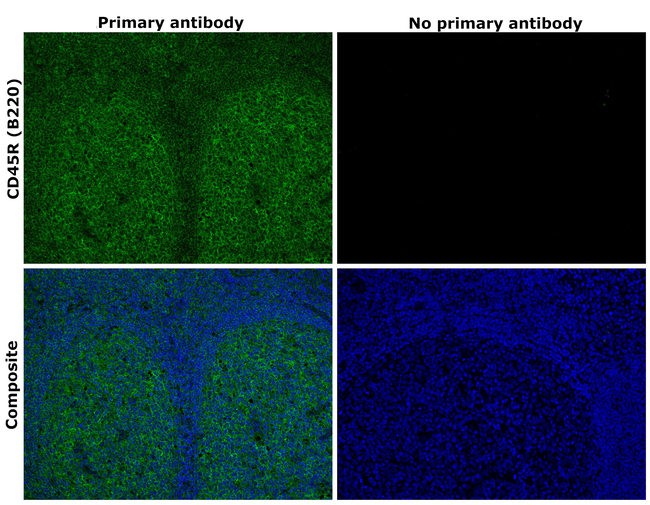
图: 1 / 3
CD45R (B220) Antibody (750020T) in IHC (P)
Immunohistochemical analysis of CD45R (B220) was performed using formalin-fixed paraffin-embedded human tonsil tissue sections. To expose the target protein, heat-induced epitope retrieval was performed on de-paraffinized sections using eBioscience™ IHC Antigen Retrieval Solution - Low pH (10X) (Product # 00-4955-58) diluted to 1X solution in water in a decloaking chamber at 110°C for 15 min. Following anti... View More
Please note: We are reviewing Western blot images included in the antibody testing data in our catalog, including those provided by third parties. Unless expressly labeled or annotated as “raw-unedited”, Western blot images included in the antibody testing data in our catalog may have been edited, optimized or otherwise adjusted for presentation.


产品信息
750020T
产品规格
种属反应
Human,
Mouse
宿主/亚型
Rat
/ IgG2a, kappa
Expression System
Expi293
分类
Recombinant Monoclonal
类型
Antibody
克隆号
RA3-6B2
偶联物
Unconjugated
Unconjugated
Unconjugated
形式
Liquid
浓度
1 mg/mL
规格
100 µg
纯化类型
Affinity chromatography
保存液
PBS, pH 7.2-7.4
内含物
0.09% sodium azide
保存条件
Store at 4°C short term. For long term storage, store at -20°C, avoiding freeze/thaw cycles.
运输条件
Wet ice
产品详细信息
Recombinant rat monoclonal antibodies are produced using in vitro expression systems. Recombinant antibodies are produced using specific genes that code for the desired antibodies. These genes are cloned into an expression vector and expressed in vitro. The advantages of recombinant antibodies include better specificity and lot-to-lot consistency.
It is recommended that the antibody be carefully titrated for optimal performance in the assay of interest.
靶标信息
CD45R (PTPRC) is a member of the protein tyrosine phosphatase (PTP) family. PTPs are known to be signaling molecules that regulate a variety of cellular processes including cell growth, differentiation, mitotic cycle, and oncogenic transformation. CD45 contains an extracellular domain, a single transmembrane segment and two tandem intracytoplasmic catalytic domains. CD45 is specifically expressed in hematopoietic cells and has been shown to be an essential regulator of T- and B-cell antigen receptor signaling. CD45 glycoprotein is crucial in lymphocyte development and antigen signaling, serving as an important regulator of Src-family kinases. CD45 protein exists in multiple isoforms as a result of alternative splicing, and these isoforms differ in their extracellular domains, but share identical transmembrane and cytoplasmic domains. Further, these CD45 isoforms differ in their ability to translocate into the glycosphingolipid-enriched membrane domains and their expression depends on cell type and physiological state of the cell. In addition to its role in immunoreceptor signaling, CD45 is important in promoting cell survival by modulating integrin-mediated signal transduction pathway and is also involved in DNA fragmentation during apoptosis. CD45RA is an isoform of the CD45 complex and has restricted expression between different subtypes of lymphoid cells. Diseases associated with CD45 dysfunction include Severe Combined Immunodeficiency (T-cell negative, B-Cell Negative) and Hepatitis C.
仅用于科研。不用于诊断过程。未经明确授权不得转售。
篇参考文献 (0)
您是否在文献中引用过该产品?请点击下方按钮邮件告知我们。
生物信息学
蛋白别名: 200 kDa T-cell leukocyte common antigen isoform; CD45 antigen; CD45; Ly5; glycoprotein 180; glycoprotein isoform Ly-5; leukocyte common antigen; lymphocyte antigen 5; lymphocyte common antigen; protein tyrosine phosphatase; protein tyrosine phosphatase, receptor type, c polypeptide; PTPRC; T200 glycoprotein; T200 leukocyte common antigen; unnamed protein product
基因别名: B220; CD45; CD45R; GP180; IMD105; L-CA; LCA; loc; Ly-5; LY5; Lyt-4; T200
UniProt ID: (Human) P08575, (Mouse) P06800
Entrez Gene ID: (Human) 5788, (Mouse) 19264
protein tyrosine phosphatase activity
transmembrane receptor protein tyrosine phosphatase activity
receptor binding
protein binding
heparin binding
protein kinase binding
protein tyrosine kinase inhibitor activity
ankyrin binding
spectrin binding
heparan sulfate proteoglycan binding
identical protein binding
negative regulation of transcription from RNA polymerase II promoter
natural killer cell differentiation
negative regulation of T cell mediated cytotoxicity
positive regulation of T cell mediated cytotoxicity
negative regulation of cytokine-mediated signaling pathway
hematopoietic progenitor cell differentiation
positive regulation of immunoglobulin production
positive regulation of T cell mediated immunity
regulation of humoral immune response mediated by circulating immunoglobulin
positive regulation of humoral immune response mediated by circulating immunoglobulin
negative regulation of protein kinase activity
protein dephosphorylation
negative regulation of cell adhesion involved in substrate-bound cell migration
leukocyte cell-cell adhesion
signal transduction
response to gamma radiation
regulation of gene expression
dephosphorylation
B cell differentiation
T cell differentiation
positive regulation of B cell proliferation
negative regulation of protein autophosphorylation
regulation of interleukin-8 production
negative regulation of interleukin-2 production
positive regulation of interleukin-2 production
positive regulation of tumor necrosis factor production
heterotypic cell-cell adhesion
T cell proliferation
B cell proliferation
positive regulation of T cell proliferation
positive regulation of MAP kinase activity
positive regulation of MAPK cascade
cell cycle phase transition
plasma membrane raft distribution
positive thymic T cell selection
negative thymic T cell selection
positive regulation of T cell differentiation
positive regulation of gamma-delta T cell differentiation
negative regulation of JAK-STAT cascade
positive regulation of alpha-beta T cell proliferation
positive regulation of isotype switching to IgG isotypes
bone marrow development
stem cell development
negative regulation of peptidyl-tyrosine phosphorylation
regulation of phagocytosis
positive regulation of phagocytosis
positive regulation of calcium-mediated signaling
T cell receptor signaling pathway
B cell receptor signaling pathway
regulation of T cell receptor signaling pathway
positive regulation of antigen receptor-mediated signaling pathway
release of sequestered calcium ion into cytosol
defense response to virus
regulation of cell cycle
positive regulation of Fc receptor mediated stimulatory signaling pathway
negative regulation of ERK1 and ERK2 cascade
positive regulation of ERK1 and ERK2 cascade
negative regulation of interleukin-4-mediated signaling pathway
positive regulation of hematopoietic stem cell migration
positive regulation of stem cell proliferation
regulation of extrinsic apoptotic signaling pathway
positive regulation of extrinsic apoptotic signaling pathway
cell surface receptor signaling pathway
T cell activation
positive regulation of protein kinase activity
negative regulation of microglial cell activation
response to aldosterone
DN2 thymocyte differentiation
Disclaimer

Clicking the images or links will redirect you to a website hosted by BenchSci that provides third-party scientific content. Neither the content nor the BenchSci technology and processes for selection have been evaluated by us; we are providing them as-is and without warranty of any kind, including for use or application of the Thermo Fisher Scientific products presented.

