Search
Invitrogen
CD56 Monoclonal Antibody (123C3)
{{$productOrderCtrl.translations['antibody.pdp.commerceCard.promotion.promotions']}}
{{$productOrderCtrl.translations['antibody.pdp.commerceCard.promotion.promocode']}}: {{promo.promoCode}} {{promo.promoTitle}} {{promo.promoDescription}}. {{$productOrderCtrl.translations['antibody.pdp.commerceCard.promotion.learnmore']}}
{{$ctrl.translations['antibody.pdp.skuNotes.additionalInformation']}}:
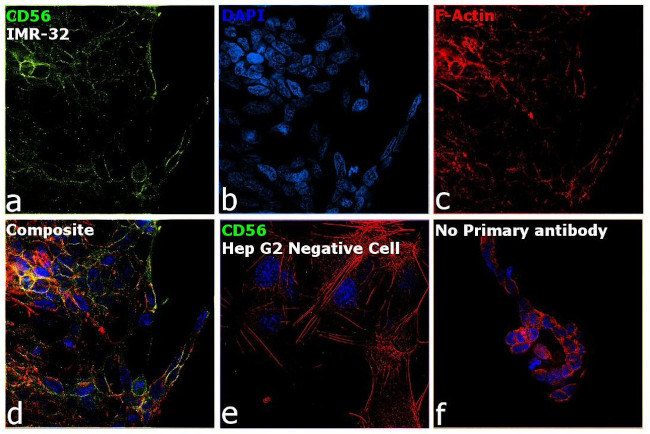
图: 1 / 2
CD56 Antibody (MA1-35249) in ICC/IF
Immunofluorescence analysis of CD56 was performed using 70% confluent log phase IMR-32. The cells were fixed with 4% paraformaldehyde for 10 minutes, permeabilized with 0.1% Triton™ X-100 for 15 minutes, and blocked with 2% BSA for 1 hour at room temperature. The cells were labeled with CD56 Monoclonal Antibody (Product # MA1-35249) at 1:20 dilution in 0.1% BSA, incubated at 4 degree celsius overnight and then with Donkey anti-Mouse IgG (H+L) Highly Cross-Adsorbed Secondary Antibody, Alexa Fluor Plus 488 (Product # A32723), (1:2000), for 4... View More
Please note: We are reviewing Western blot images included in the antibody testing data in our catalog, including those provided by third parties. Unless expressly labeled or annotated as “raw-unedited”, Western blot images included in the antibody testing data in our catalog may have been edited, optimized or otherwise adjusted for presentation.


产品信息
MA1-35249
应用
建议稀释比
已发表文章
产品规格
种属反应
Human
已发表种属
Human
宿主/亚型
Mouse
/ IgG1
分类
Monoclonal
类型
Antibody
克隆号
123C3
抗原
Proprietary Immunogen
偶联物
Unconjugated
Unconjugated
Unconjugated
形式
Liquid
纯化类型
Affinity chromatography
保存液
PBS with 0.1% BSA
内含物
0.02% sodium azide
保存条件
4°C
运输条件
Ambient (domestic); Wet ice (international)
RRID
产品详细信息
The antibody recognizes a transmembrane glycoprotein of 140 and 180 kD which has been identified as NCAM (Neural Cell Adhesion Module). At the international Workshop on SCLC antibodies 123C3 has been categorized as cluster 1 antibody. All cells in small cell carcinomas and carcinoids of the lung are strongly positive for 123C3. A minority of cases of other major types of lung carcinoma are sometimes positive as well: however this positivity is generally weak and focal. Adenoid cystic carcinomas of bronchial glands are strongly positive. Neuroblastoma's and Wilms tumors are usually also staining strongly positive. In non-small lung cell carcinomas, 123C3 staining has been associated with more advanced stage and a decreased survival after surgery. Furthermore, this antibody can be used to support diagnosis of lymphoma or to detect residual disease for cases of CD56 positive T/NK -cell lymphoma in which the neoplastic lymphoid cells are small and show minimal atypia, especially in small biopsies.
靶标信息
CD56, also known as neural cell adhesion molecule (NCAM), is a highly glycosylated transmembrane glycoprotein of the immunoglobulin family. It plays a crucial role in cell adhesion, migration, axonal growth, pathfinding, and synaptic plasticity. CD56 is ubiquitously expressed in the nervous system in isoforms ranging from 120-180 kDa and is involved in homotypic adhesion of neural cells. It mediates interactions by binding extracellular matrix components such as laminin and integrins, with polysialic modification reducing CD56-mediated adhesion. In the hematopoietic system, CD56 is expressed on natural killer (NK) cells and a subset of T cells known as NKT cells. It is also found on most neuroectodermal-derived cell lines, tissues, and neoplasms, including retinoblastoma, medulloblastoma, astrocytomas, and neuroblastoma. CD56 serves as a widely used neuroendocrine marker with high sensitivity for neuroendocrine tumors and ovarian granulosa cell tumors. Diseases associated with CD56 dysfunction include rabies and blastic plasmacytoid dendritic cell neoplasms, highlighting its importance in both neural and immune system functions.
仅用于科研。不用于诊断过程。未经明确授权不得转售。
生物信息学
蛋白别名: 145 kda neural cell adhesion molecule; antigen recognized by monoclonal antibody 5.1H11; CD-56; E NCAM; membrane glycoprotein; N CAM1; N-CAM; neural cell adhesion molecule; neural cell adhesion molecule secreted isoform; neural cell adhesion molecule, NCAM; sCD56; sNCAM; soluble CD56; soluble NCAM; unnamed protein product
基因别名: CD56; MSK39; NCAM
UniProt ID: (Human) P13591
Entrez Gene ID: (Human) 4684
Disclaimer

Clicking the images or links will redirect you to a website hosted by BenchSci that provides third-party scientific content. Neither the content nor the BenchSci technology and processes for selection have been evaluated by us; we are providing them as-is and without warranty of any kind, including for use or application of the Thermo Fisher Scientific products presented.

