Search
Abnova
CD96 Monoclonal Antibody (3H8)
{{$productOrderCtrl.translations['antibody.pdp.commerceCard.promotion.promotions']}}
{{$productOrderCtrl.translations['antibody.pdp.commerceCard.promotion.promocode']}}: {{promo.promoCode}} {{promo.promoTitle}} {{promo.promoDescription}}. {{$productOrderCtrl.translations['antibody.pdp.commerceCard.promotion.learnmore']}}
{{$ctrl.translations['antibody.pdp.skuNotes.additionalInformation']}}:
产品信息
H00010225-M01
产品规格
种属反应
Human
宿主/亚型
Mouse
/ IgG2a, kappa
分类
Monoclonal
类型
Antibody
克隆号
3H8
抗原
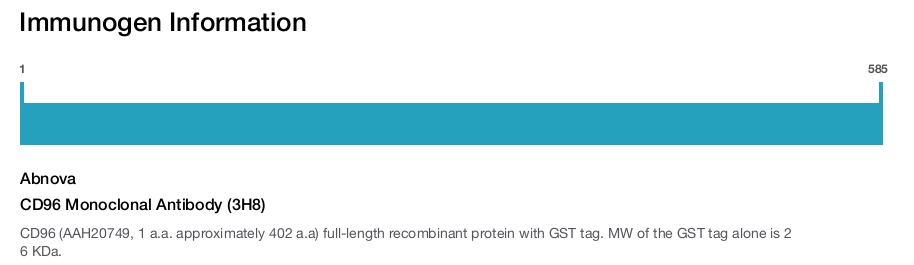
CD96 (AAH20749, 1 a.a. approximately 402 a.a) full-length recombinant protein with GST tag. MW of the GST tag alone is 26 KDa.
偶联物
Unconjugated
Unconjugated
Unconjugated
形式
Liquid
浓度
See Label
规格
100 µg
纯化类型
Affinity chromatography
保存液
PBS, pH 7.4
内含物
no preservative
保存条件
-20°C, Avoid Freeze/Thaw Cycles
运输条件
Ambient (domestic); Wet ice (international)
产品详细信息
Sequence of this protein is as follows: MEKKWKYCAV YYIIQIHFVK GVWEKTVNTE ENVYATLGSD VNLTCQTQTV GFFVQMQWSK VTNKIDLIAV YHPQYGFYCA YGRPCESLVT FTETPENGSR WTLHLRNMSC SVSGRYECML VLYPEGIQTK IYNLLIQTHV TADEWNSNHT IEIEINQTLE IPCFQNSSSK ISSEFTYAWS VEDNGTQETL ISQNHLISNS TLLKDRVKLG TDYRLHLSPV QIFDDGRKFS CHIRVGPNKI LRSSTTVKVF AKPEIPVIVE NNSTDVLVER RFTCLLKNVF PKANITWFID GSFLHDEKEG IYITNEERKG KDGFLELKSV LTRVHSNKPA QSDNLTIWCM ALSPVPGNKV WNISSGKITF LLGSEISSTD PPLSVTESTL DTQPSPASSV SPASKNVFTL SY
靶标信息
CD96 is a cell adhesion receptor also known as TACTILE. A member of the Ig superfamily, CD96 is a single pass transmembrane protein consisting of three extracellular Ig-like domains and a proline/serine/threonine rich region. CD96 is expressed on resident monocytes and T cells at all developmental stages (including gamma-delta T cells, thymocytes, and NK cells). In the mouse, this receptor is not expressed on B cells. Unlike in humans, mouse CD96 does not exist as alternative splice variants. Reports indicate that CD96 binds CD155/poliovirus receptor and Nectin-1 to mediate NK cell adhesion to target cells and cytotoxicity.
仅用于科研。不用于诊断过程。未经明确授权不得转售。
篇参考文献 (0)
您是否在文献中引用过该产品?请点击下方按钮邮件告知我们。
生物信息学
蛋白别名: cell surface antigen CD96; DKFZp667E2122; sCD96; soluble CD96; T cell activation, increased late expression; t cell-activated increased late expression protein; unnamed protein product
基因别名: TACTILE
UniProt ID: (Human) P40200
Entrez Gene ID: (Human) 10225
Disclaimer

Clicking the images or links will redirect you to a website hosted by BenchSci that provides third-party scientific content. Neither the content nor the BenchSci technology and processes for selection have been evaluated by us; we are providing them as-is and without warranty of any kind, including for use or application of the Thermo Fisher Scientific products presented.

