Search
Invitrogen
CDV Fusion glycoprotein F0 Monoclonal Antibody (4F2)
{{$productOrderCtrl.translations['antibody.pdp.commerceCard.promotion.promotions']}}
{{$productOrderCtrl.translations['antibody.pdp.commerceCard.promotion.promocode']}}: {{promo.promoCode}} {{promo.promoTitle}} {{promo.promoDescription}}. {{$productOrderCtrl.translations['antibody.pdp.commerceCard.promotion.learnmore']}}
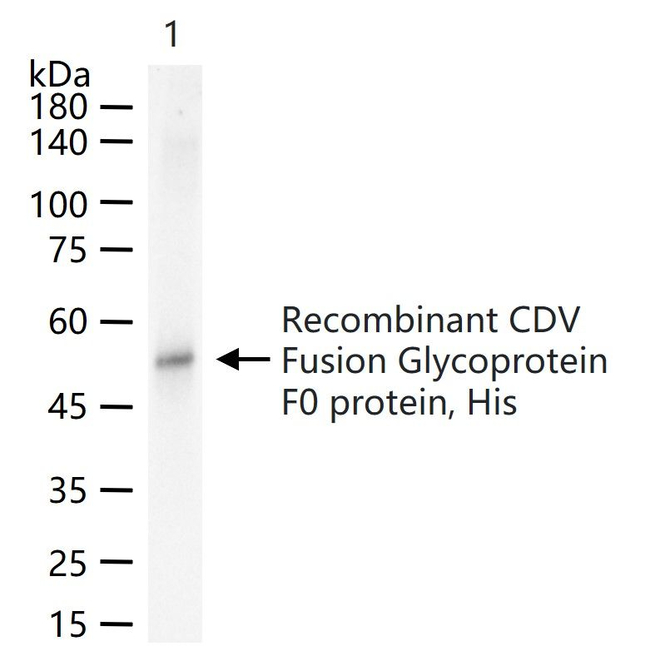
图: 1 / 1
CDV Fusion glycoprotein F0 Antibody (MA571819) in WB
Western blot analysis of CDV Fusion glycoprotein F0 in Recombinant protein at 25 µg/lane. Samples were incubated using CDV Fusion glycoprotein F0 Monoclonal (Product # MA571819) at 1:1,000 dilution and 4°C overnight incubation. Followed by corresponding conjugated secondary antibody incubation at room temperature for 60 min.
Please note: We are reviewing Western blot images included in the antibody testing data in our catalog, including those provided by third parties. Unless expressly labeled or annotated as “raw-unedited”, Western blot images included in the antibody testing data in our catalog may have been edited, optimized or otherwise adjusted for presentation.

产品信息
MA571819
产品规格
种属反应
Virus
宿主/亚型
Mouse
/ IgG
分类
Monoclonal
类型
Antibody
克隆号
4F2
抗原
Recombinant CDV Fusion glycoprotein F0.
偶联物
Unconjugated
Unconjugated
Unconjugated
形式
Liquid
浓度
1 mg/mL
规格
100 µg
纯化类型
Protein A
保存液
TBS, pH 7.4, with 50% glycerol, 1% BSA
内含物
0.02% ProClin 300
保存条件
Store at 4°C short term. For long term storage, store at -20°C, avoiding freeze/thaw cycles.
运输条件
Ambient (domestic); Wet ice (international)
靶标信息
Canine Distemper Virus (CDV) is a highly contagious virus affecting dogs and other wildlife, and its fusion (F) glycoprotein, synthesized as the inactive precursor F0, is essential for viral entry into host cells. The F0 protein undergoes proteolytic cleavage by host cell proteases to form the active F1 and F2 subunits, which remain linked by disulfide bonds; this cleavage is required for fusogenic activity. The F1 subunit contains a hydrophobic fusion peptide that inserts into the host cell membrane to initiate membrane fusion, while F2 contributes to receptor binding and structural stabilization. Viral entry begins when the CDV hemagglutinin (H) glycoprotein binds to a host cell receptor, triggering conformational changes in the F protein that enable F0 cleavage and subsequent fusion of the viral envelope with the host cell membrane, allowing nucleocapsid entry. Clinically, the F protein is a major target of the immune response, is included in vaccines, and is a key focus for antiviral drug development, as mutations in this protein can influence viral virulence, host range, and vaccine effectiveness; consequently, understanding the structure and function of the CDV fusion glycoprotein F0 is critical for developing effective vaccines, neutralizing antibodies, and therapeutic inhibitors.
仅用于科研。不用于诊断过程。未经明确授权不得转售。
篇参考文献 (0)
您是否在文献中引用过该产品?请点击下方按钮邮件告知我们。
Disclaimer

Clicking the images or links will redirect you to a website hosted by BenchSci that provides third-party scientific content. Neither the content nor the BenchSci technology and processes for selection have been evaluated by us; we are providing them as-is and without warranty of any kind, including for use or application of the Thermo Fisher Scientific products presented.

