Search
Invitrogen
CIDEC Polyclonal Antibody
{{$productOrderCtrl.translations['antibody.pdp.commerceCard.promotion.promotions']}}
{{$productOrderCtrl.translations['antibody.pdp.commerceCard.promotion.promocode']}}: {{promo.promoCode}} {{promo.promoTitle}} {{promo.promoDescription}}. {{$productOrderCtrl.translations['antibody.pdp.commerceCard.promotion.learnmore']}}
{{$ctrl.translations['antibody.pdp.skuNotes.additionalInformation']}}:

Please note: We are reviewing Western blot images included in the antibody testing data in our catalog, including those provided by third parties. Unless expressly labeled or annotated as “raw-unedited”, Western blot images included in the antibody testing data in our catalog may have been edited, optimized or otherwise adjusted for presentation.


产品信息
PA1-4316
应用
建议稀释比
已发表文章
产品规格
种属反应
Human,
Mouse
宿主/亚型
Rabbit
/ IgG
分类
Polyclonal
类型
Antibody
抗原
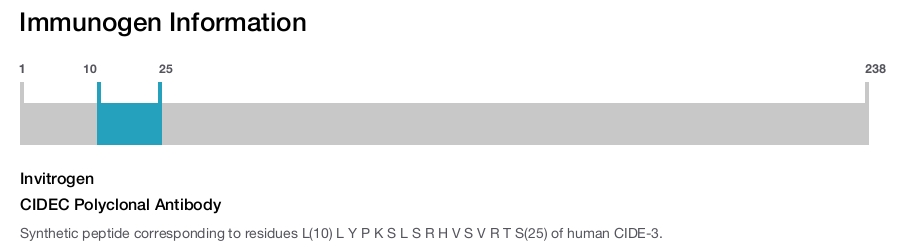
Synthetic peptide corresponding to residues L(10) L Y P K S L S R H V S V R T S(25) of human CIDE-3.
偶联物
Unconjugated
Unconjugated
Unconjugated
形式
Liquid
浓度
1 mg/mL
规格
100 µg
纯化类型
Antigen affinity chromatography
保存液
PBS
内含物
0.02% sodium azide
保存条件
Maintain refrigerated at 2-8°C for up to 3 months. For long term storage store at -20°C
运输条件
Ambient (domestic); Wet ice (international)
RRID
产品详细信息
PA1-4316 detects the human CIDE-3 protein in human samples. Expected to recognize mouse samples due to 93% sequence homology.
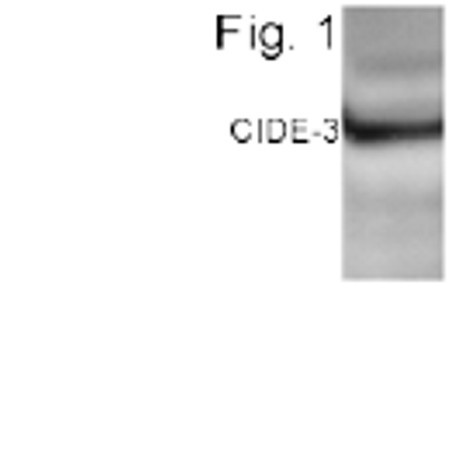
PA1-4316 has been successfully used in Western blot procedures. By Western blot this antibody detects a ~27 kDa protein representing human CIDE-3 in HepG2 cell lysate.
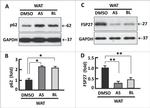
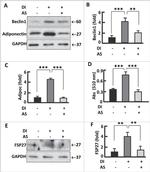
The PA1-4316 immunogen is a synthetic peptide corresponding to residues L(10) L Y P K S L S R H V S V R T S(25) of human CIDE-3. This antibody shows cross-reactivity to FSP27, which is the mouse homolog of CIDE-3, with a sequence identity of 93%.
Maintain at 4°C for 3 months or at -20°C for longer periods. Avoid repeated freeze-thaw cycles.
靶标信息
DNA fragmentation is one of the critical steps in apoptosis, which is induced by DNA fragmentation factor (DFF). DFF is composed of two subunits, a 40 kDa caspase-activated nuclease (DFF40) and a 45 kDa inhibitor (DFF45). Recently a novel family of cell-death-inducing DFF45-like effectors (CIDEs) has been identified. Human CIDE-3 is a novel member of CIDEs. There are 2 transcripts, CIDE-3 and CIDE-3alpha, were present in HepG2 and A375 cells. Consistent with its chromosome localization at 3p25, a region associated with high frequency loss of heterozygosity in many tumours, CIDE-3 may play an important role in prevention of tumorigenesis.
仅用于科研。不用于诊断过程。未经明确授权不得转售。
生物信息学
蛋白别名: cell death activator CIDE-3; cell death-inducing DFFA-like effector protein C; CID; cide 3; CIDE-3alpha; fat specific gene 27; fat specific protein 27; fat-specific protein FSP27; unnamed protein product
基因别名: CIDE-3; CIDE3; FPLD5; FSP27
UniProt ID: (Human) Q96AQ7, (Mouse) P56198
Entrez Gene ID: (Human) 63924, (Mouse) 14311
Disclaimer

Clicking the images or links will redirect you to a website hosted by BenchSci that provides third-party scientific content. Neither the content nor the BenchSci technology and processes for selection have been evaluated by us; we are providing them as-is and without warranty of any kind, including for use or application of the Thermo Fisher Scientific products presented.

