Search
Invitrogen
CLCNKB Polyclonal Antibody
{{$productOrderCtrl.translations['antibody.pdp.commerceCard.promotion.promotions']}}
{{$productOrderCtrl.translations['antibody.pdp.commerceCard.promotion.promocode']}}: {{promo.promoCode}} {{promo.promoTitle}} {{promo.promoDescription}}. {{$productOrderCtrl.translations['antibody.pdp.commerceCard.promotion.learnmore']}}
{{$ctrl.translations['antibody.pdp.skuNotes.additionalInformation']}}:
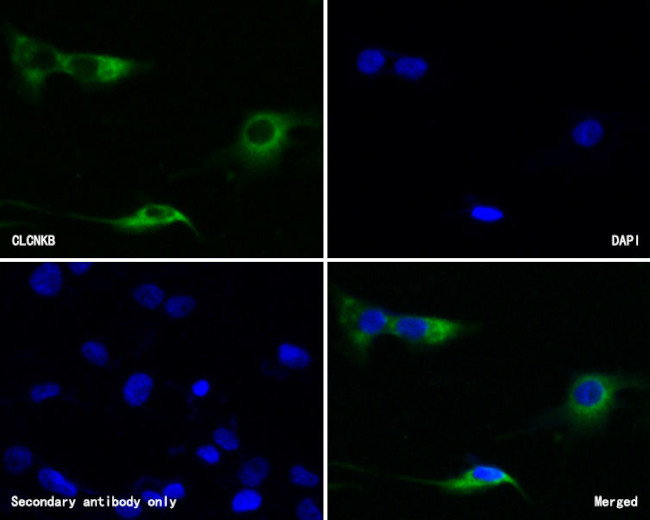
图: 1 / 5
CLCNKB Antibody (PA5-119867) in ICC/IF
Immunocytochemistry-Immunofluorescence analysis of CLCNKB in MG-63 cells (green). Formalin fixed cells were permeabilized with 0.1% Triton X-100 in TBS for 10 minutes at room temperature and blocked with 10% negative goat serum for 15 minutes at room temperature. Cells were probed with CLCNKB Polyclonal Antibody (Product # PA5-119867) at a dilution of 1:50 for 1 hour at room temperature, washed with PBS. Alexa Fluor 488 conjugate-Goat anti-Rabbit IgG was used as the secondary antibody at 1:1,000 dilution. The nuclear counter stain is DAPI ... View More
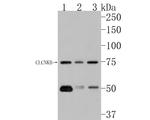

Please note: We are reviewing Western blot images included in the antibody testing data in our catalog, including those provided by third parties. Unless expressly labeled or annotated as “raw-unedited”, Western blot images included in the antibody testing data in our catalog may have been edited, optimized or otherwise adjusted for presentation.


产品信息
PA5-119867
应用
建议稀释比
已发表文章
产品规格
种属反应
Human,
Mouse,
Rat
宿主/亚型
Rabbit
/ IgG
分类
Polyclonal
类型
Antibody
抗原
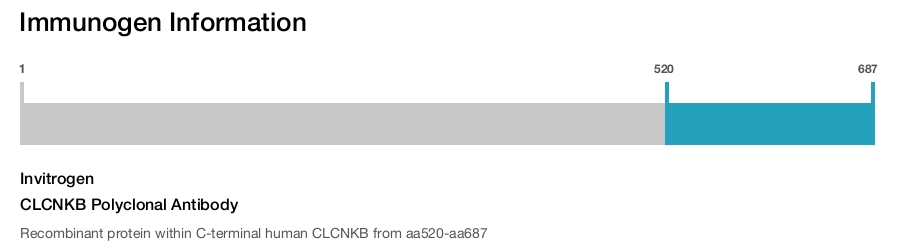
Recombinant protein within C-terminal human CLCNKB from aa520-aa687.
偶联物
Unconjugated
Unconjugated
Unconjugated
形式
Liquid
浓度
1 mg/mL
规格
100 µg
纯化类型
Antigen affinity chromatography
保存液
TBS, pH 7.4, with 50% glycerol, 0.2% BSA
内含物
0.05% sodium azide
保存条件
Store at 4°C short term. For long term storage, store at -20°C, avoiding freeze/thaw cycles.
运输条件
Ambient (domestic); Wet ice (international)
RRID
产品详细信息
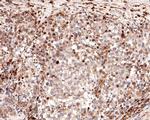
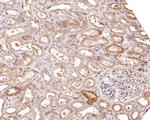
Positive Control: Mouse testis tissue lysate, rat testis tissue lysate, MCF-7 cell lysate, human kidney tissue, human seminoma tissue, MG-63, A549.
Subcellular Location: Cell membrane.
靶标信息
Chloride channel Kb (CLCNKB) is a member of the CLC family of voltage-gated chloride channels, which comprises at least 9 mammalian chloride channels. Each is believed to have 12 transmembrane domains and intracellular N and C termini. Mutations in CLCNKB result in the autosomal recessive Type III Bartter Syndrome. CLCNKA and CLCNKB are closely related (94% sequence identity), tightly linked (separated by 11 kb of genomic sequence) and are both expressed in mammalian kidney.
仅用于科研。不用于诊断过程。未经明确授权不得转售。
篇参考文献 (0)
您是否在文献中引用过该产品?请点击下方按钮邮件告知我们。
生物信息学
蛋白别名: chloride channel K1-like; putative basolateral cTAL chloride channel ClC-Ka; chloride channel K2; chloride channel Kb; chloride channel, kidney, B; chloride channel, voltage-sensitive Kb; clC-K2; CLCNK; hClC-Kb; MGC24087; putative basolateral mTAL chloride channel ClC-Ka; RP11-5P18.8; truncated ClC-K2; unnamed protein product
基因别名: ClC-K2; ClC-K2L; Clc-Ka; ClC-Kb; Clck2; CLCKB; Clcnk1l; Clcnk2
UniProt ID: (Human) P51801, (Mouse) Q9WUB6, (Rat) P51802
Entrez Gene ID: (Human) 1188, (Mouse) 56365, (Rat) 79430
Disclaimer

Clicking the images or links will redirect you to a website hosted by BenchSci that provides third-party scientific content. Neither the content nor the BenchSci technology and processes for selection have been evaluated by us; we are providing them as-is and without warranty of any kind, including for use or application of the Thermo Fisher Scientific products presented.

