Search
Agrisera
CNX1/2/Calnexin homolog 1/2 Polyclonal Antibody
{{$productOrderCtrl.translations['antibody.pdp.commerceCard.promotion.promotions']}}
{{$productOrderCtrl.translations['antibody.pdp.commerceCard.promotion.viewpromo']}}
{{$productOrderCtrl.translations['antibody.pdp.commerceCard.promotion.promocode']}}: {{promo.promoCode}} {{promo.promoTitle}} {{promo.promoDescription}}. {{$productOrderCtrl.translations['antibody.pdp.commerceCard.promotion.learnmore']}}
Additional Information:
{{banner.description}}
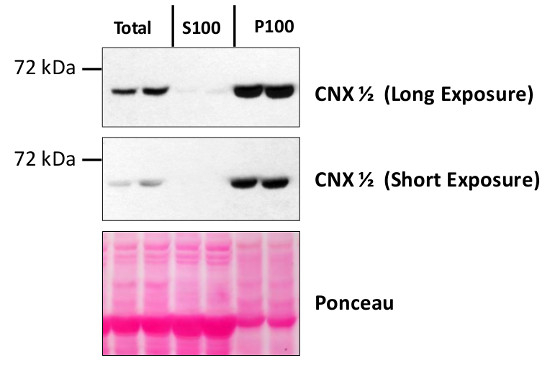
图: 1 / 1
CNX1/2/Calnexin homolog 1/2 Antibody (AS12-2365) in WB
Total protein from Col-0 (wild-type) Arabidopsis thaliana were extracted with 50 m M HEPES-KOH buffer containing 250 m M sucrose, 5% glycerol, 50 m M Na PP, 1 m M Na Mo, 25 m M Na F, 10 m M EDTA, 0.5% PVP, 3 m M DTT, 1 m M PMSF, 10 u M Leupeptin & 10 n M Calyculin, and then fractionated by ultracentrifugation at 100,000 x gravity for 30 min at 4°C into soluble (S 100) and microsomal (P 100) proteins as desc... View More
Please note: We are reviewing Western blot images included in the antibody testing data in our catalog, including those provided by third parties. Unless expressly labeled or annotated as “raw-unedited”, Western blot images included in the antibody testing data in our catalog may have been edited, optimized or otherwise adjusted for presentation.

产品信息
AS12-2365
产品规格
种属反应
Plant
宿主/亚型
Rabbit
分类
Polyclonal
类型
Antibody
抗原
KLH-conjugated synthetic peptide derived from Arabidopsis thaliana CNX1.
偶联物
Unconjugated
Unconjugated
Unconjugated
形式
Liquid
规格
50 µg
纯化类型
Antigen affinity chromatography
保存液
PBS, pH 7.4
内含物
no preservative
保存条件
-20°C, Avoid Freeze/Thaw Cycles
运输条件
Ambient (domestic); Wet ice (international)
产品详细信息
For reconstitution add 50 µL of sterile water.
Specific Species Reactivity: Arabidopsis thaliana, Nicotiana tabacum, Petunia hybrida, Solanum lycopersicum.
靶标信息
CNX1/2 encode calnexin-family lectin chaperones that localize predominantly to the endoplasmic reticulum membrane, with the bulk of the protein exposed to the ER lumen where nascent secretory and membrane glycoproteins fold. Calnexin proteins are type I single-pass membrane proteins with an N-terminal signal peptide followed by a large luminal lectin/chaperone region (including a globular domain and an extended proline-rich "arm" domain), a C-terminal transmembrane helix, and a short cytosolic tail that can be post-translationally modified to modulate interactions and trafficking. Functionally, CNX1/2 act in the calnexin cycle: they bind monoglucosylated N-linked glycans (e.g., Glc1Man9GlcNAc2) on newly synthesized glycoproteins, thereby promoting productive folding and assembly, limiting aggregation, and retaining incompletely folded clients for additional folding attempts or downstream quality-control disposal; through associated cofactors (notably ER oxidoreductases) they help coordinate disulfide bond formation and broader proteostasis in the early secretory pathway.
仅用于科研。不用于诊断过程。未经明确授权不得转售。
篇参考文献 (0)
您是否在文献中引用过该产品?请点击下方按钮邮件告知我们。
生物信息学
蛋白别名: AT5G07340; AT5G61790; ATCNX1; MAC9.15; MAC9_15; T2I1.50; T2I1_50
Disclaimer

Clicking the images or links will redirect you to a website hosted by BenchSci that provides third-party scientific content. Neither the content nor the BenchSci technology and processes for selection have been evaluated by us; we are providing them as-is and without warranty of any kind, including for use or application of the Thermo Fisher Scientific products presented.

