Search
Invitrogen
COL6A1 Polyclonal Antibody
{{$productOrderCtrl.translations['antibody.pdp.commerceCard.promotion.promotions']}}
{{$productOrderCtrl.translations['antibody.pdp.commerceCard.promotion.promocode']}}: {{promo.promoCode}} {{promo.promoTitle}} {{promo.promoDescription}}. {{$productOrderCtrl.translations['antibody.pdp.commerceCard.promotion.learnmore']}}
{{$ctrl.translations['antibody.pdp.skuNotes.additionalInformation']}}:
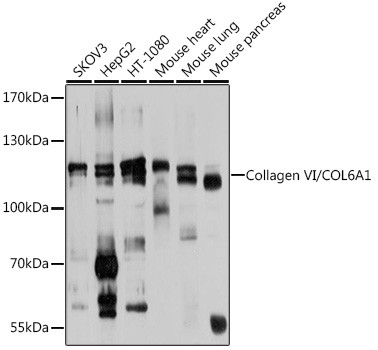
图: 1 / 1
COL6A1 Antibody (PA5-121228) in WB
Western blot analysis of COL6A1 in extracts of various cell lines. Samples were incubated with COL6A1 Polyclonal antibody (Product # PA5-121228) using a dilution of 1:1,000, followed by HRP Goat Anti-Rabbit IgG (H+L) at a dilution of 1:10,000. Lysates/proteins: 25 µg per lane. Blocking buffer: 3% nonfat dry milk in TBST. Detection: ECL Basic Kit. Exposure time: 1s.
Please note: We are reviewing Western blot images included in the antibody testing data in our catalog, including those provided by third parties. Unless expressly labeled or annotated as “raw-unedited”, Western blot images included in the antibody testing data in our catalog may have been edited, optimized or otherwise adjusted for presentation.

产品信息
PA5-121228
产品规格
种属反应
Human,
Mouse
宿主/亚型
Rabbit
/ IgG
分类
Polyclonal
类型
Antibody
抗原
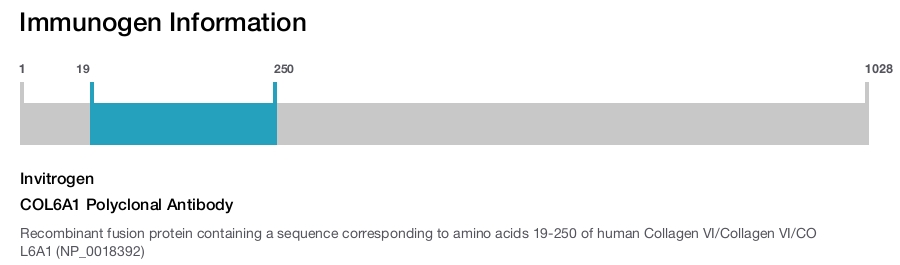
Recombinant fusion protein containing a sequence corresponding to amino acids 19-250 of human Collagen VI/Collagen VI/COL6A1 (NP_0018392)
偶联物
Unconjugated
Unconjugated
Unconjugated
形式
Liquid
浓度
1.37 mg/mL
规格
137 µg
纯化类型
Affinity Chromatography
保存液
PBS, pH 7.3, with 50% glycerol
内含物
0.02% sodium azide
保存条件
-20°C, Avoid Freeze/Thaw Cycles
运输条件
Ambient (domestic); Wet ice (international)
RRID
产品详细信息
Positive test controls include: SKOV3, HepG2, HT-1080, Mouse heart, Mouse lung, Mouse pancreas. The target is usually found in the following locations: Secreted, extracellular matrix, extracellular space.
Immunogen sequence: AQDEPETPRA VAFQDCPVDL FFVLDTSESV ALRLKPYGAL VDKVKSFTKR FIDNLRDRYY RCDRNLVWNA GALHYSDEVE IIQGLTRMPG GRDALKSSVD AVKYFGKGTY TDCAIKKGLE QLLVGGSHLK ENKYLIVVTD GHPLEGYKEP CGGLEDAVNE AKHLGVKVFS VAITPDHLEP RLSIIATDHT YRRNFTAADW GQSRDAEEAI SQTIDTIVDM IKNNVEQVCC SF
靶标信息
The extensive family of COL gene products (collagens) is composed of several chain types, including fibril-forming interstitial collagens (typesI, II, III and V) and basement membrane collagens (type IV), each type containing multiple isoforms. Collagens are fibrous, extracellular matrix proteins with high tensile strength and are the major components of connective tissue, such as tendons and cartilage. All collagens contain a triple helix domain and frequently show lateral self-association in order to form complex connective tissues. Several collagens also play a role in cell adhesion, important for maintaining normal tissue architecture and function.
仅用于科研。不用于诊断过程。未经明确授权不得转售。
篇参考文献 (0)
您是否在文献中引用过该产品?请点击下方按钮邮件告知我们。
生物信息学
蛋白别名: alpha 1 (VI) chain (61 AA); collagen VI, alpha-1 polypeptide; collagen, type VI, alpha 1; epididymis secretory sperm binding protein; procollagen, type VI, alpha 1; unnamed protein product
基因别名: BTHLM1; BTHLM1A; Col6a-1; OPLL; UCHMD1; UCHMD1A
UniProt ID: (Human) P12109, (Mouse) Q04857
Entrez Gene ID: (Human) 1291, (Mouse) 12833
response to reactive oxygen species
cell morphogenesis
ossification
hair follicle development
reduction of food intake in response to dietary excess
muscle system process
respiratory system process
glycolytic process
tricarboxylic acid cycle
2-oxoglutarate metabolic process
energy reserve metabolic process
protein phosphorylation
protein lipidation
autophagy
apoptotic process
muscle contraction
inflammatory response
mitochondrion organization
single fertilization
peripheral nervous system development
heart development
muscle organ development
skeletal muscle tissue development
circadian rhythm
insulin receptor signaling pathway
regulation of cell size
response to xenobiotic stimulus
response to UV
response to wounding
response to mechanical stimulus
response to toxic substance
anatomical structure morphogenesis
tissue development
gene expression
muscle cell apoptotic process
response to activity
response to muscle activity
transmission of nerve impulse
myelination in peripheral nervous system
cell differentiation
collagen fibril organization
apoptotic nuclear changes
bone mineralization
lung development
response to lipopolysaccharide
collagen metabolic process
response to lipid
endodermal cell differentiation
limb joint morphogenesis
response to decreased oxygen levels
skeletal muscle tissue regeneration
protein kinase B signaling
skin development
insulin-like growth factor receptor signaling pathway
response to pain
lung alveolus development
skeletal muscle tissue growth
skeletal muscle fiber development
tissue remodeling
homeostasis of number of cells
neurological system process
sensory perception of mechanical stimulus
cartilage development
protein tetramerization
neuron apoptotic process
mitochondrial depolarization
muscle cell development
uterus development
canonical Wnt signaling pathway
bone development
lung morphogenesis
lung epithelial cell differentiation
skeletal muscle organ development
adipose tissue development
muscle structure development
fat cell proliferation
caveola assembly
cellular response to amino acid stimulus
basement membrane organization
multicellular organismal locomotion
reactive oxygen species metabolic process
extracellular matrix assembly
energy homeostasis
skeletal muscle fiber differentiation
response to peptide
regulation of collagen fibril organization
response to polyamine macromolecule
response to bleomycin
mitochondrial transmembrane transport
osteoblast differentiation
Disclaimer

Clicking the images or links will redirect you to a website hosted by BenchSci that provides third-party scientific content. Neither the content nor the BenchSci technology and processes for selection have been evaluated by us; we are providing them as-is and without warranty of any kind, including for use or application of the Thermo Fisher Scientific products presented.

