Search
Abnova
CTSL2 Polyclonal Antibody, MaxPab™
{{$productOrderCtrl.translations['antibody.pdp.commerceCard.promotion.promotions']}}
{{$productOrderCtrl.translations['antibody.pdp.commerceCard.promotion.promocode']}}: {{promo.promoCode}} {{promo.promoTitle}} {{promo.promoDescription}}. {{$productOrderCtrl.translations['antibody.pdp.commerceCard.promotion.learnmore']}}
{{$ctrl.translations['antibody.pdp.skuNotes.additionalInformation']}}:
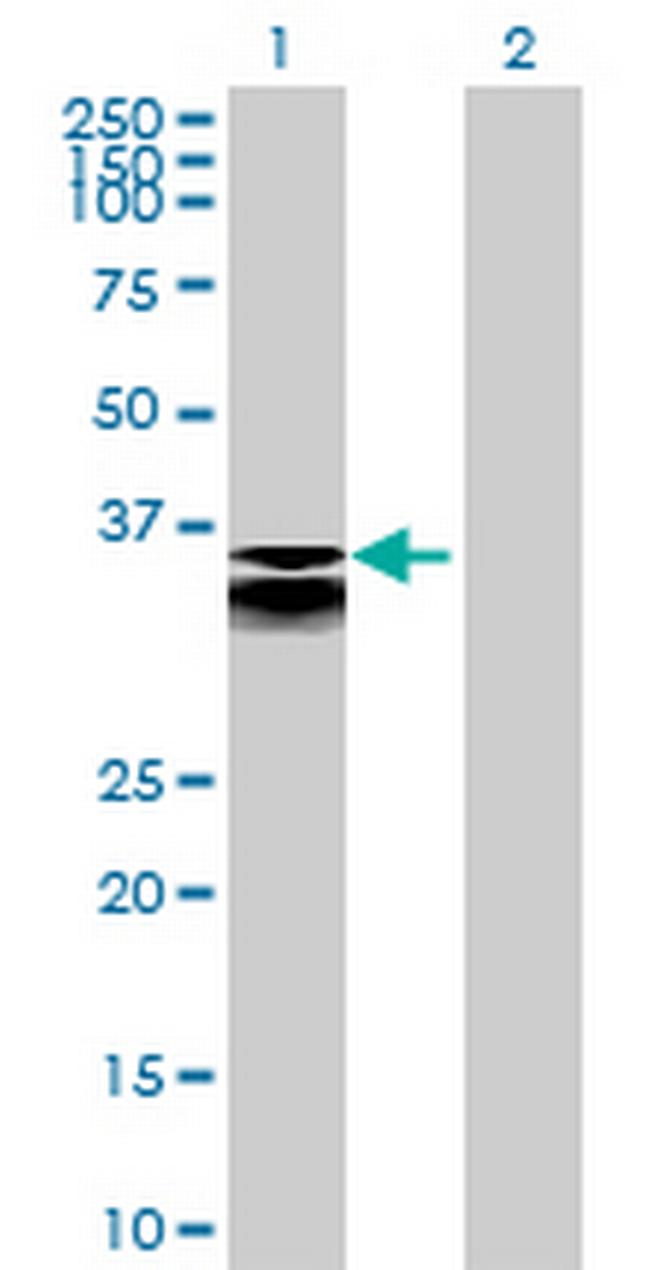
Please note: We are reviewing Western blot images included in the antibody testing data in our catalog, including those provided by third parties. Unless expressly labeled or annotated as “raw-unedited”, Western blot images included in the antibody testing data in our catalog may have been edited, optimized or otherwise adjusted for presentation.

产品信息
H00001515-B01P
产品规格
种属反应
Human
宿主/亚型
Mouse
/ IgG
分类
Polyclonal
类型
Antibody
抗原
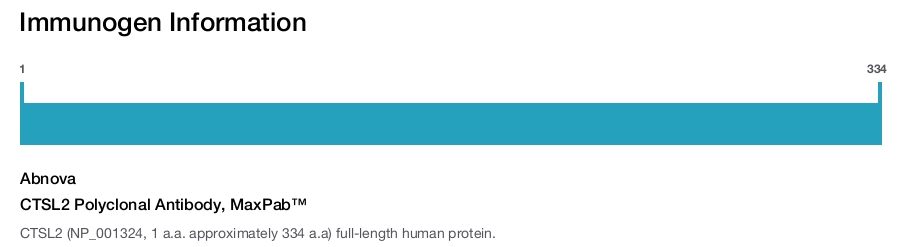
CTSL2 (NP_001324, 1 a.a. approximately 334 a.a) full-length human protein.
偶联物
Unconjugated
Unconjugated
Unconjugated
形式
Liquid
浓度
0.5-1 mg/mL
规格
50 µg
纯化类型
Protein A
保存液
PBS, pH 7.4
内含物
no preservative
保存条件
-20°C, Avoid Freeze/Thaw Cycles
运输条件
Ambient (domestic); Wet ice (international)
产品详细信息
Product may be used with Western Blot (Transfected lysate).
The Isotype of this product is composed of an IgG Mixture.
Immunogen sequence: MNLSLVLAAF CLGIASAVPK FDQNLDTKWY QWKATHRRLY GANEEGWRRA VWEKNMKMIE LHNGEYSQGK HGFTMAMNAF GDMTNEEFRQ MMGCFRNQKF RKGKVFREPL FLDLPKSVDW RKKGYVTPVK NQKQCGSCWA FSATGALEGQ MFRKTGKLVS LSEQNLVDCS RPQGNQGCNG GFMARAFQYV KENGGLDSEE SYPYVAVDEI CKYRPENSVA NDTGFTVVAP GKEKALMKAV ATVGPISVAM DAGHSSFQFY KSGIYFEPDC SSKNLDHGVL VVGYGFEGAN SNNSKYWLVK NSWGPEWGSN GYVKIAKDKN NHCGIATAAS YPNV
靶标信息
Cathepsin V (CTSU, CTSV, CATL2, cathepsin U, cathepsin L2) is a lysosomal cysteine proteinase that influences corneal physiology, and mediates degradation of invariant chain in human thymus. Cathepsin V is present in corneal epithelium, activated macrophages, and colorectal and breast carcinomas. A 1.8-kb mRNA to Cathepsin V is present in normal human thymus and testis. Cathepsin V is a member of the peptidase C1 family. Cysteine proteinases are synthesized as preproenzymes, which are processed to the corresponding proenzymes. The proenzymes are either targeted to the lysosome or continue along the cellular secretory route.
仅用于科研。不用于诊断过程。未经明确授权不得转售。
篇参考文献 (0)
您是否在文献中引用过该产品?请点击下方按钮邮件告知我们。
生物信息学
蛋白别名: cathepsin L2, preproprotein; cathepsin U; cysteine protease; PRO305; unnamed protein product; UNQ268
基因别名: CATL2; CTSL2; CTSU
UniProt ID: (Human) O60911
Entrez Gene ID: (Human) 1515
Disclaimer

Clicking the images or links will redirect you to a website hosted by BenchSci that provides third-party scientific content. Neither the content nor the BenchSci technology and processes for selection have been evaluated by us; we are providing them as-is and without warranty of any kind, including for use or application of the Thermo Fisher Scientific products presented.

