Search
Abnova
CTSW Monoclonal Antibody (4A8)
{{$productOrderCtrl.translations['antibody.pdp.commerceCard.promotion.promotions']}}
{{$productOrderCtrl.translations['antibody.pdp.commerceCard.promotion.promocode']}}: {{promo.promoCode}} {{promo.promoTitle}} {{promo.promoDescription}}. {{$productOrderCtrl.translations['antibody.pdp.commerceCard.promotion.learnmore']}}
{{$ctrl.translations['antibody.pdp.skuNotes.additionalInformation']}}:
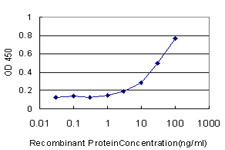
Please note: We are reviewing Western blot images included in the antibody testing data in our catalog, including those provided by third parties. Unless expressly labeled or annotated as “raw-unedited”, Western blot images included in the antibody testing data in our catalog may have been edited, optimized or otherwise adjusted for presentation.

产品信息
H00001521-M01
产品规格
种属反应
Human
宿主/亚型
Mouse
/ IgG2a, kappa
分类
Monoclonal
类型
Antibody
克隆号
4A8
抗原
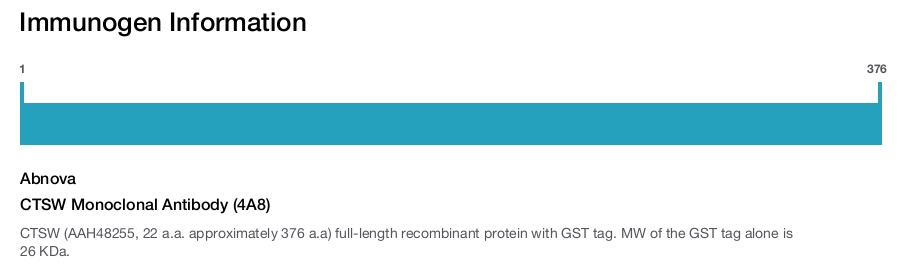
CTSW (AAH48255, 22 a.a. approximately 376 a.a) full-length recombinant protein with GST tag. MW of the GST tag alone is 26 KDa.
偶联物
Unconjugated
Unconjugated
Unconjugated
形式
Liquid
浓度
See Label
规格
100 µg
纯化类型
Affinity chromatography
保存液
PBS, pH 7.4
内含物
no preservative
保存条件
-20°C, Avoid Freeze/Thaw Cycles
运输条件
Ambient (domestic); Wet ice (international)
产品详细信息
Sequence of this protein is as follows: IRGPLRAQDL GPQPLELKEA FKLFQIQFNR SYLSPEEHAH RLDIFAHNLA QAQRLQEEDL GTAEFGVTPF SDLTEEEFGQ LYGYRRAAGG VPSMGREIRS EEPEESVPFS CDWRKVAGAI SPIKDQKNCN CCWAMAAAGN IETLWRISFW DFVDVSVQEL LDCGRCGDGC HGGFVWDAFI TVLNNSGLAS EKDYPFQGKV RAHRCHPKKY QKVAWIQDFI MLQNNEHRIA QYLATYGPIT VTINMKPLQL YRKGVIKATP TTCDPQLVDH SVLLVGFGSV KSEEGIWAET VSSQSQPQPP HPTPYWILKN SWGAQWGEKG YFRLHRGSNT CGITKFPLTA RVQKPDMKPR VSCPP
靶标信息
Cathepsin W (lymphopain) and cathepsin F comprise a novel subgroup of cathepsin proteases, and are phylogenetically distinct from other human cathepsins. The cathepsin W gene maps to chromosome 11q13.1 and contains ten exons with introns ranging from 81-119 bp. Cathepsin W protein is expressed specifically in CD8+ T lymphocytes. The expression of cathepsin W first occurs during the differentiation of thyrocytes to CD8+ T lymphocytes, just as the thymocytes cease expression of CD4+ receptors. In transfected Cos-7 and HeLa cells, cathepsin W localizes within the rough endoplasmic reticulum. Cathepsin W contains a unique 21 amino acid peptide insertion between the active site histidine and asparagine residues, in addition to a distictive 8-amino acid carboxy-terminal extension. An extended loop struc-ture in the second or beta-sheet domain and an additional disulfide bind are two of several signature features of cathepsin W. Other features of cathepsin W include an additional cysteine, an S2 pocket and an additional residue. Cathepsin W may exist as a dimer with each monomer forming a disulfide bond.
仅用于科研。不用于诊断过程。未经明确授权不得转售。
篇参考文献 (0)
您是否在文献中引用过该产品?请点击下方按钮邮件告知我们。
生物信息学
Disclaimer

Clicking the images or links will redirect you to a website hosted by BenchSci that provides third-party scientific content. Neither the content nor the BenchSci technology and processes for selection have been evaluated by us; we are providing them as-is and without warranty of any kind, including for use or application of the Thermo Fisher Scientific products presented.

