Search
Invitrogen
CUG-BP2 Polyclonal Antibody
{{$productOrderCtrl.translations['antibody.pdp.commerceCard.promotion.promotions']}}
{{$productOrderCtrl.translations['antibody.pdp.commerceCard.promotion.promocode']}}: {{promo.promoCode}} {{promo.promoTitle}} {{promo.promoDescription}}. {{$productOrderCtrl.translations['antibody.pdp.commerceCard.promotion.learnmore']}}
{{$ctrl.translations['antibody.pdp.skuNotes.additionalInformation']}}:
Please note: We are reviewing Western blot images included in the antibody testing data in our catalog, including those provided by third parties. Unless expressly labeled or annotated as “raw-unedited”, Western blot images included in the antibody testing data in our catalog may have been edited, optimized or otherwise adjusted for presentation.


产品信息
PA1-4130
产品规格
种属反应
Human,
Mouse
已发表种属
Human,
Mouse
宿主/亚型
Rabbit
/ IgG
分类
Polyclonal
类型
Antibody
抗原
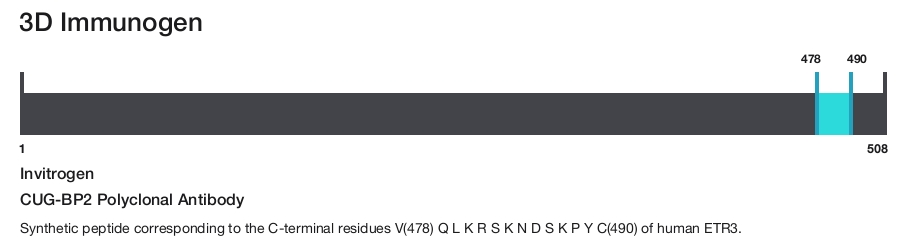
Synthetic peptide corresponding to the C-terminal residues V(478) Q L K R S K N D S K P Y C(490) of human ETR3.
偶联物
Unconjugated
Unconjugated
Unconjugated
形式
Liquid
浓度
1 mg/mL
规格
100 µg
纯化类型
Antigen affinity chromatography
保存液
PBS
内含物
0.02% sodium azide
保存条件
Maintain refrigerated at 2-8°C for up to 3 months. For long term storage store at -20°C
运输条件
Ambient (domestic); Wet ice (international)
RRID
产品详细信息
PA1-4130 detects ETR-3 in human and mouse samples.
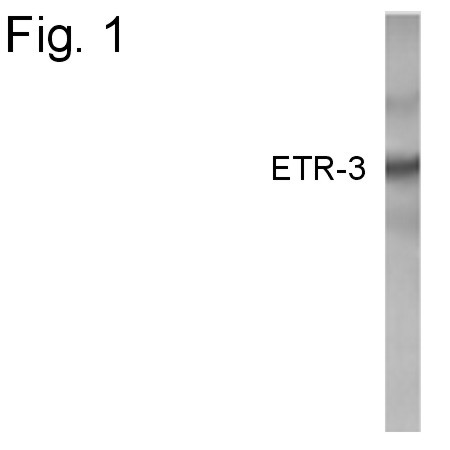
PA1-4130 has been successfully used in Western blot procedures. By Western blot this antibody detects a ~50 kDa protein representing ETR-3 in heart lysate.
The PA1-4130 immunogen is a synthetic peptide corresponding to the C-terminal residues V(478) Q L K R S K N D S K P Y C(490) of human ETR3 (a.a. 496-508 in mouse).
靶标信息
CUG-BP1 and CUG-BP2 are proteins that bind specifically to (CUG)8 oligonucleotides in vitro. While CUG-BP1 has the major binding activity in normal cells, nuclear CUG-BP2 binding activity increases in DM cells. Both CUG-BP1 and CUG-BP2 are isoforms of a novel heterogeneous nuclear ribonucleoprotein (hnRNP), hNab50. CUG-BP1, an RNA CUG triplet repeat binding protein, regulates splicing and translation of various RNAs. Expansion of RNA CUG repeats in the DMPK in DM is associated with alterations in binding activity of CUG-BP1 as well as alterations in the translation of the C/EBPb transcription factor. CUG-BP1 is an important regulator of initiation from different AUG codons of C/EBPb mRNA.
仅用于科研。不用于诊断过程。未经明确授权不得转售。
生物信息学
蛋白别名: bruno-like protein 3; CELF 2; CUG triplet repeat RNA-binding protein 2; CUG triplet repeat, RNA binding protein 2; CUG-BP- and ETR-3-like factor 2; ELAV-type RNA-binding protein 3; KDM2B/CELF2 fusion; mNapor; NAPOR-4; neur; neuroblastoma apoptosis-related RNA-binding protein; RNA-binding protein BRUNOL-3; RP23-124P7.1; unnamed protein product
基因别名: B230218O03; B230345P09Rik; BRUNOL3; CELF-2; CUG-BP2; CUGBP2; D230046B21Rik; DEE97; ETR-3; ETR3; mETR-3; NAPOR; Napor-2
UniProt ID: (Human) O95319, (Mouse) Q9Z0H4
Entrez Gene ID: (Human) 10659, (Mouse) 14007
Disclaimer

Clicking the images or links will redirect you to a website hosted by BenchSci that provides third-party scientific content. Neither the content nor the BenchSci technology and processes for selection have been evaluated by us; we are providing them as-is and without warranty of any kind, including for use or application of the Thermo Fisher Scientific products presented.

