Search
Invitrogen
CXCL12 Polyclonal Antibody
{{$productOrderCtrl.translations['antibody.pdp.commerceCard.promotion.promotions']}}
{{$productOrderCtrl.translations['antibody.pdp.commerceCard.promotion.promocode']}}: {{promo.promoCode}} {{promo.promoTitle}} {{promo.promoDescription}}. {{$productOrderCtrl.translations['antibody.pdp.commerceCard.promotion.learnmore']}}
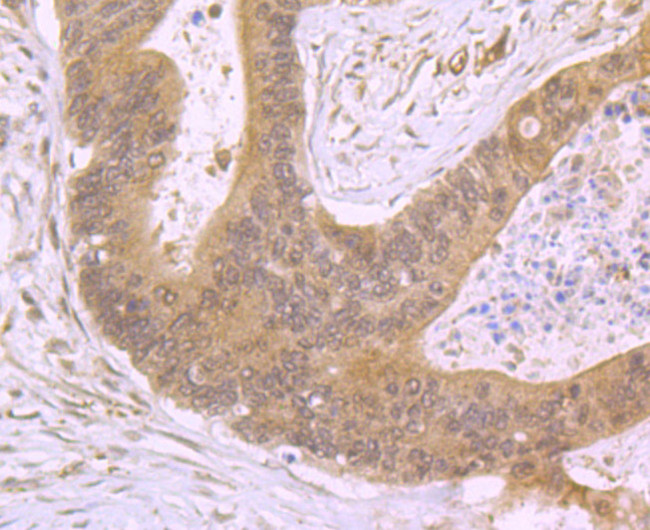
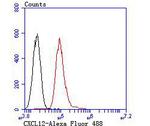
Please note: We are reviewing Western blot images included in the antibody testing data in our catalog, including those provided by third parties. Unless expressly labeled or annotated as “raw-unedited”, Western blot images included in the antibody testing data in our catalog may have been edited, optimized or otherwise adjusted for presentation.


产品信息
PA5-119655
产品规格
种属反应
Human
宿主/亚型
Rabbit
/ IgG
分类
Polyclonal
类型
Antibody
抗原
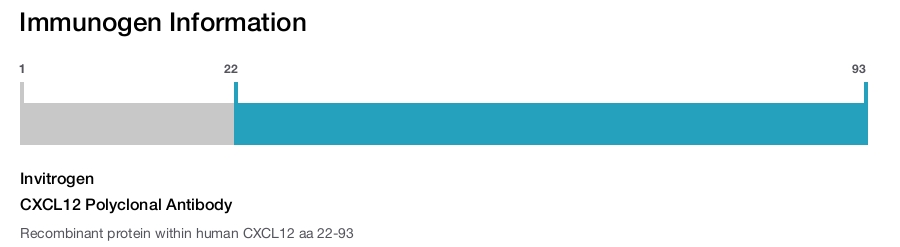
Recombinant protein within human CXCL12 aa 22-93.
偶联物
Unconjugated
Unconjugated
Unconjugated
形式
Liquid
浓度
1 mg/mL
规格
100 µg
纯化类型
Antigen affinity chromatography
保存液
PBS, pH 7.4, with 50% glycerol, 0.2% BSA
内含物
0.05% sodium azide
保存条件
Store at 4°C short term. For long term storage, store at -20°C, avoiding freeze/thaw cycles.
运输条件
Ambient (domestic); Wet ice (international)
RRID
产品详细信息
Positive Control: Hela, rat brain tissue, mouse small intestine tissue, HepG2.
Subcellular Location: Secreted.
靶标信息
CXCL12 is a stromal cell-derived alpha chemokine member of the intercrine family. This gene product and its receptor CXCR4 can activate lymphocytes and have been implicated in the metastasis of some cancers such as breast cancer. Mutations in this gene are associated with resistance to human immunodeficiency virus type 1 infections. Multiple transcript variants encoding different isoforms have been found for this gene.
仅用于科研。不用于诊断过程。未经明确授权不得转售。
篇参考文献 (0)
您是否在文献中引用过该产品?请点击下方按钮邮件告知我们。
生物信息学
蛋白别名: AI174028; C Cmotif chemokine; C X C motif chemokine; CC motif chemokine; CCmotif chemokine; chemokine; chemokine (C-X-C motif) ligand 12; CXC; CXC motif chemokine; CXCL; CXCL12; hIRH; hSDF-1; intercrine reduced in hepatomas; pre-B cell growth-stimulating factor; SDF-1 delta; chemokine (C-X-C motif) ligand 12 transcript variant 5; SDF-1 epsilon; chemokine (C-X-C motif) ligand 12 transcript variant 6; SDF-1 gamma; chemokine (C-X-C motif) ligand 12 transcript variant 4; SDF-1 theta; chemokine (C-X-C motif) ligand 12 transcript variant 7; SDF-1a; SDF-1b; SDF1a; stromal cell-derived factor-1 alpha; TLSF-a; TLSF-b; Tlsfa; Tlsfb; unnamed protein product
基因别名: IRH; PBSF; SCYB12; SDF1; TLSF; TPAR1
UniProt ID: (Human) P48061
Entrez Gene ID: (Human) 6387
response to hypoxia
neuron migration
positive regulation of endothelial cell proliferation
cellular calcium ion homeostasis
chemotaxis
defense response
immune response
cell adhesion
signal transduction
G-protein coupled receptor signaling pathway
axon guidance
blood circulation
regulation of actin polymerization or depolymerization
positive regulation of cell proliferation
adult locomotory behavior
response to mechanical stimulus
response to virus
T cell chemotaxis
telencephalon cell migration
positive regulation of cell migration
organ regeneration
killing of cells of other organism
positive regulation of dopamine secretion
integrin activation
chemokine (C-X-C motif) ligand 12 signaling pathway
CXCL12-activated CXCR4 signaling pathway
response to peptide hormone
positive regulation of neuron differentiation
positive regulation of cell adhesion
positive regulation of axon extension involved in axon guidance
positive regulation of chemotaxis
induction of positive chemotaxis
detection of temperature stimulus involved in sensory perception of pain
detection of mechanical stimulus involved in sensory perception of pain
regulation of calcium ion transport
cell chemotaxis
antimicrobial humoral immune response mediated by antimicrobial peptide
chemokine-mediated signaling pathway
positive regulation of monocyte chemotaxis
positive regulation of calcium ion import
negative regulation of intrinsic apoptotic signaling pathway in response to DNA damage
negative regulation of leukocyte tethering or rolling
positive regulation of vasculature development
response to ultrasound
cellular response to chemokine
positive regulation of T cell migration
negative regulation of dendritic cell apoptotic process
Disclaimer

Clicking the images or links will redirect you to a website hosted by BenchSci that provides third-party scientific content. Neither the content nor the BenchSci technology and processes for selection have been evaluated by us; we are providing them as-is and without warranty of any kind, including for use or application of the Thermo Fisher Scientific products presented.

