Search
Invitrogen
Cardiac Myosin Heavy Chain Monoclonal Antibody (3-48)
{{$productOrderCtrl.translations['antibody.pdp.commerceCard.promotion.promotions']}}
{{$productOrderCtrl.translations['antibody.pdp.commerceCard.promotion.promocode']}}: {{promo.promoCode}} {{promo.promoTitle}} {{promo.promoDescription}}. {{$productOrderCtrl.translations['antibody.pdp.commerceCard.promotion.learnmore']}}
{{$ctrl.translations['antibody.pdp.skuNotes.additionalInformation']}}:
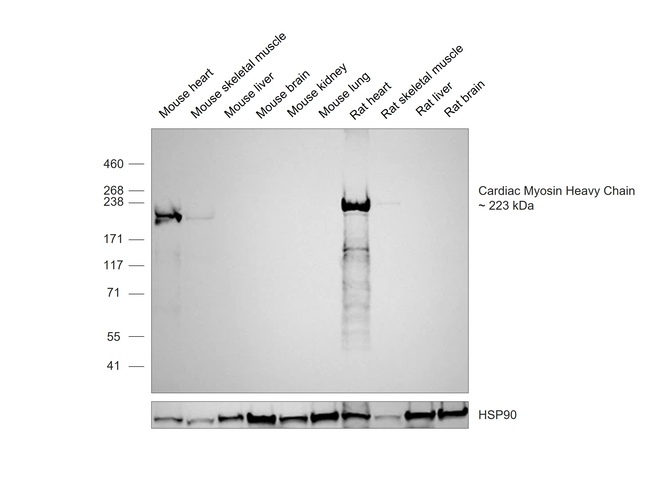
图: 1 / 3
Cardiac Myosin Heavy Chain Antibody (MA1-26180) in WB
Western blot was performed using Anti-Cardiac Myosin Heavy Chain Monoclonal Antibody (3-48) (Product # MA1-26180) and a ~ 223 kDa band corresponding to Cardiac Myosin Heavy Chain was observed in Mouse heart, Mouse skeletal muscle, Rat heart, Rat skeletal muscle and was not observed in Mouse liver, Mouse brain, Mouse kidney, Mouse lung, Rat liver and Rat brain. Tissue extracts (30 µg lysate) of Mouse Heart (... View More
Please note: We are reviewing Western blot images included in the antibody testing data in our catalog, including those provided by third parties. Unless expressly labeled or annotated as “raw-unedited”, Western blot images included in the antibody testing data in our catalog may have been edited, optimized or otherwise adjusted for presentation.


产品信息
MA1-26180
应用
建议稀释比
已发表文章
产品规格
种属反应
Bovine,
Human,
Mouse,
Rat
已发表种属
Human,
Mouse,
Pig,
Rat
宿主/亚型
Mouse
/ IgG1
分类
Monoclonal
类型
Antibody
克隆号
3-48
抗原
Human ventricular myosin.
偶联物
Unconjugated
Unconjugated
Unconjugated
形式
Liquid
浓度
1 mg/mL
规格
100 µg
纯化类型
Protein G
保存液
PBS, pH 7.4
内含物
no preservative
保存条件
Store at 4°C short term. For long term storage, store at -20°C, avoiding freeze/thaw cycles.
运输条件
Ambient (domestic); Wet ice (international)
RRID
产品详细信息
This antibody is myosin alpha and beta heavy chain specific. Affinity constants: Human ventricular myosin heavy chains - 3.33 x 10⁸M-1; Human atrial myosin heavy chains - 1.48 x 10⁸M-1; Human skeletal muscle myosin - 1.06 x 10⁸M-1; Canine cardiac myosin heavy chains - 2.06 x 10⁸M-1. This antibody cross-reacts with heavy chains of human myosin isolated from slow skeletal muscle, fast skeletal muscle, eye muscle, and streptococcal M5 peptide. It does not react with human platelets, smooth muscle myosin heavy chains, myosin light chains, myosin fragments circulating in blood of patients with myocardial infarction, nor does it react with any other human tissue antigens or blood cells.
Recommended positive control: Slow skeletal muscle, fast skeletal muscle, eye muscle.
靶标信息
Cardiac Myosin Heavy Chain (MHC) is a crucial component of the contractile machinery in heart muscle cells. It primarily forms part of the thick filament in sarcomeres, the fundamental units of muscle contraction. The cardiac myosin heavy chain comes in two isoforms, alpha-MHC and beta-MHC, which are encoded by the MYH6 and MYH7 genes, respectively. The alpha-MHC isoform is predominant in the atria and is characterized by faster ATPase activity and contraction speed, whereas the beta-MHC isoform is predominant in the ventricles and is associated with greater endurance. Each myosin molecule consists of two heavy chains, two essential light chains (ELC), and two regulatory light chains (RLC). The heavy chains have distinct functional regions: the globular head, which binds to actin and hydrolyzes ATP to produce force, and the helical tail, which organizes into the thick filament backbone. Mutations in cardiac MHC can lead to various cardiomyopathies, including hypertrophic cardiomyopathy (HCM) and dilated cardiomyopathy (DCM), both of which significantly affect the heart's functionality. These disorders underscore the importance of MHC in maintaining normal cardiac physiology and highlight its complex regulation and mechanotransduction capabilities.
仅用于科研。不用于诊断过程。未经明确授权不得转售。
生物信息学
蛋白别名: alpha cardiac MHC; alpha myosin; alpha-myosin heavy chain; antigen MLAA-21; beta myosin heavy chain; beta-myosin heavy chain; cardiac muscle myosin heavy chain 7 beta; cardiac myosin heavy chain 21/26; cardiac myosin heavy chain 5; cardiomyopathy, hypertrophic 1; muscle-type myosin II; myHC-alpha; myHC-beta; myHC-slow; myosin 7; myosin heavy chain; myosin heavy chain 6; Myosin heavy chain 7; myosin heavy chain beta-subunit; myosin heavy chain MYH7; muscle filament; myosin heavy chain polypeptide 6 cardiac muscle adult; myosin heavy chain polypeptide 7 cardiac muscle fetal; myosin heavy chain slow isoform; myosin heavy chain, cardiac muscle beta isoform; myosin heavy chain, cardiac muscle, adult; myosin heavy chain, cardiac muscle, fetal; myosin heavy chain, polypeptide 6, cardiac muscle, alpha; myosin heavy chain, polypeptide 7; myosin, heavy chain 6, cardiac muscle, alpha; myosin, heavy chain 7, cardiac muscle, beta; myosin, heavy chain 7B, cardiac muscle, beta; myosin, heavy polypeptide 6, cardiac muscle, alpha; myosin, heavy polypeptide 6, cardiac muscle, alpha (cardiomyopathy, hypertrophic 1); myosin, heavy polypeptide 7, cardiac muscle, beta; myosin, heavy polypeptide 7B, cardiac muscle, beta; rhabdomyosarcoma antigen MU-RMS-40.7A; sarcomeric protein; slow A MYH14; type slow/beta myosin heavy chain; U937-associated antigen; unnamed protein product
基因别名: A830009F23Rik; alpha-MHC; alphaMHC; ASD3; B-MHC; beta-MHC; betaMHC; Bmyo; CMD1EE; CMD1S; CMH1; CMH14; CMYO7A; CMYO7B; CMYP7A; CMYP7B; lncMYH7b; MHC14; MPD1; MYH-beta/slow; MYH14; Myh7; MYHC; Myhc-a; Myhc-b; MyHC-beta; MyHC-I; MyHC-slow; MYHCA; MYHCB; Myosin-7; SPMD; SPMM; SSS3
UniProt ID: (Human) P13533, (Human) P12883, (Bovine) Q9BE39, (Human) A7E2Y1, (Mouse) Q02566, (Rat) P02564, (Mouse) Q91Z83, (Mouse) A2AQP0
Entrez Gene ID: (Human) 4624, (Human) 4625, (Bovine) 282714, (Human) 57644, (Mouse) 17888, (Rat) 29556, (Rat) 29557, (Mouse) 140781, (Mouse) 668940, (Rat) 311570
regulation of the force of heart contraction
regulation of heart rate
skeletal muscle contraction
muscle contraction
striated muscle contraction
adult heart development
regulation of the force of skeletal muscle contraction
muscle filament sliding
regulation of slow-twitch skeletal muscle fiber contraction
ATP metabolic process
ventricular cardiac muscle tissue morphogenesis
cardiac muscle contraction
muscle system process
transition between fast and slow fiber
cardiac muscle hypertrophy in response to stress
cellular response to hydrogen peroxide
cellular response to angiotensin
cellular response to 3,3',5-triiodo-L-thyronine
in utero embryonic development
visceral muscle development
regulation of heart contraction
regulation of blood pressure
actin filament-based movement
myofibril assembly
regulation of ATPase activity
sarcomere organization
atrial cardiac muscle tissue morphogenesis
cardiac muscle cell development
regulation of heart growth
regulation of calcium-mediated signaling
regulation of cytosolic calcium ion concentration
regulation of cardiac muscle cell contraction
regulation of CAMKK-AMPK signaling cascade
Disclaimer

Clicking the images or links will redirect you to a website hosted by BenchSci that provides third-party scientific content. Neither the content nor the BenchSci technology and processes for selection have been evaluated by us; we are providing them as-is and without warranty of any kind, including for use or application of the Thermo Fisher Scientific products presented.

