Search
Antibodies Inc
Clcn4 Monoclonal Antibody (N222/6), FL594
{{$productOrderCtrl.translations['antibody.pdp.commerceCard.promotion.promotions']}}
{{$productOrderCtrl.translations['antibody.pdp.commerceCard.promotion.promocode']}}: {{promo.promoCode}} {{promo.promoTitle}} {{promo.promoDescription}}. {{$productOrderCtrl.translations['antibody.pdp.commerceCard.promotion.learnmore']}}
{{$ctrl.translations['antibody.pdp.skuNotes.additionalInformation']}}:
产品信息
75-260-FL594
应用
建议稀释比
已发表文章
产品规格
种属反应
Human,
Mouse,
Rat
宿主/亚型
Mouse
/ IgG1
分类
Monoclonal
类型
Antibody
克隆号
N222/6
抗原
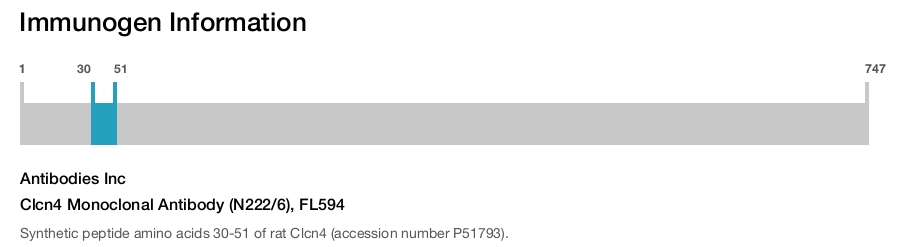
Synthetic peptide amino acids 30-51 of rat Clcn4 (accession number P51793).
偶联物
FL594
FL594
FL594
激发/发射光谱
594/615 nm
形式
Liquid
浓度
0.5 mg/mL
规格
100 µg
纯化类型
Protein A
保存液
PBS
内含物
0.09% sodium azide
保存条件
Store at 4°C short term. For long term storage, store at -20°C, avoiding freeze/thaw cycles.
运输条件
Ambient (domestic); Dry ice (international)
产品详细信息
For maximum recovery of product, centrifuge the vial prior to removing the cap.
Sequence of this protein is as follows: TDRHRKITSK SKESIWEFIK SL
靶标信息
The family of voltage-dependent chloride channels (CLCs) regulate cellular trafficking of chloride ions, a critical component of all living cells. CLCs regulate excitability in muscle and nerve cells, aid in organic solute transport and maintain cellular volume. The genes encoding human CLC-1 through CLC-7 map to chromosomes 7, 3q26, 4q32, Xp22, Xp11, 1p36 and 16p13, respectively. CLC-1 is highly expressed in skeletal muscle. Mutations in the gene encoding CLC-1 lead to myotonia, an inheritable disorder characterized by muscle stiffness and renal salt wasting. CLC-2 is highly expressed in the epithelia of several organs including lung, which suggests CLC-2 may be a possible therapeutic target for cystic fibrosis. CLC-3 expression is particularly abundant in neuronal tissue, while CLC-4 expression is evident in skeletal and cardiac muscle as well as brain.
仅用于科研。不用于诊断过程。未经明确授权不得转售。
篇参考文献 (0)
您是否在文献中引用过该产品?请点击下方按钮邮件告知我们。
生物信息学
蛋白别名: chloride channel 4; chloride channel 4-2; chloride channel protein 4; chloride channel, voltage-sensitive 4; chloride transporter ClC-4; chloride voltage-gated channel 4; CLC 4; clC-4; Clcn4; MGC163150; putative chloride channel (similar to Mm Clcn4-2); putative chloride channel 4-2; unnamed protein product; voltage-gated chloride channel ClC-4A
基因别名: ClC-4; ClC-4A; CLC4; Clc4-2; Clcn4-2; MRX15; MRX49; MRXSRC
UniProt ID: (Human) P51793, (Mouse) Q61418
Entrez Gene ID: (Human) 1183, (Rat) 60586, (Mouse) 12727
Disclaimer

Clicking the images or links will redirect you to a website hosted by BenchSci that provides third-party scientific content. Neither the content nor the BenchSci technology and processes for selection have been evaluated by us; we are providing them as-is and without warranty of any kind, including for use or application of the Thermo Fisher Scientific products presented.

