Search
Invitrogen
Cortactin Monoclonal Antibody (4C6)
{{$productOrderCtrl.translations['antibody.pdp.commerceCard.promotion.promotions']}}
{{$productOrderCtrl.translations['antibody.pdp.commerceCard.promotion.promocode']}}: {{promo.promoCode}} {{promo.promoTitle}} {{promo.promoDescription}}. {{$productOrderCtrl.translations['antibody.pdp.commerceCard.promotion.learnmore']}}
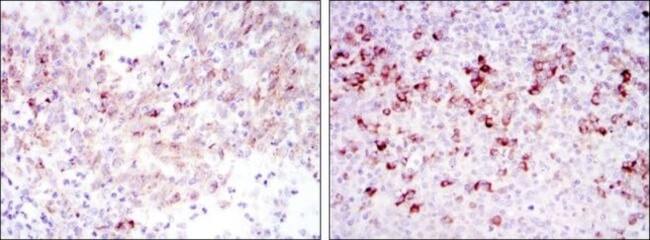

Please note: We are reviewing Western blot images included in the antibody testing data in our catalog, including those provided by third parties. Unless expressly labeled or annotated as “raw-unedited”, Western blot images included in the antibody testing data in our catalog may have been edited, optimized or otherwise adjusted for presentation.


产品信息
MA5-15831
应用
建议稀释比
已发表文章
产品规格
种属反应
Human,
Mouse
已发表种属
Human,
Mouse
宿主/亚型
Mouse
/ IgG1
分类
Monoclonal
类型
Antibody
克隆号
4C6
抗原
Purified recombinant fragment of human CTTN expressed in E. Coli.
偶联物
Unconjugated
Unconjugated
Unconjugated
形式
Liquid
浓度
Conc. Not Determined
保存液
ascites
内含物
0.03% sodium azide
保存条件
Store at 4°C short term. For long term storage, store at -20°C, avoiding freeze/thaw cycles.
运输条件
Ambient (domestic); Wet ice (international)
RRID
产品详细信息
MA5-15831 targets CTTN in indirect ELISA, IHC and WB applications and shows reactivity with Human and mouse samples.
The MA5-15831 immunogen is purified recombinant fragment of human CTTN expressed in E. Coli. .
MA5-15831 detects CTTN which has a predicted molecular weight of approximately 80kDa.
靶标信息
Cortactin (Cttn) is a ubiquitous actin-binding protein that was originally identified as a substrate for Src. It contributes to the organization of the actin cytoskeleton and cell shape. Cortactin also plays a role in the formation of lamellipodia and cell migration. It is accumulated in peripheral, actin-enriched structures of cells suggesting that cortactin facilitates actin network formation. Cortactin has four major domains of interest the N-terminal acidic (NTA) and tandem repeats domains and the C-terminal proline-rich and SH3 Domains. NTA associates with the Arp2/3 and WASP complex at F-actin branches. Cortactin is involved in promoting cell motility and invasion, including a critical role in invadopodia, actin rich-subcellular protrusions associated with degradation of the ECM by cancer cells. Cortactin is phosphorylated by src family kinases at Y421, Y466, and Y482 and S405 and S418 that are phosphorylated by Erk family kinases.
仅用于科研。不用于诊断过程。未经明确授权不得转售。
生物信息学
蛋白别名: amplaxin; ems1 sequence (mammary tumor and squamous cell carcinoma-associated (p80/85 src substrate); epididymis secretory sperm binding protein; FLJ34459; mammary tumor and squamous cell carcinoma associated (p80/85 src substrate); oncogene EMS1; Oncogene SRC8; src8; unnamed protein product
基因别名: 1110020L01Rik; EMS1
UniProt ID: (Human) Q14247, (Mouse) Q60598
Entrez Gene ID: (Human) 2017, (Mouse) 13043
intracellular protein transport
receptor-mediated endocytosis
substrate-dependent cell migration, cell extension
cell migration
actin cytoskeleton organization
regulation of axon extension
regulation of actin filament polymerization
positive regulation of actin filament polymerization
positive regulation of smooth muscle contraction
focal adhesion assembly
neuron projection morphogenesis
cell motility
positive regulation of chemotaxis
regulation of cell projection assembly
dendritic spine maintenance
lamellipodium organization
modification of postsynaptic actin cytoskeleton
modification of postsynaptic structure
regulation of mitophagy
negative regulation of extrinsic apoptotic signaling pathway
signal transduction
Disclaimer

Clicking the images or links will redirect you to a website hosted by BenchSci that provides third-party scientific content. Neither the content nor the BenchSci technology and processes for selection have been evaluated by us; we are providing them as-is and without warranty of any kind, including for use or application of the Thermo Fisher Scientific products presented.

