Search
Abnova
DGKE Monoclonal Antibody (7E1)
{{$productOrderCtrl.translations['antibody.pdp.commerceCard.promotion.promotions']}}
{{$productOrderCtrl.translations['antibody.pdp.commerceCard.promotion.promocode']}}: {{promo.promoCode}} {{promo.promoTitle}} {{promo.promoDescription}}. {{$productOrderCtrl.translations['antibody.pdp.commerceCard.promotion.learnmore']}}
{{$ctrl.translations['antibody.pdp.skuNotes.additionalInformation']}}:
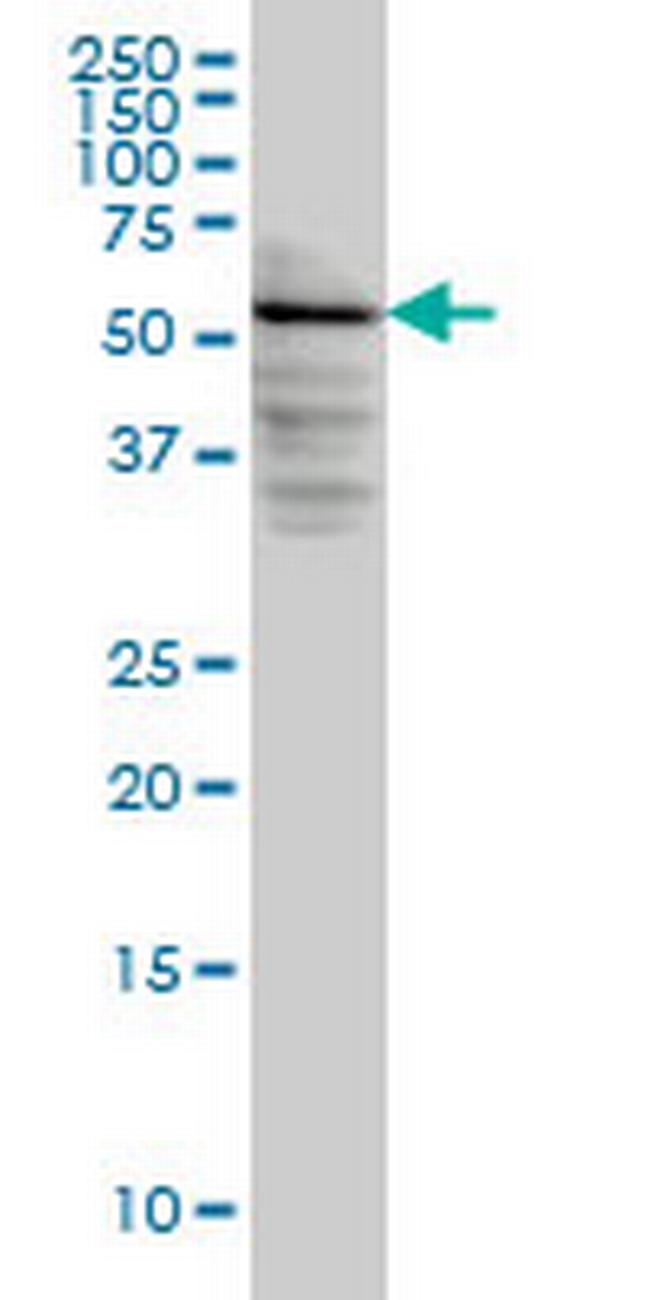
Please note: We are reviewing Western blot images included in the antibody testing data in our catalog, including those provided by third parties. Unless expressly labeled or annotated as “raw-unedited”, Western blot images included in the antibody testing data in our catalog may have been edited, optimized or otherwise adjusted for presentation.

产品信息
H00008526-M03
产品规格
种属反应
Human,
Mouse,
Rat
宿主/亚型
Mouse
/ IgG3, lambda
分类
Monoclonal
类型
Antibody
克隆号
7E1
抗原
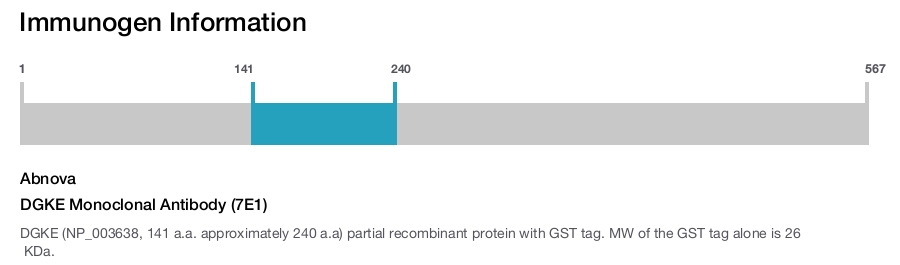
DGKE (NP_003638, 141 a.a. approximately 240 a.a) partial recombinant protein with GST tag. MW of the GST tag alone is 26 KDa.
偶联物
Unconjugated
Unconjugated
Unconjugated
形式
Liquid
浓度
0.5 mg/mL
规格
100 µg
纯化类型
Protein A
保存液
PBS, pH 7.4
内含物
no preservative
保存条件
-20°C, Avoid Freeze/Thaw Cycles
运输条件
Ambient (domestic); Wet ice (international)
产品详细信息
Product may be used with Western Blot (Cell lysate).
Immunogen sequence: CKQQCGCQPK LCDYRCIWCQ KTVHDECMKN SLKNEKCDFG EFKNLIIPPS YLTSINQMRK DKKTDYEVLA SKLGKQWTPL IILANSRSGT NMGEGLLGEF
靶标信息
Diacylglycerol (DAG) influences numerous cell signaling cascades by functioning as an intracellular, allosteric activator of protein kinase C (PKC), and as a potent activator of guanine nucleotide exchange factors. In order to maintain cellular homeostasis, intracellular DAG levels are tightly regulated by diacylglycerol kinases (DGKs, DAGKs), which phosphorylate DAG to phosphatidic acid, thus removing DAG. Human DGK-alpha (80 kDa), -beta (90 kDa), and - gamma (90 kDa) have calcium-binding EF-hand motifs at their N termini and are classified as type I DGKs. Human DGK- delta (130 kDa) and DGK-i (130 kDa) contain N-terminal pleckstrin homology (PH) domains and are classified as type II. Human DGK- epsilon (64 kDa) contains no identifiable regulatory domains and is classified as a type III DGK. Human DGK- zeta (104 kDa) and -iota (130 kDa) possess C-terminal ankyrin repeats and are classified as type IV DGKs. Human DGK-theta (110 kDa) contains 3 cysteine-rich domains and a PH domain and is classified as a type V DGK.
仅用于科研。不用于诊断过程。未经明确授权不得转售。
篇参考文献 (0)
您是否在文献中引用过该产品?请点击下方按钮邮件告知我们。
生物信息学
蛋白别名: DAG kinase epsilon; DGK-epsilon; diacylglycerol kinase, epsilon 64kDa; diglyceride kinase epsilon; EC 2.7.1.107; lipid kinase; unnamed protein product
基因别名: AHUS7; DAGK5; DAGK6; DGK; DGK-epsilon; NPHS7
UniProt ID: (Human) P52429, (Mouse) Q9R1C6
Entrez Gene ID: (Human) 8526, (Mouse) 56077, (Rat) 497978
phosphatidic acid biosynthetic process
phosphatidylinositol biosynthetic process
signal transduction
phospholipase C-activating G-protein coupled receptor signaling pathway
platelet activation
intracellular signal transduction
diacylglycerol metabolic process
glycerophospholipid biosynthetic process
glycerolipid metabolic process
lipid phosphorylation
modulation of synaptic transmission
Disclaimer

Clicking the images or links will redirect you to a website hosted by BenchSci that provides third-party scientific content. Neither the content nor the BenchSci technology and processes for selection have been evaluated by us; we are providing them as-is and without warranty of any kind, including for use or application of the Thermo Fisher Scientific products presented.

