Search
Invitrogen
DGKQ Monoclonal Antibody (652308)
{{$productOrderCtrl.translations['antibody.pdp.commerceCard.promotion.promotions']}}
{{$productOrderCtrl.translations['antibody.pdp.commerceCard.promotion.promocode']}}: {{promo.promoCode}} {{promo.promoTitle}} {{promo.promoDescription}}. {{$productOrderCtrl.translations['antibody.pdp.commerceCard.promotion.learnmore']}}
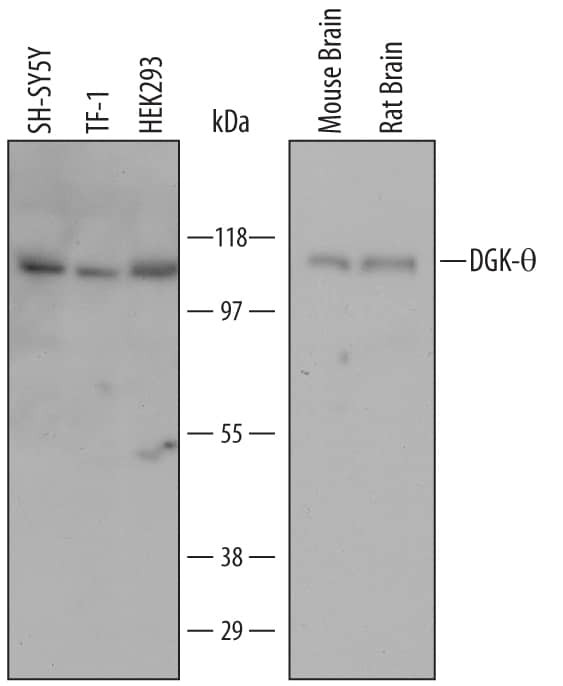
Please note: We are reviewing Western blot images included in the antibody testing data in our catalog, including those provided by third parties. Unless expressly labeled or annotated as “raw-unedited”, Western blot images included in the antibody testing data in our catalog may have been edited, optimized or otherwise adjusted for presentation.


产品信息
MA5-61692
产品规格
种属反应
Human,
Mouse,
Rat
宿主/亚型
Mouse
/ IgG1
分类
Monoclonal
类型
Antibody
克隆号
652308
抗原
E. coli-derived recombinant human DGK-theta , Asp696-Lys839
偶联物
Unconjugated
Unconjugated
Unconjugated
形式
Lyophilized
浓度
0.5 mg/mL
规格
100 µg
纯化类型
Protein A/G
保存液
PBS with 5% trehalose
内含物
no preservative
保存条件
Store at 4°C short term. For long term storage, store at -20°C, avoiding freeze/thaw cycles.
运输条件
Ambient (domestic); Wet ice (international)
RRID
产品详细信息
Reconstitute with sterile PBS to a final concentration of 0.5 mg/mL.
靶标信息
Diacylglycerol (DAG) is a fundamental lipid second messenger that is produced in the nucleus. The accumulation of DAG in the nucleus is important for the regulation of cell growth and differentiation. Diacylglycerol kinases (DGKs) convert DAG to phosphatidic acid, thereby terminating diacylglycerol signaling, which results in the reduction of protein kinase C activity and cell cycle progression of T lymphocytes. Diacylglycerol kinases are divided into five subtypes, Type I-Type V. DGK-theta is a Type V DGK, and localizes mainly to the nucleus of various cell lines, such as MDA-MB-453, MCF-7, PC12 and HeLa. Nuclear DGK-theta co-localizes with phosphatidylinositol 4, 5-bisphosphate (PIP(2)). DGK-theta is the isoform responsive to alpha-Thrombin stimulation.
仅用于科研。不用于诊断过程。未经明确授权不得转售。
篇参考文献 (0)
您是否在文献中引用过该产品?请点击下方按钮邮件告知我们。
生物信息学
蛋白别名: DAG kinase theta; Dgk theta; DGK-theta; DGKtheta; diacylglycerol kinase, delta (110 kDa); diacylglycerol kinase, theta 110kDa; diglyceride kinase theta; testis tissue sperm-binding protein Li 38a; unnamed protein product
基因别名: 110kDa; DAGK; DAGK4; DAGK7; Dgkd
UniProt ID: (Human) P52824, (Rat) D3ZEY4, (Mouse) Q6P5E8
Entrez Gene ID: (Human) 1609, (Rat) 100361138, (Mouse) 110524
regulation of gluconeogenesis
regulation of transcription from RNA polymerase II promoter
phosphatidic acid biosynthetic process
signal transduction
epidermal growth factor receptor signaling pathway
G-protein coupled receptor signaling pathway
adenylate cyclase-activating G-protein coupled receptor signaling pathway
phospholipase C-activating G-protein coupled receptor signaling pathway
positive regulation of gene expression
negative regulation of gene expression
intracellular signal transduction
diacylglycerol metabolic process
glycerolipid metabolic process
lipid phosphorylation
response to cAMP
thrombin receptor signaling pathway
positive regulation of protein kinase C signaling
regulation of cholesterol metabolic process
regulation of synaptic vesicle endocytosis
cellular response to bile acid
regulation of TORC1 signaling
regulation of cortisol biosynthetic process
regulation of progesterone biosynthetic process
platelet activation
Disclaimer

Clicking the images or links will redirect you to a website hosted by BenchSci that provides third-party scientific content. Neither the content nor the BenchSci technology and processes for selection have been evaluated by us; we are providing them as-is and without warranty of any kind, including for use or application of the Thermo Fisher Scientific products presented.

