Search
Invitrogen
DNAJB14 Polyclonal Antibody
{{$productOrderCtrl.translations['antibody.pdp.commerceCard.promotion.promotions']}}
{{$productOrderCtrl.translations['antibody.pdp.commerceCard.promotion.promocode']}}: {{promo.promoCode}} {{promo.promoTitle}} {{promo.promoDescription}}. {{$productOrderCtrl.translations['antibody.pdp.commerceCard.promotion.learnmore']}}
{{$ctrl.translations['antibody.pdp.skuNotes.additionalInformation']}}:
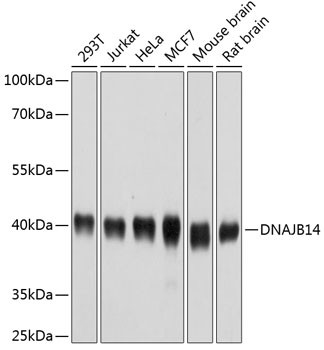
图: 1 / 1
DNAJB14 Antibody (PA5-117007) in WB
Western blot analysis of DNAJB14 in extracts of various cell lines. Samples were incubated with DNAJB14 Polyclonal antibody (Product # PA5-117007) using a dilution of 1:1,000, followed by HRP Goat Anti-Rabbit IgG (H+L) at a dilution of 1:10,000. Lysates/proteins: 25 µg per lane. Blocking buffer: 3% nonfat dry milk in TBST. Detection: ECL Basic Kit. Exposure time: 1s.
Please note: We are reviewing Western blot images included in the antibody testing data in our catalog, including those provided by third parties. Unless expressly labeled or annotated as “raw-unedited”, Western blot images included in the antibody testing data in our catalog may have been edited, optimized or otherwise adjusted for presentation.

产品信息
PA5-117007
产品规格
种属反应
Human,
Mouse,
Rat
宿主/亚型
Rabbit
/ IgG
分类
Polyclonal
类型
Antibody
抗原
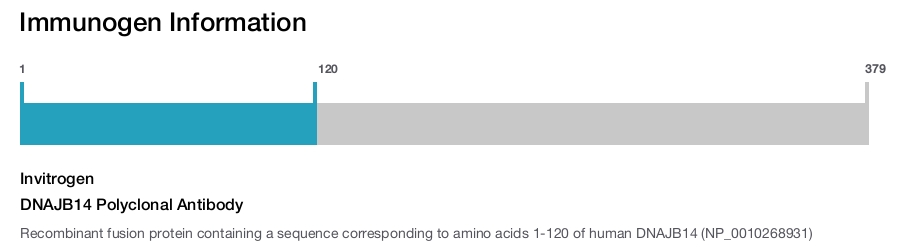
Recombinant fusion protein containing a sequence corresponding to amino acids 1-120 of human DNAJB14 (NP_0010268931)
偶联物
Unconjugated
Unconjugated
Unconjugated
形式
Liquid
浓度
2.22 mg/mL
规格
222 µg
纯化类型
Affinity chromatography
保存液
PBS, pH 7.3, with 50% glycerol
内含物
0.02% sodium azide
保存条件
-20°C, Avoid Freeze/Thaw Cycles
运输条件
Ambient (domestic); Wet ice (international)
RRID
产品详细信息
Positive Samples: 293T, Jurkat, HeLa, MCF7, Mouse brain, Rat brain
Immunogen sequence: MEGNRDEAEK CVEIAREALN AGNREKAQRF LQKAEKLYPL PSARALLEII MKNGSTAGNS PHCRKPSGSG DQSKPNCTKD STSGSGEGGK GYTKDQVDGV LSINKCKNYY EVLGVTKDAG
靶标信息
Acts as a co-chaperone with HSPA8/Hsc70; required to promote protein folding and trafficking, prevent aggregation of client proteins, and promote unfolded proteins to endoplasmic reticulum-associated degradation (ERAD) pathway (PubMed:24732912). Acts by determining HSPA8/Hsc70's ATPase and polypeptide-binding activities (PubMed:24732912). Can also act independently of HSPA8/Hsc70: together with DNAJB12, acts as a chaperone that promotes maturation of potassium channels KCND2 and KCNH2 by stabilizing nascent channel subunits and assembling them into tetramers (PubMed:27916661). While stabilization of nascent channel proteins is dependent on HSPA8/Hsc70, the process of oligomerization of channel subunits is independent of HSPA8/Hsc70 (PubMed:27916661). When overexpressed, forms membranous structures together with DNAJB12 and HSPA8/Hsc70 within the nucleus; the role of these structures, named DJANGOs, is still unclear (PubMed:24732912). [UniProt]
仅用于科研。不用于诊断过程。未经明确授权不得转售。
篇参考文献 (0)
您是否在文献中引用过该产品?请点击下方按钮邮件告知我们。
生物信息学
蛋白别名: DnaJ (Hsp40) homolog, subfamily B, member 14; unnamed protein product
基因别名: 5730496F10Rik; EGNR9427; PRO34683
UniProt ID: (Human) Q8TBM8, (Mouse) Q149L6
Entrez Gene ID: (Human) 79982, (Mouse) 70604, (Rat) 499716
Disclaimer

Clicking the images or links will redirect you to a website hosted by BenchSci that provides third-party scientific content. Neither the content nor the BenchSci technology and processes for selection have been evaluated by us; we are providing them as-is and without warranty of any kind, including for use or application of the Thermo Fisher Scientific products presented.

