Search
Invitrogen
DUSP12 Polyclonal Antibody
{{$productOrderCtrl.translations['antibody.pdp.commerceCard.promotion.promotions']}}
{{$productOrderCtrl.translations['antibody.pdp.commerceCard.promotion.promocode']}}: {{promo.promoCode}} {{promo.promoTitle}} {{promo.promoDescription}}. {{$productOrderCtrl.translations['antibody.pdp.commerceCard.promotion.learnmore']}}
{{$ctrl.translations['antibody.pdp.skuNotes.additionalInformation']}}:
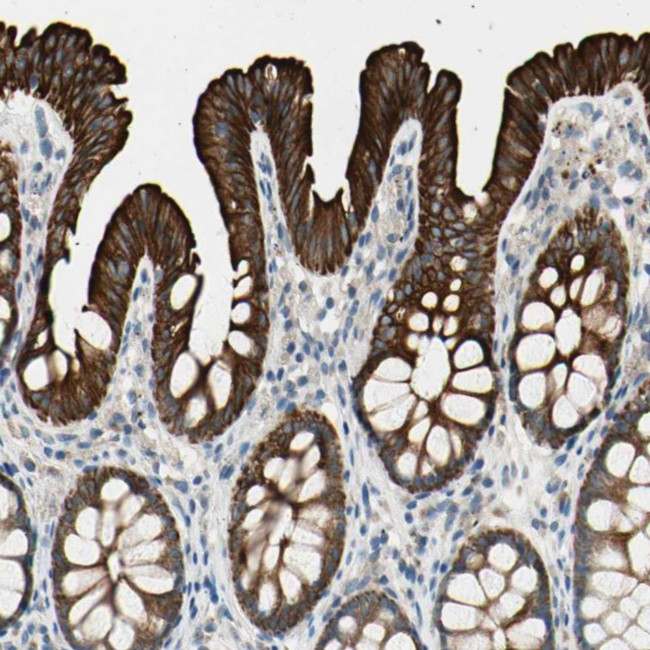
Please note: We are reviewing Western blot images included in the antibody testing data in our catalog, including those provided by third parties. Unless expressly labeled or annotated as “raw-unedited”, Western blot images included in the antibody testing data in our catalog may have been edited, optimized or otherwise adjusted for presentation.

产品信息
PA5-110753
产品规格
种属反应
Human
宿主/亚型
Rabbit
/ IgG
分类
Polyclonal
类型
Antibody
抗原
偶联物
Unconjugated
Unconjugated
Unconjugated
形式
Liquid
浓度
0.1 mg/mL
规格
10 µg
纯化类型
Antigen affinity chromatography
保存液
PBS, pH 7.2, with 40% glycerol
内含物
0.02% sodium azide
保存条件
Store at 4°C short term. For long term storage, store at -20°C, avoiding freeze/thaw cycles.
运输条件
Ambient (domestic); Wet ice (international)
RRID
产品详细信息
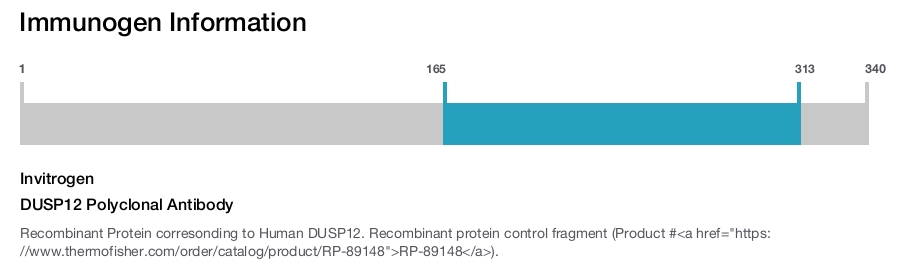
Immunogen sequence: YQAMGYEVDT SSAIYKQYRL QKVTEKYPEL QNLPQELFAV DPTTVSQGLK DEVLYKCRKC RRSLFRSSSI LDHREGSGPI AFAHKRMTPS SMLTTGRQAQ CTSYFIEPVQ WMESALLGVM DGQLLCPKCS AKLGSFNWYG EQCSCGRWI
Highest antigen sequence indentity to the following orthologs: Rat - 89%, Mouse - 89%.
靶标信息
Dual specificity phosphatase (DUSP) inactivate their target kinases by dephosphorylating both the phosphoserine/threonine and phosphotyrosine residues. DUSPs can be divided into six subgroups on the basis of sequence similarity (PRLs, Cdc14 phosphatases, PTENs, myotubularins, MKPs, atypical DUSPs). DUSP inhibitors might be used to manipulate MAPK and cellular responses in both positive and negative ways. The regulated expression and activity of DUSP family members in different cells and tissues controls MAPK intensity and duration to determine the type of physiological response. DUSP12 (YVH1, GKAP) contains the consensus DUSP catalytic domain as well as an extended C-terminal domain of unknown function, thought to be related to its potential role in glucokinase regulation. It is localized in the cytoplasm and nucleus.
仅用于科研。不用于诊断过程。未经明确授权不得转售。
篇参考文献 (0)
您是否在文献中引用过该产品?请点击下方按钮邮件告知我们。
生物信息学
蛋白别名: dual specificity tyrosine phosphatase YVH1; serine/threonine specific protein phosphatase; YVH1 protein-tyrosine phosphatase ortholog
基因别名: DUSP1; YVH1
UniProt ID: (Human) Q9UNI6
Entrez Gene ID: (Human) 11266
Disclaimer

Clicking the images or links will redirect you to a website hosted by BenchSci that provides third-party scientific content. Neither the content nor the BenchSci technology and processes for selection have been evaluated by us; we are providing them as-is and without warranty of any kind, including for use or application of the Thermo Fisher Scientific products presented.

