Search
Invitrogen
DUSP16 Polyclonal Antibody
{{$productOrderCtrl.translations['antibody.pdp.commerceCard.promotion.promotions']}}
{{$productOrderCtrl.translations['antibody.pdp.commerceCard.promotion.promocode']}}: {{promo.promoCode}} {{promo.promoTitle}} {{promo.promoDescription}}. {{$productOrderCtrl.translations['antibody.pdp.commerceCard.promotion.learnmore']}}
{{$ctrl.translations['antibody.pdp.skuNotes.additionalInformation']}}:
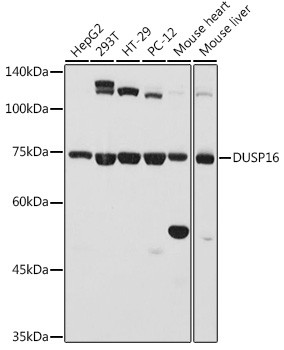
图: 1 / 1
DUSP16 Antibody (PA5-87683) in WB
Western blot analysis of DUSP16 in extracts of various cell lines. Samples were incubated with DUSP16 Polyclonal antibody (Product # PA5-87683) using a dilution of 1:1,000, followed by HRP Goat Anti-Rabbit IgG (H+L) at a dilution of 1:10,000. Lysates/proteins: 25 µg per lane. Blocking buffer: 3% nonfat dry milk in TBST. Detection: ECL Basic Kit. Exposure time: 10s.
Please note: We are reviewing Western blot images included in the antibody testing data in our catalog, including those provided by third parties. Unless expressly labeled or annotated as “raw-unedited”, Western blot images included in the antibody testing data in our catalog may have been edited, optimized or otherwise adjusted for presentation.

产品信息
PA5-87683
产品规格
种属反应
Human,
Mouse,
Rat
宿主/亚型
Rabbit
/ IgG
分类
Polyclonal
类型
Antibody
抗原
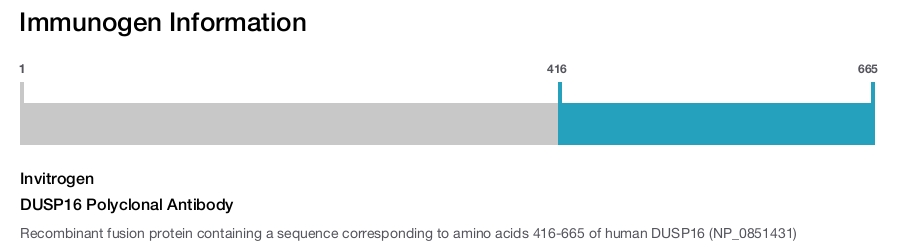
Recombinant fusion protein containing a sequence corresponding to amino acids 416-665 of human DUSP16 (NP_0851431)
偶联物
Unconjugated
Unconjugated
Unconjugated
形式
Liquid
浓度
0.33 mg/mL
规格
33 µg
纯化类型
Affinity Chromatography
保存液
PBS, pH 7.3, with 50% glycerol
内含物
0.02% sodium azide
保存条件
-20°C, Avoid Freeze/Thaw Cycles
运输条件
Ambient (domestic); Wet ice (international)
RRID
产品详细信息
Immunogen sequence: SLHGFSSSED ALEYYKPSTT LDGTNKLCQF SPVQELSEQT PETSPDKEEA SIPKKLQTAR PSDSQSKRLH SVRTSSSGTA QRSLLSPLHR SGSVEDNYHT SFLFGLSTSQ QHLTKSAGLG LKGWHSDILA PQTSTPSLTS SWYFATESSH FYSASAIYGG SASYSAYSCS QLPTCGDQVY SVRRRQKPSD RADSRRSWHE ESPFEKQFKR RSCQMEFGES IMSENRSREE LGKVGSQSSF SGSMEIIEVS; Positive Samples: HeLa, A-549, K-562, HepG2, Mouse liver; Cellular Location: Cytoplasm, Cytoplasmic vesicle, Nucleus
靶标信息
Dual-specificity phosphatases constitute a large heterogeneous subgroup of the type I cysteine-based protein-tyrosine phosphatase superfamily. DUSPs are characterized by their ability to dephosphorylate both tyrosine and serine/threonine residues. DUSP16 belongs to a class of DUSPs, designated MKPs, that dephosphorylate MAPK proteins ERK, JNK, and p38 with specificity distinct from that of individual MKP proteins. MKPs contain a highly conserved C-terminal catalytic domain and an N-terminal Cdc25-like domain. MAPK activation cascades mediate various physiologic processes, including cellular proliferation, apoptosis, differentiation, and stress responses.
仅用于科研。不用于诊断过程。未经明确授权不得转售。
篇参考文献 (0)
您是否在文献中引用过该产品?请点击下方按钮邮件告知我们。
生物信息学
蛋白别名: MAP kinase phosphatase 7; MAP kinase phosphatase-7; map kinase phosphatase-M; MAPK phosphatase-7; MGC129701; MGC129702; mitogen-activated protein kinase phosphatase 7; MKP-M A1 isoform; protein phosphatase; MKP-M A2 isoform; protein phosphatase; MKP-M B1 isoform; protein phosphatase; MKP-M B2 isoform; protein phosphatase; unnamed protein product
基因别名: 3830417M17Rik; D6Ertd213e; MKP-7; MKP7; Mkpm
UniProt ID: (Human) Q9BY84
Entrez Gene ID: (Human) 80824, (Mouse) 70686, (Rat) 297682
phosphoprotein phosphatase activity
protein serine/threonine phosphatase activity
protein tyrosine phosphatase activity
protein binding
protein tyrosine/threonine phosphatase activity
JUN kinase binding
phosphatase activity
MAP kinase tyrosine/serine/threonine phosphatase activity
MAP kinase tyrosine phosphatase activity
mitogen-activated protein kinase p38 binding
mitogen-activated protein kinase binding
protein carrier chaperone
Disclaimer

Clicking the images or links will redirect you to a website hosted by BenchSci that provides third-party scientific content. Neither the content nor the BenchSci technology and processes for selection have been evaluated by us; we are providing them as-is and without warranty of any kind, including for use or application of the Thermo Fisher Scientific products presented.

