Search
Invitrogen
Desmosome/Hemidesmosome Chimeric Recombinant Rabbit Monoclonal Antibody (F12)
{{$productOrderCtrl.translations['antibody.pdp.commerceCard.promotion.promotions']}}
{{$productOrderCtrl.translations['antibody.pdp.commerceCard.promotion.viewpromo']}}
{{$productOrderCtrl.translations['antibody.pdp.commerceCard.promotion.promocode']}}: {{promo.promoCode}} {{promo.promoTitle}} {{promo.promoDescription}}. {{$productOrderCtrl.translations['antibody.pdp.commerceCard.promotion.learnmore']}}
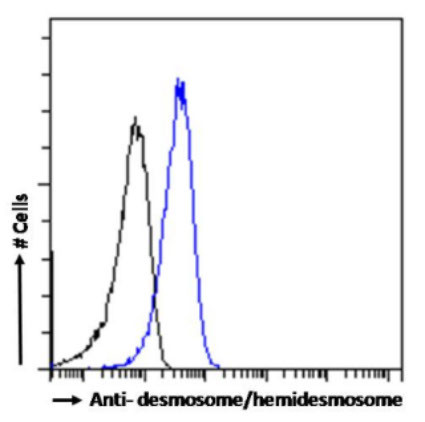
图: 1 / 1
Desmosome/Hemidesmosome Chimeric Antibody (MA5-48076) in Flow
Flow Cytometry analysis of Desmosome/Hemidesmosome in A431 cells using Desmosome/Hemidesmosome Chimeric Monoclonal Antibody (Product # MA5-48076). Cells were fixed using 2% PFA, permeabilized using 0.5% Triton and stained with an isotype control (black line), or Desmosome/Hemidesmosome Chimeric Monoclonal Antibody (blue line) at a dilution of 1:100 for 1h at RT. After washing, the bound antibody was detecte... View More
Please note: We are reviewing Western blot images included in the antibody testing data in our catalog, including those provided by third parties. Unless expressly labeled or annotated as “raw-unedited”, Western blot images included in the antibody testing data in our catalog may have been edited, optimized or otherwise adjusted for presentation.

产品信息
MA5-48076
产品规格
种属反应
Human
宿主/亚型
Rabbit
/ IgG, kappa
Expression System
HEK293 cells
分类
Recombinant Monoclonal
类型
Antibody
克隆号
F12
抗原
F12 was established by fusing peripheral blood lymphocytes derived from a human vulgaris patient with a hetermyeloma cell line.
偶联物
Unconjugated
Unconjugated
Unconjugated
形式
Liquid
浓度
1 mg/mL
规格
200 µg
纯化类型
Protein A
保存液
PBS
内含物
0.02% ProClin 300
保存条件
Store at 4°C short term. For long term storage, store at -20°C, avoiding freeze/thaw cycles.
运输条件
Ambient (domestic); Wet ice (international)
RRID
产品详细信息
Specificity: F12 recognizes an unknown polypeptide of desmosomal and hemidesmosomal plaques with a MW of 185 kDa (determined from immunoblotting using bovine tongue epithelium extract as the substrate), and by IEM (immunoelectron microscopy) it was determined that it is the intracellular part of the desmosome that is bound. F12 shares some immunochemical properties with autoantibodies present in paraneoplastic pemphigus sera. Pemphigus diseases are those resulting in blistering of the skin due to the production of autoantibodies against keratinocyte surface proteins-autoantibodies of patients with pemphius vulgaris recognize desmoglein 1 (Dsg1), a major glycoprotein of the desmosome complex.
靶标信息
Desmosomes and Hemidesmosomes are two types of intercellular junctions that play important roles in maintaining the structural integrity of tissues subjected to mechanical stress or shear forces. Desmosomes connect neighboring cells using cadherins and intermediate filaments, while Hemidesmosomes anchor epithelial cells to the underlying extracellular matrix using integrins. Both junctions are found in tissues like skin, heart, and muscle.
仅用于科研。不用于诊断过程。未经明确授权不得转售。
篇参考文献 (0)
您是否在文献中引用过该产品?请点击下方按钮邮件告知我们。
Disclaimer

Clicking the images or links will redirect you to a website hosted by BenchSci that provides third-party scientific content. Neither the content nor the BenchSci technology and processes for selection have been evaluated by us; we are providing them as-is and without warranty of any kind, including for use or application of the Thermo Fisher Scientific products presented.

