Search
Invitrogen
E-Cadherin Monoclonal Antibody (4A2C7)
{{$productOrderCtrl.translations['antibody.pdp.commerceCard.promotion.promotions']}}
{{$productOrderCtrl.translations['antibody.pdp.commerceCard.promotion.promocode']}}: {{promo.promoCode}} {{promo.promoTitle}} {{promo.promoDescription}}. {{$productOrderCtrl.translations['antibody.pdp.commerceCard.promotion.learnmore']}}
{{$ctrl.translations['antibody.pdp.skuNotes.additionalInformation']}}:
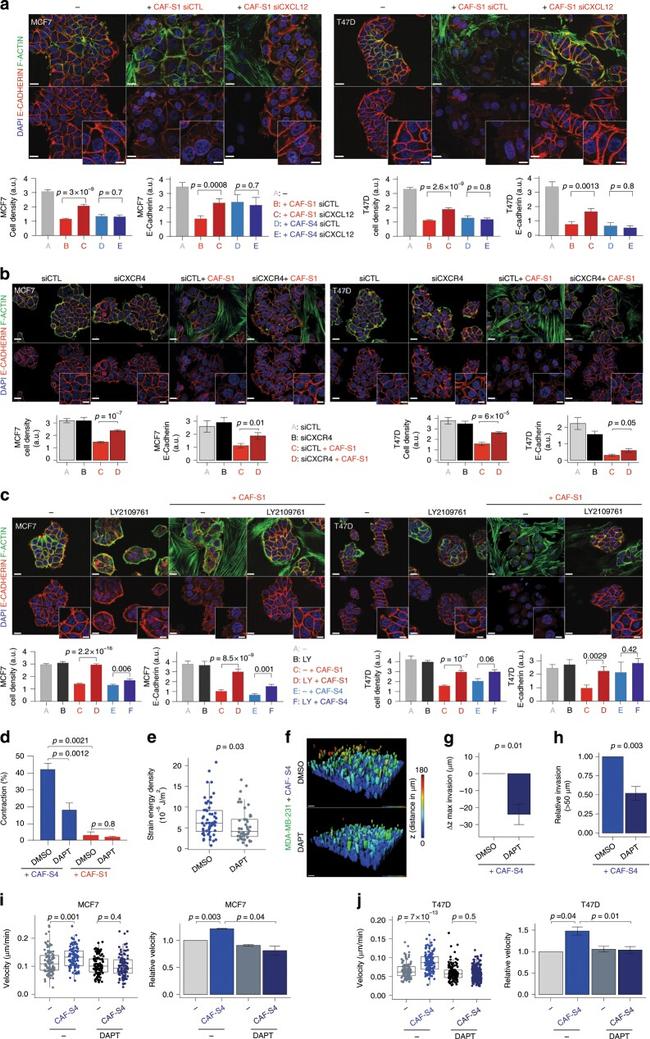
图: 1 / 21
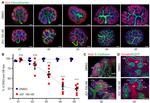
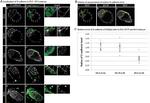
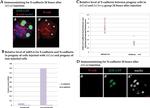
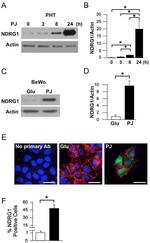
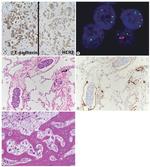
E-Cadherin Antibody (18-0223) in ICC/IF
Nature communications 2020 -
Fig. 7 CAF-S1 and CAF-S4 promote cancer cell invasion by TGFbeta, CXCL12 and NOTCH. a Up, Representative images of E-cadherin (red), F-actin (green) and DAPI (blue) in BC cells alone (-) or with CAF-S1 transfected with non-targeting (siCTL) or CXCL12-targeting (siCXCL12) siRNA. CAF-S4 images in Supplementary Fig. 5c . Scale bars, 20 mum; inset 10 mum. Down, BC cell density and E-cadherin staining alone (gra... View More

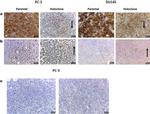
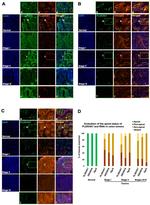
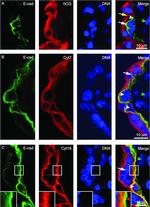
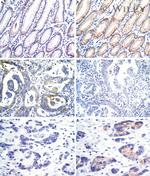
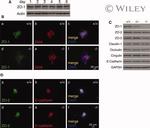
Please note: We are reviewing Western blot images included in the antibody testing data in our catalog, including those provided by third parties. Unless expressly labeled or annotated as “raw-unedited”, Western blot images included in the antibody testing data in our catalog may have been edited, optimized or otherwise adjusted for presentation.


产品信息
18-0223
应用
建议稀释比
已发表文章
产品规格
种属反应
Human
已发表种属
Human,
Rat
宿主/亚型
Mouse
分类
Monoclonal
类型
Antibody
克隆号
4A2C7
抗原
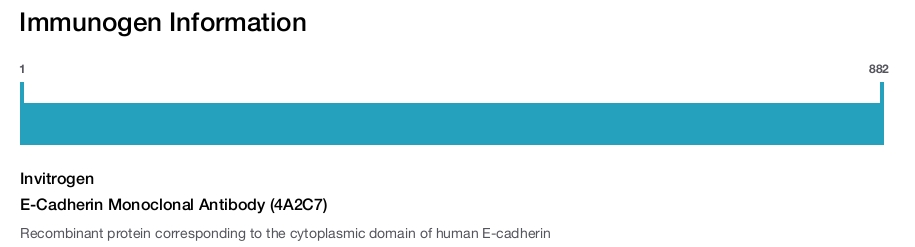
Recombinant protein corresponding to the cytoplasmic domain of human E-cadherin
偶联物
Unconjugated
Unconjugated
Unconjugated
形式
Liquid
纯化类型
purified
保存液
PBS with 1% BSA
内含物
0.1% sodium azide
保存条件
2-8°C
运输条件
Ambient (domestic); Wet ice (international)
RRID
产品详细信息
This monoclonal antibody reacts with human epithelial cadherin (E-cadherin, uvomorulin, Cell-CAM 120/80), a 120 kDa transmembrane glycoprotein. Reduction and/or loss of E-cadherin expression in carcinomas correlates positively with tumor cell invasion and metastasis. Altered expression of E-cadherin is common in the progression of cancers including breast carcinoma, lung carcinoma, gastric tumors, hepatocellular carcinoma, and prostatic tumors. It has recently been reported that E-cadherin is a useful marker for differentiating lobular lesions (negative) from ductal invasive lesions (positive) in breast cancer. Positive tissue: Non-neural epithelia. Reacts strongly with human E-cadherin and weakly with human P-cadherin.
Expected Staining Pattern: Mainly cellular membrane, some cytoplasmic
靶标信息
E-Cadherin (epithelial cadherin) is a classical cadherin from the cadherin (alcium dependent adhesion protein) superfamily. The encoded protein is a calcium dependent cell-cell adhesion glycoprotein comprised of five extracellular cadherin repeats, a transmembrane region and a highly conserved cytoplasmic tail. Mutations in this gene are correlated with gastric, breast, colorectal, thyroid and ovarian cancer. Loss of function is thought to contribute to progression in cancer by increasing proliferation, invasion, and/or metastasis. The ectodomain of this protein mediates bacterial adhesion to mammalian cells and the cytoplasmic domain is required for internalization. Identified transcript variants arise from mutation at consensus splice sites. E-cadherin plays a central role in the growth and development of cells by controlling tissue architecture, and maintenance of tissue integrity. In humans, E-cadherin is encoded by the CDH1 gene present on chromosome 16. Studies have demonstrated that reduction and/or loss of E-cadherin expression in carcinomas correlates positively with the potential of these tumors for invasion and metastasis.
仅用于科研。不用于诊断过程。未经明确授权不得转售。
生物信息学
蛋白别名: cadherin 1, E-cadherin (epithelial); cadherin 1, type 1, E-cadherin (epithelial); cadherin e; cadherin-E; calcium-dependent adhesion protein, epithelial; CAM 120/80; cell-CAM 120/80; E-cadherin 1; Ecadherin; epididymis secretory sperm binding protein; epithelial cadherin; unnamed protein product; uvomorulin
基因别名: Arc-1; BCDS1; CD324; CDHE; ECAD; LCAM; UVO
UniProt ID: (Human) P12830
Entrez Gene ID: (Human) 999
cell morphogenesis
desmosome assembly
cell-cell junction assembly
cell adhesion
homophilic cell adhesion via plasma membrane adhesion molecules
synapse assembly
response to xenobiotic stimulus
response to toxic substance
regulation of gene expression
calcium-dependent cell-cell adhesion via plasma membrane cell adhesion molecules
cell migration
pituitary gland development
negative regulation of cell-cell adhesion
negative regulation of cell migration
negative regulation of axon extension
neuron projection development
cell junction assembly
adherens junction organization
positive regulation of protein import into nucleus
cell-cell adhesion mediated by cadherin
positive regulation of transcription, DNA-templated
cellular response to lithium ion
response to heparin
cellular response to indole-3-methanol
protein localization to plasma membrane
cell-cell adhesion
regulation of protein catabolic process at postsynapse, modulating synaptic transmission
response to Gram-positive bacterium
positive regulation of cellular protein localization
Disclaimer

Clicking the images or links will redirect you to a website hosted by BenchSci that provides third-party scientific content. Neither the content nor the BenchSci technology and processes for selection have been evaluated by us; we are providing them as-is and without warranty of any kind, including for use or application of the Thermo Fisher Scientific products presented.

